 In the book of Hebrews, the author delivers a sobering rebuke to his audience:
For though by this time you ought to be teachers, you need someone to teach you again the basic principles of the oracles of God. You need milk, not solid food, for everyone who lives on milk is unskilled in the word of righteousness, since he is a child. (Heb 5:12–13 ESV)
These words were not addressed to new believers but to Christians who had walked with Christ long enough that they should have been capable of instructing others. Instead, they had become spiritually stagnant and were in spiritual danger. They had ceased growing in their understanding of God’s Word and were no longer equipped to discern truth from error. Their problem was not a lack of intelligence or opportunity. It was a failure to mature through continual interaction with the Scriptures. They failed to see the principle the author presents: Spiritual maturity comes from actively engaging the Scriptures.1
The church today faces a similar challenge. We live in an age of unprecedented access to biblical resources. We have countless translations, study Bibles, audio Bibles, podcasts, commentaries, and videos. But access has not translated into engagement. Many Christians know isolated Bible stories but struggle to explain the overarching storyline of Scripture, the gospel’s connection to the Old Testament, or the meaning of passages within their context. As a result, believers often depend upon others to tell them what the Bible means rather than developing the ability to study it for themselves. They feel ill-equipped to share their faith for fear of not knowing enough Scripture. They struggle with dealing rightly with sin.
The solution is not merely more information. It is a return to the pattern God established for His people long before the New Testament church existed. Moses gives Israel a blueprint for lifelong spiritual formation:
Therefore you shall lay up these words of mine in your heart and in your soul, and bind them as a sign on your hand, and they shall be as frontlets between your eyes. You shall teach them to your children, speaking of them when you sit in your house, when you walk by the way, when you lie down, and when you rise up. And you shall write them on the doorposts of your house and on your gates.… (Deut 11:18–20 NKJV)
In this passage, God is addressing the generation of Israel that will actually enter the land. Remember, their parents refused to obey God in Numbers 14 and wandered in the wilderness for forty years until they all perished. In these verses, God is giving them three principles to follow to be prosperous in the land. All three principles focus on His word.
We can identify principles in the passage as follows. God says:
- My word shall shape your heart (Deut 11:18).
- My word shall shape your home (Deut 11:19).
- My word shall shape your community (Deut 11:20).
My Word Shall Shape Your Heart
God’s Word must be treasured internally. Moses begins with the heart. Scripture is not intended merely to occupy our minds but to shape our desires, convictions, and affections. Biblical knowledge that never reaches the heart produces pride rather than maturity. The Scriptures should be our place of contemplation.
So, we are to store up God’s word in our hearts and in our souls. What does this mean? It means God’s word is to form the foundation for how we think. How does this happen? We read it. Deeply and often.
A “Read the Bible in a Year” plan is commendable, but to properly engage with this first principle requires more. I recommend a daily reading plan that uses the ancient Jewish order of the Old Testament called the Tanak,2 combined with readings from the gospels and then the rest of the New Testament. The Tanak is made up of three sections: the Torah, the Prophets, and the Writings. Read one chapter from each section every day. Combine this with reading a chapter from the gospels, starting in Matthew, and then a chapter from the rest of the New Testament, starting in Acts. This is just five chapters a day—three from the Tanak and two from the New Testament. You may even break it up, so you do your Old Testament reading in the morning and your New Testament reading in the evening. When you finish reading through a section, start over and read it again. Make this practice a habit, and you will be amazed at how the Lord will use His word in your heart.
Next, I encourage you to start memorizing Scripture. Not just individual verses but entire books like, say, Philippians! But first, I would start with a Psalm. I suggest Psalm 32. The simplest way is to read a verse several times out loud. Close your eyes and say it again. Check yourself and correct as needed. Once you can recite the verse correctly, move on to the next one and repeat the process. Learning and reviewing Scripture this way is part of Biblical meditation. You will find that having Scripture memorized gives your mind a place to go when unwanted thoughts intrude. You will find it a safe haven and a blessing.
Once you begin practicing this first principle, you will be surprised how naturally the second principle will occur.
My Word Shall Shape Your Home
God’s Word must become the subject of continual conversation. Moses describes ordinary moments of life—sitting, walking, lying down, and rising up. Scripture was never meant to be confined to one hour on Sunday. It is to become the lens through which families interpret life, make decisions, and understand God. His word should form the core of our conversation. This doesn’t mean talking in Bible verses all the time. It means Scripture shapes the tenor and substance of our conversations. It does involve discussing vexing passages or sharing some insight the Lord gave you in a reading. The things you learn in your private contemplation are to inform your family conversations. This is how we edify one another.
My Word Shall Shape Your Community
If God’s word shapes our heart and home, the natural effect is that it will shape our community. God tells His people to write His word on their doorposts and their gates. The doorpost is part of their home. The gates could be the gate to the city, the temple, or some other public area. The point is that God’s word is to govern public life. Every believer is both a student and, eventually, a teacher. Spiritual maturity is measured not simply by how much we know but by our ability to faithfully help others know and obey God’s Word.
The church does not primarily need new programs to solve biblical illiteracy. It needs Christians who daily immerse themselves in God’s Word, meditate upon it, discuss it in their homes, teach it to others, and allow it to shape every area of life. The pattern of Deuteronomy 11 has never become obsolete, and it never will. Jesus commissioned His disciples to make disciples by “teaching them to observe all that I have commanded you” (Matt 28:20 ESV). Deuteronomy 6:4-9 indicates this adherence to God’s word is how we show that we love Him, as confirmed by Christ: “If you love me, you will keep my commandments” (John 14:15 ESV).
Imagine what would happen if every Christian committed to this pattern. Families would regularly discuss Scripture around the dinner table. Parents would view themselves as primary instructors of their children rather than outsourcing biblical instruction. Church members would arrive prepared not merely to receive teaching but to encourage and instruct one another. Small groups would move beyond exchanging opinions to carefully examining the text itself. The church would become increasingly resilient against false teaching because believers would know the Scriptures well enough to recognize error.
Conclusion
The writer of Hebrews expected ordinary believers to become teachers over time. Moses provided the pathway centuries earlier. Fill your heart with God’s Word. Make it the conversation of your home. Teach it faithfully to those around you. Through this ordinary, daily pattern, the Holy Spirit conforms God’s people into the likeness of His Son.
The challenge remains as urgent today as when Hebrews was written: By now, ought we not to be teachers?

Tim Brittain is a retired engineer who was blessed to serve as an Elder and teacher at Anniston Bible Church in Anniston, AL, for over 24 years. He has a deep interest in helping believers study Scripture carefully and apply it faithfully. His interests include biblical theology, biblical exposition, and biblical languages.
Footnotes
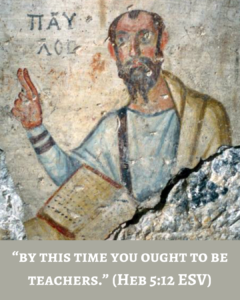
- The image in this post is Fresco of Saint Paul at the cave of Saint Paul at Ephesus, by an unknown artist in the 6th century. It is in the public domain.
- A simple internet search for the Tanak order of the Bible will return a list of the books in each section.

