As I mentioned in my last post, Betty and I enjoyed stimulating conversations with the saints at Grace Heritage Baptist Church on a recent Lord’s Day evening. Two ideas for blog posts sprang from them.
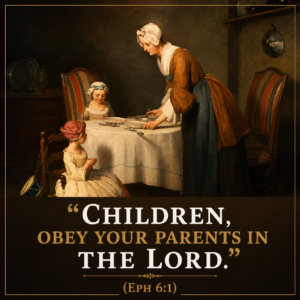
I shared some thoughts on one of them in my post titled The Talmud and Temple Termination. Here, I want to reflect on our conversation regarding Ephesians 6:1: “Children, obey your parents in the Lord.” What did Paul mean by the phrase “in the Lord”?1
Our discussion went in interesting directions. Perhaps the Apostle was telling children to obey their parents unless their parents’ orders were contrary to the word of God, in which case they should disobey. This would mean the Apostle was telling children to imitate the first Christians, who told the Jewish authorities, “We ought to obey God rather than men” (Acts 5:29).
This option doesn’t violate Scripture, but it seems implausible. Would Paul tell children to judge the correctness of their parents’ commands and obey only if they conform to the written Word?
Someone wondered aloud whether our pedobaptist brothers in Christ might see this command as support for infant baptism. Should we reconsider our staunch Baptist stand on this matter? (Nobody suggested that we should.)
This variety extends beyond our congregation; commentators also have varying suggestions. One says Paul’s phrase “in the Lord” designates that children’s obligation to obey arises from “the conviction that such obedience is the will of the Lord,”2 not from the parents’ spiritual status or conduct. Chuck Swindoll notes that a common misreading limits obedience to Christian parents alone, but that this interpretation misses the point entirely.3 Another writer points out that the phrase modifies the verb (i.e., “obey”) rather than the noun “parents,” locating both the manner and the motive of obedience in children’s Christian identity.4
I sense that all these suggestions fail to consider the context adequately. Further, I believe that the inmillennial prophetic framework can inform that context and shed light on this phrase in Paul’s admonition to children.5
For those unfamiliar with this model, I will mention a few of its leading points. The Apostles lived and ministered during the last days of the Mosaic age. Their generation was one of transition from that age to the messianic age. The kingdom of God would be taken from Israel after the flesh and given to Israel defined by faith in Christ (Matt 21:43; Rom 2:28–29; 1 Pet 2:9). The apostles were busy establishing churches and preparing them for the soon-coming of Christ to judge apostate Israel and destroy their temple.
Let’s see how these facts shed light on the context of Ephesians 6:1 and its phrase, “in the Lord.”
The Broader Context
Ephesians is not known as an eschatological letter, yet from the beginning, we see strong prophetic themes undergirding Paul’s statements. The first three chapters lay a doctrinal foundation, beginning with God’s election: “He (i.e., God) chose us in Him (i.e., Christ) before the foundation of the world” (Eph 1:4). This radically affects one of “the three most fundamental Jewish beliefs: monotheism, election, and eschatology.”6 The definition of election in terms of those in Christ was a kingdom-transition move.
This move happened in “the fullness of the times” (Eph 1:10). One facet of this fullness involved the law and how it had guided the people of God, corporately speaking, in their youth. The Mosaic-to-messianic-age transition meant they had reached maturity (Gal 3:23; 4:3); the law would no longer serve its former purpose.
Paul discusses the inheritance that now belongs to God’s people (Eph 1:11, 14, 18). In the former age, that inheritance was tied to physical objects: “Temple, Land, Torah and racial identity were the key symbols which anchored the first-century Jewish worldview in everyday life.”7 This changed during the age transition, and this will shed light on our understanding of “in the Lord” in Ephesians 6:1, as we shall soon see.
Paul makes the age change explicit: God has exalted Christ above every name, “not only in this age, but also in the one about to come.”8 The age “about to come” in Paul’s day was the messianic (kingdom) age foreseen by the prophets (e.g., Dan 2:44).
The temple of the Mosaic age would soon fall (Matt 24:1–3, 34), so God had made provision for a new one, with “Jesus Christ Himself being the chief cornerstone” (Eph 2:20).
Other prophetic themes lace these opening chapters. The divine revelation of truth in the new age far surpasses that in former ages (Eph 3:1–5). The family of God now comprises those in whom Christ dwells by faith, not those who are only the physical descendants of Abraham, Isaac, and Jacob (Eph 3:14–19). Etc.
These changes are permanent. After the transition to the messianic age, glory would flow to God “in the church by Christ Jesus to all generations, forever and ever” (Eph 3:21).
The More Immediate Context
After laying this doctrinal foundation, laced with prophetic themes, Paul exhorts the Ephesians based on these truths. God has given gifts to the churches so that the people can learn to behave as mature saints (Eph 4:10–16). They can achieve this through spiritual renewal (Eph 4:23).
Mature living in the new age means obeying God’s law. We must put away lying according to the ninth commandment (Eph 4:25), and not steal per the eighth (Eph 4:28). The Holy Spirit sealed us for the day of redemption and enables us to live this way.
As we draw closer to our verse of interest (i.e., Eph 6:1), Paul makes the eschatological themes more explicit:
No fornicator, unclean person, nor covetous man, who is an idolater, has any inheritance in the kingdom of Christ and God. Let no one deceive you with empty words, for because of these things the wrath of God comes upon the sons of disobedience. Therefore do not be partakers with them. (Eph 5:5–7)
Jesus had taught about the soon-coming kingdom: “Assuredly, I say to you, there are some standing here who shall not taste death till they see the Son of Man coming in His kingdom” (Matt 16:28). As a result, statements about it and its glory permeate the New Testament (Acts 8:12; 14:22; 19:8; 20:25; 28:31; to mention references in just one book).
The wrath of God, which He would soon pour out upon disobedient Israel, also finds a prominent place in the apostolic writings. For example, Paul says, “wrath has come upon them to the uttermost” (1 Thess 2:16).
In this setting, the Apostle gives a command based on messianic prophecies in Isaiah: “Awake, you who sleep, arise from the dead, and Christ will give you light” (Eph 5:14; cf. Isa 26:19; 60:1). This is a command to leave the dead works of the former age and walk in the light of the new one. As Paul said in another place,
Do this, knowing the time, that now it is high time to awake out of sleep; for now our salvation is nearer than when we first believed. The night (i.e., of the Mosaic age) is far spent, the day (i.e., of the messianic age) is at hand. Therefore let us cast off the works of darkness, and let us put on the armor of light. (Rom 13:11–12)
This way of life involves mutual submission to one another (Eph 5:21): wives to husbands (Eph 5:22–24); husbands to wives by loving them as Christ loved the church (Eph 5:25–32); children to their parents (Eph 6:1–3); etc.
Conclusion
Seen in this sometimes latent, sometimes explicit prophetic framework, for children to obey their parents “in the Lord” means for them to live as God has ordained in the messianic (kingdom) age.
This phrase also suggests God has elevated the promise of the fifth commandment. Originally, it was, “Honor your father and your mother, that your days may be long upon the land which the LORD your God is giving you” (Exod 20:12). Under Moses and Joshua, He was giving them a physical land. In Paul’s day, God was giving His people a heavenly land; they were “receiving a kingdom which cannot be shaken.” Therefore, they were to “ have grace, by which [they might] serve God acceptably with reverence and godly fear” (Heb 12:28).
For children to obey “in the Lord” is for them to conform to His will for the messianic (kingdom) age.
Footnotes
- The AI-enhanced image in this post is The Prayer before Meal, by Jean-Baptiste-Siméon Chardin (1699–1779). It is in the public domain.
- John G. Butler, Analytical Bible Expositor: Galatians-Philemon (Clinton, IA: LBC Publications, 2009), 114.
- Charles R. Swindoll, Galatians, Ephesians, Swindoll’s Living Insights New Testament Commentary (Carol Stream, IL: Tyndale House Publishers, Inc., 2015), 290–91.
- Stephen E. Fowl, Ephesians: A Commentary, ed. C. Clifton Black, M. Eugene Boring, and John T. Carroll, The New Testament Library (Louisville, KY: Westminster John Knox Press, 2012), 192–93.
- Please consider becoming familiar with the inmillennial view of prophecy. You can read a summary version here or tackle the full book-length version here. The title of the book—Inmillennialism: Redefining the Last Days—hints at the reason for my suggestion. This model says the “last days” are identical to Peter’s “these days”; both terms refer to the “last days” of the Mosaic age. This perspective will shed light on the prophets as we work through them.
- N. T. Wright, Jesus and the Victory of God, Christian Origins and the Question of God (London: Society for Promoting Christian Knowledge, 1996), 652.
- N. T. Wright, The New Testament and the People of God, Christian Origins and the Question of God (London: Society for Promoting Christian Knowledge, 1992), 224.
- Kenneth S. Wuest, The New Testament: An Expanded Translation (Grand Rapids: Eerdmans, 1961), Eph 1:15–23.

