The Bible is filled with patterns. God does not merely reveal truth through isolated doctrines or disconnected events. He weaves themes, images, and historical parallels throughout Scripture so that earlier events prepare us to understand later ones. The apostle Paul repeatedly draws attention to this, especially in his discussion of Adam, Christ, and the Exodus.
In 1 Corinthians 15, while defending the doctrine of the resurrection, Paul introduces a foundational principle of biblical typology:
“The first man Adam became a living being.” The last Adam became a life-giving spirit. However, the spiritual is not first, but the natural, and afterward the spiritual.” (1 Cor 15:45–46)
That brief statement becomes a key to understanding much of redemptive history. God first establishes natural and earthly realities that later point forward to greater spiritual fulfillments in Christ. Adam points to Christ. Earthly Jerusalem points to the heavenly Jerusalem. The old covenant points to the new covenant. The Exodus itself points to the greater redemption accomplished by Jesus.
For advocates of inmillennialism, this typological structure is deeply significant. The Exodus and its fulfillment in Christ confirm that God’s kingdom program moves from shadow to substance, from earthly forms to spiritual realities, and from temporary arrangements to everlasting fulfillment.
Adam, Christ, and the Pattern of Typology
Paul explicitly calls Adam “the figure” or type “of him that was to come” (Rom 5:14). Adam and Christ are connected, but they are also opposites. Adam brought condemnation; Christ brings justification. Adam brought death; Christ brings life.
This introduces an important feature of typology: sometimes the antitype fulfills the type by reversing it. Christ does not merely repeat Adam’s work—he overturns its effects.
Paul develops the same pattern in Galatians 4. Ishmael and Isaac become pictures of two covenants. Ishmael, born according to the flesh, represents the covenant associated with earthly Jerusalem and bondage. Isaac, born according to promise, represents the covenant associated with the Jerusalem above and spiritual freedom.
Again, the order is the same: the natural first, then the spiritual.
The old covenant age came first. The new covenant age followed. Earthly realities prepared the way for heavenly realities.
This principle is not incidental. It lies at the heart of Paul’s theology and becomes especially important when we consider the Exodus.
Paul’s Exodus Typology
In 1 Corinthians 10, Paul says something remarkable about Israel’s Exodus from Egypt. He tells the Corinthians that the events surrounding Moses and the wilderness generation “became types of us.” He even repeats the point for emphasis:
“Now all these things happened to them as examples (Gk, tupikos = type), and they were written for our admonition, upon whom the ends of the ages have come.” (1 Cor 10:11)
Paul was not treating the Exodus as a mere history lesson. He believed those events were intentionally designed by God to foreshadow what was taking place in his own generation.
This is crucial. Paul says the “ends of the ages” had come upon him and the Corinthians. Like Jesus in the Olivet Discourse, Paul believed the old covenant order was approaching its climactic judgment.
The Exodus, therefore, became a prophetic model.
Israel passed through the Red Sea under the cloud. They ate supernatural food and drank supernatural water. They fell into idolatry and immorality. Many perished under divine judgment in the wilderness.
Paul says these things were written for the church’s instruction.
Some of the types are explicit. The rock that supplied water represented Christ. The manna pointed to spiritual provision. Israel’s failures warned believers not to repeat the same sins.
But Scripture also allows us to recognize broader typological patterns even where the New Testament does not specifically use the Greek word tupos.
The Passover lamb clearly points to Christ. Paul openly declares, “Christ our passover is sacrificed for us” (1 Cor. 5:7).
The tabernacle foreshadowed heavenly realities. Moses himself pointed forward to Christ. Israel’s physical bondage anticipated humanity’s spiritual bondage under sin.
The Exodus was never merely about escaping Egypt. It was a divinely designed preview of redemption in Christ.
The Great Exodus Fulfilled in Christ
The connection becomes even more powerful when we turn to the New Testament.
At the Mount of Transfiguration, Moses and Elijah spoke with Jesus about “his exodus (Gk. exodos),” which he was about to accomplish in Jerusalem (Luke 9:31). Christ’s death was described as an Exodus.
That language is stunning.
The redemption accomplished through Moses was glorious, but the redemption accomplished through Christ would be infinitely greater.
Israel in Egypt had been trapped in physical slavery. Humanity under sin was trapped in spiritual slavery.
Moses came from a distant place to deliver Israel from Pharaoh. Christ came from heaven to deliver his people from sin and death.
Moses authenticated his mission through miracles. Christ likewise performed signs and wonders so people would believe.
Even the miracles themselves display typological inversion. Moses’ first miracle against Egypt turned water into blood. In John’s gospel, Jesus’ first recorded miracle turned water into wine. Moses’ final great act brought death upon Egypt’s firstborn. According to John, Jesus’ climactic miracle before the cross was raising Lazarus from the dead.
Then came Passover.
On the night before Israel left Egypt, the Passover lamb was slain. On the night before his crucifixion, Jesus instituted the Lord’s Supper. The next day, the true Passover Lamb was sacrificed.
Christ accomplished the greater Exodus through his death.
Through his blood, God’s people crossed from bondage into freedom—not freedom from Pharaoh, but freedom from sin and death.
Pentecost and the Inversion of Sinai
One of the most striking parallels appears in the relationship between Mount Sinai and Pentecost.
Jewish tradition held that the law was given approximately fifty days after the Passover. Likewise, the Holy Spirit was poured out fifty days after Christ’s crucifixion.
But here again we find typological inversion.
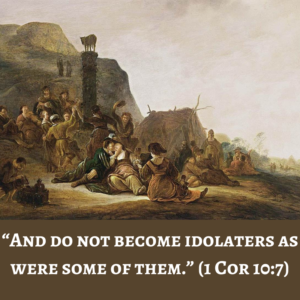
At Sinai, Israel fell into idolatry with the golden calf, and about three thousand people died under judgment.1
At Pentecost, after Peter preached Christ crucified and risen, about three thousand people were brought to life through the gospel.
The contrast is profound.
The law condemned. The Spirit gives life.
The old covenant exposed sin and brought death. The new covenant brings forgiveness and life through Christ.
Paul himself makes this connection repeatedly in his letters. The “law of the Spirit of life” replaces the old covenant administration that brought condemnation.
Again, the pattern is unmistakable: the natural first, then the spiritual.
Forty Years in the Wilderness
The wilderness period also becomes significant within the inmillennial framework.
Israel wandered in the wilderness for forty years before entering the promised land. During that time, God sustained them with extraordinary miracles.
Likewise, from AD 30 to AD 70, the church experienced a unique transitional period. During those forty years, the gospel spread throughout the nations while miraculous signs accompanied the apostolic witness.
Hebrews says God was “bearing witness both with signs and wonders, with various miracles, and gifts of the Holy Spirit” (Hebr 2:4).
Just as Israel’s wilderness generation stood between Egypt and Canaan, the early church stood between the old covenant age and the fully manifested messianic kingdom.
When Israel entered the promised land, the daily manna ceased. God still cared for his people, but the extraordinary wilderness provisions were no longer necessary in the same way.
In the same manner, the author argues that the routine miraculous gifts associated with the church’s transitional period ceased when the messianic kingdom order was fully established after the destruction of the temple: “that which is perfect” had come (1 Cor 13:10).
Jesus himself connected redemption with those events. In Luke 21:28, after describing the coming judgment on Jerusalem, he told his disciples:
“Now when these things begin to happen, look up and lift up your heads, because your redemption draws near.”
Within this framework, the fall of the temple marked the completion of the transition from the Mosaic age into the fully established messianic age.
Why Typology Matters
Some readers may wonder why all of this matters.
It matters because typology reveals the unity and intentional design of Scripture.
The parallels between Moses’ generation and Jesus’ generation are too extensive and too precise to be accidental. Events separated by fifteen centuries correspond in remarkable ways.
Israel’s physical redemption anticipated spiritual redemption.
The earthly kingdom anticipated the heavenly kingdom.
Natural Israel anticipated spiritual Israel.
The old covenant anticipated the new covenant.
Paul’s principle governs the whole structure: first the natural, then the spiritual.
This typological framework also strengthens the inmillennial model because it fits naturally within the biblical story without requiring complicated adjustments or disconnected prophetic timelines.
The Exodus was not merely an isolated miracle in Israel’s past. It was a prophetic pattern that pointed forward to Christ and his kingdom.
The Final Typological Lesson: Kingdom Optimism
One final Exodus type brings the argument to its climax.
When Israel prepared to enter Canaan, God promised that victory would come gradually:
“Little by little I will drive them out from before you, until you have increased, and you inherit the land.” (Exod 23:30)
Israel would inherit the land progressively.
But ten of the twelve spies lost sight of God’s promise. They looked at the size of the opposition, the fortified cities, and the giants in the land. Though they admitted the land was good, they concluded victory was impossible.
Only Joshua and Caleb believed God’s promise.
The author sees a modern parallel here.
Christ has commanded his church to disciple the nations. Scripture describes the kingdom growing like leaven through dough and like a stone becoming a mountain that fills the earth.
Yet many Christians adopt a pessimistic vision of history. They expect evil to grow stronger and stronger until the church largely fails in its mission.
In this view, gospel victory belongs only to a future age.
The inmillennial perspective rejects that pessimism.
According to this framework, the darkest “last days” passages in the New Testament primarily referred to the final days of the Mosaic age before Jerusalem’s destruction in AD 70. They were not descriptions of the permanent condition of Christ’s kingdom.
Instead, the messianic kingdom is portrayed as victorious.
Christ reigns now. His kingdom grows now. The gospel advances now.
The church wages warfare, not with earthly weapons, but with the powerful spiritual weapons of truth, prayer, proclamation, and faithful obedience.
The Exodus itself provides the pattern. God did not fail to bring Israel into the land. Neither will Christ fail to accomplish the mission entrusted to his church.
Conclusion
What makes these typological connections so compelling is not merely their intellectual elegance but their theological beauty.
The same God who delivered Israel from Egypt also delivered his people from sin through Christ.
The same God who led Israel through the sea now leads his people into spiritual freedom.
The same God who established an earthly kingdom under Moses has now established a heavenly kingdom through Christ.
And the same God who fulfilled his promises in the past will fulfill his promises in the present and future.
Typology therefore becomes more than an interpretive method. It becomes a testimony to God’s wisdom, sovereignty, and faithfulness.
The Exodus confirms the inmillennial vision because it reveals the direction of God’s redemptive plan. Scripture moves from shadow to substance, from earthly to heavenly, from temporary forms to enduring fulfillment.
Israel after the flesh came first. Israel after the Spirit came second.
The natural came first. The spiritual followed.
And now, through Christ, the people of God inherit a kingdom that cannot be shaken—a kingdom characterized not by external rituals and earthly boundaries, but by “righteousness, and peace, and joy in the Holy Ghost” (Rom. 14:17).
Footnotes
- The image in this post is The Adoration of the Golden Calf by Gerrit de Wet (1616–74). This file (here) is in the public domain (PD-US).

