
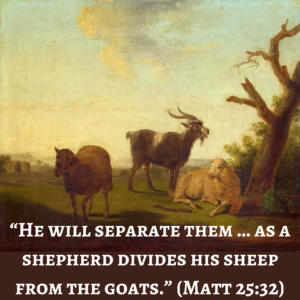
Ian Thomson, a faithful and long-time reader, left several objections to my views in the comment section of my post, The Final Judgment. They relate to my observations on James Stuart Russell’s view of the Sheep and Goats judgment in Matthew 25:31–46.1
I want to respond in the spirit Paul described in Colossians 4:6: “Let your speech always be with grace, seasoned with salt, that you may know how you ought to answer each one.” I will provide the statements I made in the post (if applicable), Ian’s comments, and my responses.
Comments and Responses
My blog statement: “Russell redefines ‘all nations’ in a way the New Testament never does.”
Ian’s comment: The KJV translates Strong’s G1484 in the following manner: Gentiles (93x), nation (64x), heathen (5x), people (2x); a multitude (whether of men or of beasts) associated or living together; a company, troop, swarm; a multitude of individuals of the same nature or genus; the human family, a tribe (Mat 24:30, Rev 1:7), people group (e.g., Judeans, Galileans, Samaritans).
My response: The New Testament consistently uses “all nations” (πάντα τὰ ἔθνη) to mean the Gentiles in distinction from Israel. Here’s an example: “Another angel followed, saying, ‘Babylon is fallen, is fallen, that great city, because she has made all nations drink of the wine of the wrath of her fornication’” (Rev 14:8). Russell, however, applies this term to the tribes of Israel. I would be happy to retract my statement if someone could provide an example from Scripture using it this way. Otherwise, I will stand by my point.

My blog statement: “Russell ignores that Christ has sheep outside Israel.”
Ian’s comment: No. The disciples had not yet been sent to those outside Israel!
My response: This negation of my statement begs the question. It assumes that this passage refers to the judgment of apostate Israel that culminated in AD 70, but that is precisely the point in question. Without this assumption, the fact that the disciples had not gone beyond Israel is irrelevant. This passage describes the judgment of “the sheep” and “the goats” (Matt 25:33), not part of the sheep and some of the goats. I think my point stands: Russell’s perspective prevents the inclusion of Jesus’ sheep among the Gentiles (John 10:16). If my conclusion is incorrect, please provide an example where he acknowledges these “other sheep” exist.
My blog statement: [Russell] “treats a universal judgment as if it were covenantal and local.”
Ian’s comment: But for the listeners (the disciples) being Jewish, it was certainly covenantal and local, just as everything in this discourse. It’s Jewish through and through—the Olivet Discourse runs from Matthew 24:1 to Matthew 25:46—just as we see in other Matthew discourses.
My response: This objection also begs the question and points back to the original question about “all nations.” Yes, the judgment of Jerusalem and the temple was covenantal and local, but the judgment of Noah that Jesus mentions in this context was neither local nor Jewish (Matt 24:37–39). It included “all nations” (without using that term), and Jesus introduced it, I believe, as the counterbalance to the sheep-and-goats judgment. I show the symmetry this creates on page 204 of my book, Inmillennialism: Redefining the Last Days.
I believe the disciples understood Jesus’ words this way, for their later writings mirror His projection of the messianic age to the end of history. Paul, for example, says Jesus will reign during the messianic age as His enemies become His footstool. The last enemy, says Paul, is physical death (1 Cor 15). John likewise portrays the Lord reigning for an extended period—a “thousand years”—before the general resurrection and final judgment (Rev 20). These disciples seem to have understood Jesus in the manner I am proposing.
My blog statement: “Leaves no final resolution to sin in history.”
Ian’s comment: That’s hardly relevant for these disciples.
My response: Hardly relevant? This response appears to be a value judgment based on a preconceived view of this passage. It does not affect the truthfulness of my statement. Either Russell’s view “leaves no final resolution to sin in history,” or it does. If it does, how? And where does discuss it?
In contrast to Russell, the disciples had the same perspective as the Lord Jesus, who said, “Do not marvel at this; for the hour is coming in which all who are in the graves will hear His voice and come forth—those who have done good, to the resurrection of life, and those who have done evil, to the resurrection of condemnation” (John 5:28–29). Therefore, they emphasized that the kingdom of God included the resurrection of our “mortal bodies” (Rom 8:11), and that “the creation itself also will be delivered from the bondage of corruption” (Rom 8:21). They taught that the physical death and corruption caused by Adam’s sin will be reversed, “far as the curse is found.”2 This Russell did not do.
My blog statement: “Russell eliminates judgment for all who lived after AD 70.”
Ian’s comment: Well, the NT was written before AD 70!
My response: I agree, the apostles finished the New Testament before AD 70, but I fail to see how this fact affects my statement. Either Russell’s view “eliminates judgment for all who lived after AD 70,” or it doesn’t. If it does, my statement is accurate. If it doesn’t, where did he affirm such a judgment?
Ian’s comment: I cannot see how Russell undermines the doctrine of the resurrection. (1 Cor 15:51-57, Phil 1:21-23 , 3:9-11, 1 Thess 4:16f).
My response: I’m thankful that you wish to preserve the doctrine of the bodily resurrection at the end of the messianic age, as these verses and the historic Christian creeds and confessions based on them teach. However, Russell undermines this perspective with comments like the following: “We conclude that the Parousia, the resurrection, the judgment, and the last day, all belong to the period of the destruction of Jerusalem.”3 This view contradicts the orthodox faith.
Ian’s comment: Then there is the irrefutable testimony of thousands of people who have had near- death experiences.
My response: I don’t understand how this relates to the sheep-and-goats judgment of “all nations,” so I’ll not respond.
Ian’s comment: Why would Jesus be telling his 4 disciples something irrelevant to first-century followers? What would they take away from what he said? He is still answering their questions raised (Matt 24:1-2).
My response: In my view, the bodily resurrection and sheep-and-goats judgment of “all nations” is relevant to all God’s people in every age. Your question seems to imply that a prophet can speak only about their generation. Is that what you mean? If so, please consider the many Old Testament prophecies about events centuries in the future.
Yes, Jesus is still answering their questions, including the one about His parousia (i.e., presence) with the church during the messianic age. He is showing them the outcome of that presence, the final result of the age transition that concluded in AD 70.
My blog statement: “Russell’s objection misunderstands the relationship between faith and works.”
Ian’s comment: I agree with you on this, Mike.
My response: I’m glad we can end on a point of agreement!
Ian’s comment: In this final ‘parable’ (what’s in a name?). I believe Jesus gave encouragement to the disciples that there will be times when people will take care of them, like giving them a cup of water when thirsty or a visit when in prison. (Cf Mat 10:40-42)
My response: I don’t think my view (i.e., inmillennialism) detracts from this purpose.
Conclusion
I’m thankful for Ian; he has encouraged me many times over the years. I pray that interactions like this will help us and others come to a better understanding of the Scriptures.
Footnotes
- The image in this post is Pasture with Sheep and a Goat by Louis Robbe (1806–1887). This file (here) is in the public domain (PD-US).
- A line in the hymn Joy to the World! The Lord is Come by Isaac Watts.
- James Stuart Russell, The Parousia: A Critical Inquiry into the New Testament Doctrine of Our Lord’s Second Coming (London: Daldy, Isbister & Co., 1878), 126.

