In my book, Inmillennialism: Redefining the Last Days, I appeal to Paul’s exodus typology to confirm the prophetic model found in the Olivet Discourse and First Corinthians 15.1
Here, I want to reinforce that idea and expand it to include the idea that God means for us to use the exodus as one of our basic interpretive tools for understanding the Bible. It is found extensively in the Old and New Testaments, as well as in the literature of Second Temple Judaism.
Lord willing, in my next post, I will show how this emphasis can help answer some criticisms of inmillennialism.2
New Exodus Imagery in the Old Testament
Paul did not originate this exodus typology; the Old Testament prophets often used it to describe how God would establish the future (to them) messianic age. To undervalue this truth is a serious mistake. “Exodus is far more than simply the story of Israelite slaves led to freedom. Indeed, to read Exodus as such is to miss not only the theology of the book itself, but also the transfiguration of that theology in the NT.”3 I will provide a few examples to reinforce this point.
Hosea described Israel as God’s unfaithful wife:
Yahweh reverses his earlier declaration: Israel becomes ‘Lo-Ruhamah’ (i.e. ‘not loved’) and ‘Lo-Ammi’ (i.e. ‘not my people’; Hos. 1:6–9; Exod. 5:1; 6:5), and is returned to Egypt (Hos. 8:3; 9:1–3), but not for ever.” Those said not to be God’s people will again be called his children (1:10–2:1). In a new Exodus Yahweh will gather Israel from the nations (11:1, 10–11), and woo her in the desert (2:14), and the site of her first infidelity in Canaan (that of Achan at Achor, Josh. 7:1; 1 Chr. 2:7) will become a doorway of hope (Hos. 2:15).4
The apostles viewed the church as the beloved bride of Christ (Eph 5:21–33), and the true people of God (e.g., 1 Pet 2:10). Their generation was the time of the new-exodus espousal (2 Cor 11:2).
Through Amos, God asked a rhetorical question: “Did I not bring up Israel from the land of Egypt?” (Amos 9:7). He promised to judge the wicked nation, but not utterly destroy it. They would again leave the land and dwell among the nations (Amos 9:8–9). However, a time would come when God would again establish His tabernacle among His people: “On that day I will raise up the tabernacle of David, which has fallen down, and repair its damages; I will raise up its ruins, and rebuild it as in the days of old” (Amos 9:11). The apostles applied this prophecy to their generation—God was using them to raise the tabernacle (Acts 15:16–17).
Isaiah 40–55 stands as the most extensive Old Testament passage about the new exodus. The prophecy describes a return to God after He judged them and drove them from the land (Isa 51:9–11). It presents an extended new-exodus framework for what God would do for Israel. The prophet summons preparation for Yahweh’s coming as Israel’s warrior shepherd and redeemer, who will deliver his plundered people and gather them through the Messiah.5 All this is typological—the future return will mirror and surpass the original exodus.
Jeremiah 16:14–15 and 31:31–33 also emphasize a future deliverance. Jeremiah explicitly prophesies that future generations will speak of Yahweh bringing Israelites from “the land of the north and out of all the countries where he had banished them” rather than from Egypt. The accompanying “new covenant” will differ from Sinai’s, proving more lasting and inscribed on hearts rather than threatened by disobedience, with the new exodus accompanied by this superior covenant.6
Ezekiel 20:33–38 presents a purifying return. Ezekiel announces that Yahweh will gather Israel from the nations with a mighty hand, but this gathering will occur in the desert where, like wilderness chastisement, he will purge them thoroughly. He sees this new exodus as a resurrection and recovery of Eden.7
Habakkuk 3:2–15 and Hosea 12:9–10 will round out our list of OT references to the coming exodus. Habakkuk, perplexed over Yahweh’s dealings with Israel, consoles himself with a song recalling the exodus and conquest.8 Hosea envisions Yahweh repeating the exodus event and wilderness wandering to reclaim his people.9
Conservative scholars treat these passages as genuine predictions of future restoration, viewing them as typological fulfillment rather than mere metaphor—the exodus from Egypt prefigured an ultimate redemption. The exodus permeated the thinking of Israel as the preeminent foundational event in her history, a free act of her God, Yahweh. It is in the background even when it is not specifically mentioned; it is “between the lines.”10
I affirm that this way of thinking should also permeate our thinking as we open the New Testament and consider the greater, antitypical exodus it describes.
New Exodus Imagery in the New Testament
The New Testament employs exodus imagery far more extensively than 1 Corinthians 10 alone. Christian salvation is presented as a new creation, a new exodus, and a new restoration from exile,11 with this framework permeating multiple Gospel accounts and epistles.
Matthew portrays Jesus’s infancy as recapitulating Israel’s early experiences, including the descent into Egypt and return. After his baptism, Jesus’ responses to temptation echo Israel’s wilderness wanderings, but as the true Israel and true Son of God, he succeeds where Israel failed. Matthew explicitly connects Jesus’s healings to his servant role and to Isaiah’s new exodus vision.12
John implies Christ is the antitypical Passover lamb, while Paul makes this explicit: “Christ, our Passover, was sacrificed for us,” therefore we should “keep the feast, not with old leaven, nor with the leaven of malice and wickedness; but with the unleavened bread of sincerity and truth” (1 Cor 5:7–8).
For Luke, Jesus’s birth and inaugural proclamation initiate Yahweh’s new exodus salvation. The Lord has come to “proclaim liberty to the captives” (Luke 4:18). His exorcisms constitute a new exodus, and the sending of the seventy recalls the anointing of elders to assist Moses.
L. Michael Morales summarizes what I’m getting at with a sweeping statement: “It would not be unjustified to claim that New Testament theology may be formulated as new exodus theology.”13
Several biblical passages reinforce this pattern: Jesus tells his audience that Moses did not give them true bread from heaven, but his Father gives the true bread—Jesus himself, the bread of life (John 6:30–35). Jesus compares his crucifixion to Moses lifting the serpent in the wilderness (John 3:14–15). Hebrews contrasts the old covenant made when God led Israel from Egypt with the new covenant, where God writes his laws on hearts and all shall know him, with sins remembered no more (Heb 8).
We should think about our redemption in explicit biblical categories, not artificial ones necessary to make a system work. The exodus is one of the most prominent categories in both the Old and New Testaments.
New Exodus Imagery in Second-Temple Judaism
Before concluding this survey of exodus passages, I want to make an interesting observation. It does not carry the weight of the Scriptural passages above, but it provides useful context for references to a new exodus.
Scholars have observed that many first-century Jews believed Israel remained in exile despite the physical return from Babylon. Iain Duguid notes that the return fell short of prophetic expectations because “Israel’s land was still governed by foreigners, not by a descendant of the line of David; many (the diaspora) were still scattered through other lands; and those who returned persisted in all kinds of sin,”14 and crucially, “the shekinah glory, which filled the temple at Solomon’s dedication of the temple and which departed from the temple in Ezekiel’s vision, is nowhere said to return to Jerusalem in Second Temple literature.”15
N. T. Wright similarly argues that most Jews of the period understood their situation as ongoing exile:
Most Jews of this period, it seems, would have answered the question ‘where are we?’ in language which, reduced to its simplest form, meant: we are still in exile. They believed that, in all the senses which mattered, Israel’s exile was still in progress. Although she had come back from Babylon, the glorious message of the prophets remained unfulfilled. Israel still remained in thrall to foreigners; worse, Israel’s god had not returned to Zion.16
The apocryphal books reflect this conviction:
As is well known, the exile did not end in the early Persian period when people returned to Jerusalem in order to rebuild the city and the temple. Only some of the people deported to Babylonia went back to Jerusalem.… Sources such as Ben Sira, 2 Maccabees and Tobit testify to the view that the return in the Persian period was only a partial one.17
The Qumran sectarians similarly viewed Israel as a nation in exile, though their own community represented the righteous remnant of Israel who were finding God’s ‘way’ in the wilderness. And the Damascus Document expresses this ongoing exile perspective, stating that the exile “has continued long after the ‘return,’ long after the work of Ezra and Nehemiah; it is finally being undone through the community that tells its story in this Scroll.”18
Wright emphasizes the absence of Shekinah return in post-exilic literature: “Nowhere in the so-called post-exilic literature is there any passage corresponding to 1 Kings 8:10f., according to which, when Solomon’s temple had been finished, ‘a cloud filled the house of YHWH, so that the priests could not stand to minister because of the cloud; for the glory of YHWH filled the house of YHWH.’ Instead, Israel clung to the promises that one day the Shekinah, the glorious presence of her god, would return at last.”19
Scholars directly connect Second Temple Jewish conceptions of continuing exile to exodus imagery. In Second Temple Judaism, as evidenced by the Qumran scrolls, “wilderness is a common metaphor used to characterize a variety of ideological exiles.”20 This connection appears most prominently in how Jewish writers reinterpreted Isaiah 40, which itself draws on exodus language.
Second Temple period literature describes the return from exile as a new exodus, with the Wilderness period frequently used to describe the initial marriage of Israel and their God, creating various combinations of joyous celebration of a renewed marriage at the end of the exile.21
The connection between exile and exodus imagery thus functioned theologically rather than merely poetically—it allowed Jews to interpret their present condition as part of an unfinished story that would culminate in restoration, mirroring the original exodus narrative.
Conclusion
The exodus theme is fundamental to understanding God’s relationship to His people. The first exodus established the law and the priesthood as the mechanisms that mediated this relationship. The second exodus defined those relations through Christ’s mediatorial work and the ministry of the Holy Spirit. The Lord contrasts these two events in passages such as Jeremiah 31:31 and Hebrews 8:6–13.
Exodus imagery helps us understand the Bible’s fundamental message and supports our discussions as we evaluate prophetic models designed to help us in that quest.
Footnotes
- Michael A. Rogers, Inmillennialism: Redefining the Last Days (Tullahoma, TN: McGahan Publishing House, 2020), 265–80.
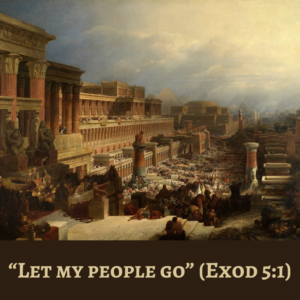
- The image in this post, Departure of the Israelites by David Roberts, 1829 (here), is licensed under the Creative Commons Attribution-Share Alike 3.0 Unported license.
- P. E. Enns, “Exodus (Book),” in New Dictionary of Biblical Theology, ed. T. Desmond Alexander and Brian S. Rosner (Downers Grove, IL: InterVarisy Press, 2000), 146.
- R. E. Watts, “Exodus,” in New Dictionary of Biblical Theology, ed. T. Desmond Alexander and Brian S. Rosner (Downers Grove, IL: InterVarsity, 2000), 482.
- Watts, “Exodus,” 482–83.
- Enns, “Exodus (Book),” 150.
- Watts, “Exodus,” 483.
- Watts, “Exodus,” 483.
- Eugene Carpenter, Exodus, vol. 1 of Evangelical Exegetical Commentary (Bellingham, WA: Lexham Press, 2016), 35.
- Carpenter, Exodus, 35. Emphasis in the original.
- F. F. Bruce, “Typology,” in New Bible Dictionary, ed. D. R. W. Wood et al. (Leicester, England; Downers Grove, IL: InterVarsity, 1996), 1214.
- Watts, “Exodus,” 485.
- L. Michael Morales, Who Shall Ascend the Mountain of the Lord?: A Biblical Theology of the Book of Leviticus (Downers Grove, IL: IVP Academic, 2015), 251.
- I. M. Duguid, “Exile,” in New Dictionary of Biblical Theology, ed. T. Desmond Alexander and Brian S. Rosner (Downers Grove, IL: InterVarsity Press, 2000.
- Mark L. Strauss, “Exile and Restoration,” in Dictionary of the New Testament Use of the Old Testament, ed. G. K. Beale et al. (Grand Rapids, MI: Baker Academic, 2023), 228.
- N. T. Wright, The New Testament and the People of God, Christian Origins and the Question of God 1 (Minneapolis: Fortress Press, 1992), 268–69.
- A. Van der Kooij, 2021, “LXX Jeremiah 25 and 36 in the light of Jewish literature of the time: On the word usage related to exile and diaspora,” HTS Teologiese Studies/Theological Studies 77(1), a6693. https://doi.org/10.4102/hts.v77i1.6693
- Wright, The People of God, 269–70.
- Wright, The People of God, 269–70.
- Bryan D. Estelle, Echoes of Exodus: Tracing a Biblical Motif (Downers Grove, IL: IVP Academic: An Imprint of InterVarsity Press, 2018), 240.
- Phillip J. Long, Jesus the Bridegroom: The Origin of the Eschatological Feast as a Wedding Banquet in the Synoptic Gospels (Eugene, OR: Pickwick Publications, 2013), 185.

