In my last post (here), I stressed what some conservative biblical scholars call “Exodus theology.” This view holds that the theological framework introduced in Exodus recurs throughout the Old Testament and serves as a central organizing principle for understanding Scripture.
Exodus … is not really a story in its own right, but the continuation of the story begun in Genesis and a bridge to what follows. The theology of the book of Exodus is central to a right understanding of redemptive history, not only the unfolding of Israel’s story in the OT, but also the climax of that story in the death and resurrection of Jesus Christ.1
Exodus theology centers on God’s action to create a people—“a kingdom of priests and a holy nation”—through whom his universal plan of blessing will be realized. The Exodus is not just a liberation narrative; it continues the Genesis story and bridges to what follows. Its theology is central to understanding redemptive history through to Christ’s death and resurrection and the end of the Mosaic age.
Later, the prophets portrayed Israel’s captivity in Babylon as a reversal of the Exodus, yet this captivity would not be permanent; God would bring about another exodus for his people. This exodus pattern is central to how we should understand the entire biblical narrative.
This insight will help me respond to certain criticisms of the inmillennial prophetic model. I have documented that model in a book and many blog posts.2 Here, I want to list those objections and show some of the problems they create. In my next post, I will respond to the objections using Exodus theology.
Some Objections to Inmillennialism
Before stating the objections, I need to define the term preterism. This word comes from a Latin word meaning “past.” All Christian prophetic models are preteristic to some extent because they all assert that God has already fulfilled some prophecies. Inmillennialism leans further in this direction than most models, but it is not a full-preterist position because it asserts a future (and final) coming of Christ, resurrection, and final judgment.
Conservative scholars often argue that strong preterist prophetic models, such as inmillennialism, wrongly defer redemptive accomplishments to AD 70, when the New Testament connects them to Christ’s crucifixion, resurrection, and ascension, or to Pentecost. These events then become the key elements needed to establish the kingdom of God, not the temple’s fall. The kingdom had already existed for about forty years before that event.
This criticism concerns the Old Covenant’s termination: inmillennialism places it at AD 70, but evangelical critics contend this denies Christ’s reconciling power. It also, they say, contradicts Paul’s teaching: the blood of Christ had already brought Jews and Gentiles to God when he wrote Ephesians. God had already set the Old Covenant aside and established the New Covenant through Christ’s death. Jonathan Menn says,
[Preterism] undermines the significance of what Christ accomplished on the cross. The cross (which entails the resurrection, ascension, and the pouring out of the Holy Spirit), not the events of AD 70, ended the Old Covenant and instituted the New Covenant (Luke 22:20; John 19:30). The cross ended the efficacy and significance of the temple (Matt 27:51; Mark 15:38; Luke 23:45; John 2:19–22). Jesus ascended to the “true tabernacle” and established a new relationship between God and humanity (Heb 8:1–10:22). The cross inaugurated the “last days” (Acts 2:16–17).3
A friend has written a critical review of inmillennialism, for which I am thankful. He argues along the same lines. Before the temple fell in AD 70, Pentecost had come, and the Holy Spirit was fulfilling the role of the Shekinah glory in God’s new temple. The church was already worshipping in “spirit and truth” (John 4:23). Christ’s presence with the church through the Holy Spirit was a reality, and AD 70 added nothing. Eternal life was already being offered, the new covenant was operative, and the nations were beginning to be gathered. None of it was waiting for AD 70. “The testimony of Acts 1-2 identifies the inauguration of the ingathering at Pentecost as the covenantal transition. AD 70 is an event within the mission the Spirit launched at Pentecost. It is not the event that gives that mission its meaning.”
These arguments reflect a broad evangelical conviction that redemptive accomplishment centers on Christ’s passion, resurrection, and exaltation—not on Jerusalem’s destruction. The core objection to inmillennialism and similar prophetic models centers on whether redemptive accomplishment—covenant transition, temple efficacy, and the establishment of Christ’s kingdom—occurred at the cross and Pentecost or was deferred to AD 70.
But these objections create problems.
Problems with the Objections
These critiques deserve an honest response, and I hope to provide it in due time. However, I first want to note that these objections arise from assumptions that create significant problems. Answering the objections will also remove some of these underlying problems.
First, the assumptions lead to a denial of the significance of the temple’s presence during Jesus’ generation, its fall, and God’s judgment on Jerusalem. My friend says, “The entire argument … is that the order was covenantally defunct long before the building came down.” From Pentecost onward, the temple of God was merely “the building,” having no significance for the apostles or their churches. He continues:
What stood until AD 70 was not a rival order but a vacated shell—a structure whose covenantal function had ended at the cross and whose physical persistence for another forty years signified nothing about the status of Christ’s presence. Demolishing it removed a building, not a competitor.
One wonders why the writer of Hebrews was so concerned about Christians returning to “a building” that was “not a competitor” to the gospel of the kingdom. The letter to the Hebrews takes the opposite view:
The basic theme of Hebrews is found in the use of the word ‘better’.… The writer develops this theme to prevent the readers from giving up the substance for the shadow by abandoning Christianity and retreating into the old Judaic system.4
Contrary to the assumed insignificance of “a building,” the temple rivaled Christianity and drew many new converts away from the faith. Its destruction would remove that threat to a large extent.
Second, these objections minimize the fact that Jesus’ truthfulness was at stake. Had the temple not fallen, Jesus’ ministry would have faced a profound credibility crisis regarding the replacement of the old covenant system. Consider how early Christians would have defended Jesus against skeptics. It is difficult to doubt that Jesus said the temple would fall in His generation. Imagine the saints’ apologetic vulnerability: opponents could have pointed to the still-standing temple as evidence that Jesus’ predictions failed. Without the temple’s actual destruction, critics could dismiss his prediction as, perhaps, a guess rather than genuine prophecy. And, of course, this would make Him a false prophet, not the Messiah.
The temple’s fall was more than “a building” collapsing; it vindicated Jesus’ truthfulness.
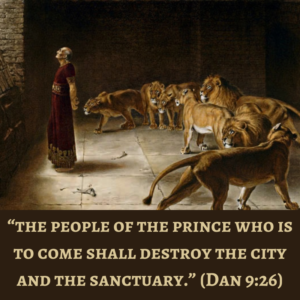
Third, these objections separate what God has joined. Consider what Gabriel told Daniel5 in his seventy-week vision:
Seventy weeks are determined for your people and for your holy city, to finish the transgression, to make an end of sins, to make reconciliation for iniquity, to bring in everlasting righteousness, to seal up vision and prophecy, and to anoint the Most Holy.… And after the sixty-two weeks Messiah shall be cut off, but not for Himself; and the people of the prince who is to come shall destroy the city and the sanctuary. The end of it shall be with a flood, and till the end of the war desolations are determined. Then he shall confirm a covenant with many for one week; but in the middle of the week He shall bring an end to sacrifice and offering. And on the wing of abominations shall be one who makes desolate, even until the consummation, which is determined, is poured out on the desolate. (Daniel 9:24–27)
This passage links wonderful results to the “cutting off” of the Messiah and the destruction of Jerusalem and the temple. Jesus specifically referred to these later events, including the abomination of desolation, in His prophecy about the destruction of the temple (Matt 24:15; Mark 13:14; Luke 21:20). And Gabriel says these events—not the cross or Pentecost—would bring “the consummation.” The Messiah’s death was the cause, but, historically, the “end to sacrifice and offering” occurred when the temple fell, and not before.
None of this detracts from what happened before AD 70, as we shall see, but it does show the folly of minimizing the temple’s fall.
Finally, and more broadly, these objections overlook the role the war that led to the destruction of the temple and Jerusalem played. The scriptures and the literature of Second Temple Judaism assert that it was a necessary prelude to the kingdom of God. Brant Pitre says,
The concept of eschatological tribulation may be broadly defined as the common Jewish expectation of a final period of suffering and catastrophe that precedes the advent of the age of salvation. The presence of this general expectation can be demonstrated by even the most cursory reading of late Second Temple literature.6
Jesus spoke of this period in the Olivet Discourse: “For then there will be great tribulation, such as has not been since the beginning of the world until this time, no, nor ever shall be” (Matt 24:21–22). Josephus and other sources tell us this period lasted about forty-two months.
This belief that Israel would suffer a time of tribulation before the coming of the messianic-age kingdom is deeply rooted in the Old Testament. In addition to Daniel’s prophecy, consider Micah’s testimony to this effect:
Now it shall come to pass in the latter days that the mountain of the LORD’s house shall be established on the top of the mountains, and shall be exalted above the hills; and peoples shall flow to it. Many nations shall come and say, “Come, and let us go up to the mountain of the LORD, to the house of the God of Jacob; He will teach us His ways, and we shall walk in His paths.” For out of Zion the law shall go forth, and the word of the LORD from Jerusalem.… So the LORD will reign over them in Mount Zion from now on, even forever. And you, O tower of the flock, the stronghold of the daughter of Zion, to you shall it come, even the former dominion shall come, the kingdom of the daughter of Jerusalem.” Now why do you cry aloud? Is there no king in your midst? Has your counselor perished? For pangs have seized you like a woman in labor. Be in pain, and labor to bring forth, O daughter of Zion, like a woman in birth pangs.… (Micah 4:1–2, 7–10)
Inmillennialism sees “the latter days” as the final generation of the Mosaic age—Jesus’ generation. This is when the law went forth from Jerusalem, and the Lord began to reign in Mount Zion. But these wonderful developments involved Israel’s messianic woes, the tribulation and war of which we’ve been speaking.
Let’s see how Micah continues to reinforce this idea:
Now gather yourself in troops, O daughter of troops; He has laid siege against us; they will strike the judge of Israel with a rod on the cheek. “But you, Bethlehem Ephrathah, though you are little among the thousands of Judah, yet out of you shall come forth to Me the One to be Ruler in Israel, whose goings forth are from of old, from everlasting.” Therefore He shall give them up, until the time that she who is in labor has given birth; then the remnant of His brethren shall return to the children of Israel. And He shall stand and feed His flock in the strength of the LORD, in the majesty of the name of the LORD His God; and they shall abide, for now He shall be great to the ends of the earth; and this One shall be peace. (Micah 5:1–5)
Consider the cluster from our New Testament perspective: Jesus was born in Bethlehem, and people struck His cheek with a rod at His trial and crucifixion. As before, the prophet links these events to Israel’s “birth pains” (cf. Matt 24:8 ESV). All these must happen before His greatness spreads to the ends of the earth through the preaching of the gospel.
Here’s another example, this time from Isaiah:
Hear the word of the LORD, you who tremble at His word: “Your brethren who hated you, who cast you out for My name’s sake, said, ‘Let the LORD be glorified, that we may see your joy.’ But they shall be ashamed.” The sound of noise from the city! A voice from the temple! The voice of the LORD, who fully repays His enemies! “Before she was in labor, she gave birth; before her pain came, she delivered a male child. Who has heard such a thing? Who has seen such things? Shall the earth be made to give birth in one day? Or shall a nation be born at once? For as soon as Zion was in labor, she gave birth to her children. Shall I bring to the time of birth, and not cause delivery?” says the LORD. “Shall I who cause delivery shut up the womb?” says your God. “Rejoice with Jerusalem, and be glad with her, all you who love her; rejoice for joy with her, all you who mourn for her; that you may feed and be satisfied with the consolation of her bosom, that you may drink deeply and be delighted with the abundance of her glory. (Isa 66:5–11)
Israel would give birth to “a male child” (the Lord Jesus) and a nation would be born. We now know this would happen through the Lord’s death, burial, and resurrection, and Pentecost. Isaiah foretold that all these would happen before Israel’s birth pains came, but they must come. This travail of Israel, including the temple’s fall, would happen. Without it, the new age could not come.
Objections that treat the temple’s fall as covenantally insignificant run counter to much biblical revelation.
Conclusion
My desire is not to diminish God’s pre-AD 70 acts. Those events stand at the very heart of the gospel and the establishment of the New Covenant. However, the question is whether those accomplishments exhaust what the prophets and apostles said would happen in the last days in order to end the Mosaic age. The biblical evidence suggests that they do not. Scripture presents a pattern in which God’s redemptive work unfolds through successive acts that are necessarily and inextricably related.
The events of AD 70 brought the old age to its appointed consummation and vindicated Jesus’ prophetic word, while marking the decisive transition into the age of the Messiah.
This is the perspective I have called inmillennialism. It takes seriously both what Christ accomplished in His earthly ministry and what the prophets said would occur in the generation that witnessed His coming. If you would like to see how these pieces fit together—and why I believe this approach provides a coherent way of understanding the “last days,” the Olivet Discourse, Daniel, Revelation, and the broader biblical story—I invite you to consider reading my book, Inmillennialism: Redefining the Last Days. The book develops the argument at much greater length than I can in a blog post and, I hope, will encourage you to read these familiar passages with fresh eyes.
Next time, we will see how the Exodus theology answers the objections and removes some of the above problems.
Footnotes
- P. E. Enns, “Exodus (Book),” in New Dictionary of Biblical Theology, ed. T. Desmond Alexander and Brian S. Rosner, electronic ed. (Downers Grove, IL: InterVarsity Press, 2000), 146.
- Michael A. Rogers, Inmillennialism: Redefining the Last Days (Tullahoma, TN: McGahan Publishing House, 2020). The book is available here.
- Jonathan Menn, Biblical Eschatology (Eugene, OR: Resource Publications, 2013), 92–93.
- Bruce Wilkinson and Kenneth Boa, Talk Thru the Bible (Nashville: T. Nelson, 1983), 456.
- The image in this post is Daniel’s Answer to the King by Briton Rivière (1840–1920). This file (here) is in the public domain (PD-US).
- Brant Pitre, Jesus, the Tribulation, and the End of the Exile: Restoration Eschatology and the Origin of the Atonement (Grand Rapids; Tübingen: Baker Academic; Mohr Siebeck, 2005), 42.

