Betty and I enjoyed stimulating conversations this past Lord’s Day evening with the saints at Grace Heritage Baptist Church. Two ideas for blog posts sprang from them.
The one I will share here relates to my last post on typology. The other relates to Paul’s meaning when he says, “Children, obey your parents in the Lord” (Eph 6:1). I plan to consider the phrase “in the Lord” in my next post.
Now for the typology-related idea. Over dinner, a beloved brother mentioned the need for Christians to grasp the Bible’s overall message to understand its individual parts. He also said that a working knowledge of the historical context helps us understand the individual passages in the Bible. As a helpful example, he mentioned a passage from the Talmud that reinforces the inmillennial prophetic model.1
A couple of caveats before I continue. First, whatever supporting evidence the Talmud provides for the typology I discussed earlier (here) pales in comparison to the inspired Scriptures. It is interesting, but not authoritative.
Second, I am not a talmudic scholar and haven’t read all these Jewish writings. Over the years, I’ve indirectly gleaned various facts, and quick searches have supplemented my limited knowledge.
The Talmud is a collection of rabbinic Jewish discussions about law, ethics, ritual, biblical (OT) interpretation, and tradition. It is a compilation of debates and teachings developed over several centuries, with two major parts: 1) The Mishnah, an organized collection of Jewish oral law, and 2) The Gemara, later rabbinic discussions and commentary on the Mishnah. Rabbis compiled it around AD 200, but didn’t produce its ultimate form until about AD 500.
Here is the passage my friend mentioned:
The Sages taught: During the tenure of Shimon HaTzaddik, the lot for God always arose in the High Priest’s right hand; after his death, it occurred only occasionally; but during the forty years prior to the destruction of the Second Temple, the lot for God did not arise in the High Priest’s right hand at all. So too, the strip of crimson wool that was tied to the head of the goat that was sent to Azazel did not turn white, and the westernmost lamp of the candelabrum did not burn continually. And the doors of the Sanctuary opened by themselves as a sign that they would soon be opened by enemies, until Rabban Yoḥanan ben Zakkai scolded them. He said to the Sanctuary: Sanctuary, Sanctuary, why do you frighten yourself with these signs? I know about you that you will ultimately be destroyed, and Zechariah, son of Ido, has already prophesied concerning you: “Open your doors, O Lebanon, that the fire may devour your cedars” (Zechariah 11:1), Lebanon being an appellation for the Temple.2
I will make a few observations on these ideas under these headings: 1) the timing; 2) the signs; 3) Zechariah’s anticipation of the temple’s destruction; and 4) Jewish objections to these observations. Christians did not write these words; their opponents penned them. This increases the significance of the lessons gleaned here.
The Timing
According to this passage, certain signs occurred “during the forty years prior to the destruction of the Second Temple.” The Romans destroyed the temple in AD 70, so forty years before that date would be around AD 30, the year Jesus died on the cross.
In inmillennialism, much is made of this period. It was the “this generation” in Jesus’ prophecy about the future (to him) fall of the temple (Matt 24:1–3, 34). It would see the abomination of desolation (Matt 24:15), the “great tribulation” (Matt 24:21), His parousia (presence, Matt 24:27), and the collapse of Israel’s cosmos (Matt 24:29).
Inmillennialism also stresses the typology associated with this period, as I mentioned earlier. As a reminder, here is one of the diagrams in my book that summarizes the major elements in this association:

The period specified by this talmudic passage is of utmost importance to the proper understanding of Biblical prophecy.
The Signs
To us modern Christians, these signs seem fantastical. My purpose here is not to question their legitimacy; I will take them at face value. The non-Christian Jews had no reason to use them to emphasize the year of Christ’s death, but followers of the Lamb do.
The Sacrifices
Two of the signs concern the sacrifices made on the Day of Atonement. The first involved “the lot for God.” This is a reference to the two goats specified in Leviticus 16. To determine which was sacrificed and which was set free, “Aaron … cast lots for the two goats: one lot for the LORD and the other lot for the scapegoat” (Lev 16:8).
For believers, the failure of this sign is not surprising, for in AD 30, Jesus offered “one offering” that “perfected forever those who are being sanctified” (Heb 10:14). Once the temple fell, the “lot(s) for God” would cease forever.
The next sacrifice sign—the strip of crimson wool that did not turn white—is nonbiblical. The symbolism no doubt comes from Isaiah: “Though your sins are like scarlet, they shall be as white as snow; though they are red like crimson, they shall be as wool” (Isa 1:18). However, no Old Testament passage speaks of a strip tied around the goat’s neck. Still, we Christians rejoice that in AD 30, the blood of Jesus cleansed us from all our sins.
The Presence
The next sign is that “the westernmost lamp of the candelabrum did not burn continually.” According to rabbinic tradition, “the lighting of the candelabrum is testimony to mankind that the Divine Presence rests among Israel.”3 The western lamp miraculously stayed lit longer than the others to emphasize God’s presence. Its failure was a sign that God’s presence was not with those who adhered to the temple.
This allows me to highlight a way inmillennialism differs from all other prophetic models. It says that the presence of God with His people changed dramatically in AD 30. Fifty days after Jesus rose from the dead, Jesus came to dwell with the church through the Holy Spirit. This is His parousia (presence) with them. It was a reality in AD 70 (Matt 24:27) and will continue to be a reality until the resurrection at the end of the messianic (kingdom) age (1 Cor 15:23).
The doors of the temple opening by themselves stresses this change regarding the presence of God with the church. Before Christ came, that presence dwelt in the temple. When the disciples heard Jesus say the temple would be destroyed in their lifetime, they no doubt wondered where the Presence would dwell after that. They soon learned that God would build another temple, the church, and dwell there. It was fitting that the temple doors indicated the temple would soon perish, for it was no longer God’s house.
Josephus reports something similar in his eyewitness account of the temple’s destruction. He says, “The eastern gate of the inner court of the temple … was seen to be opened of its own accord about the sixth hour of the night.” In addition, he says he heard the voice of a great multitude say, “Let us remove hence.”4
Inmillennialism insists that the parousia of Christ is not a point-in-time event in our future. It is His presence with His church throughout the messianic age in which we now live.
Zechariah’s Prophecy
The reference to Zechariah 11:1 is instructive. The Talmud interprets it to refer to the temple’s fall in AD 70. Inmillennialism agrees. Zechariah says this would occur in the time of the latter rain, or in Israel’s last days (Zech 10:1). It would occur in conjunction with the gathering of God’s people from far countries (Zech 10:8–9; cf Matt 24:31). It was the time in which God would break his covenant with Israel after the flesh (Zech 11:10; cf. 1 Cor 10:18).
In these 40 years, the Jews would contribute thirty pieces of silver to destroy their Messiah (Zech 11:12; cf. Matt 26:15). In that day, Israel would look on Him whom they pierced and mourn (Zech 12:10–12).
I could extend this list, but my point is that this passage in the Talmud places the temple’s destruction within the complex of events that ended the Mosaic age and established the messianic age, just as inmillennialism suggests.
Jewish Objections
Modern Jewish writers naturally object to these observations. They sometimes say the passage never mentions Jesus, a fact I cheerfully acknowledge. But who would expect non-believers to associate these things with a person they claim was a false messiah? The absence of Jesus’ name in this talmudic context is completely to be expected.
Others say these signs pointed to Israel’s moral decline and the coming national catastrophe, and were not proof that the sacrifices had become invalid. I would point out that God had often warned Israel that He no longer accepted their sacrifices because of such moral decline. For example, He said to them,
Hear the word of the LORD, you rulers of Sodom; give ear to the law of our God, you people of Gomorrah: “To what purpose is the multitude of your sacrifices to Me?” says the LORD. “I have had enough of burnt offerings of rams and the fat of fed cattle. I do not delight in the blood of bulls, or of lambs or goats.” (Isa 1:10–11)
Other objections arise, but the limits of a blog post do not allow me to address them here.
Conclusion
There is a striking irony in this passage. In it, a collection of Jews who denied that Jesus was their messiah unwittingly provide a list of signs that contradict their denial. May this unintended witness encourage us Christians to understand better the historical events that contribute so much to our understanding of God’s word.
Footnotes
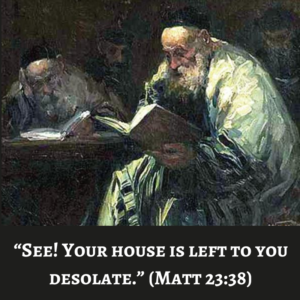
- The image in this post is Talmud Readers, by Adolf Behrman (1876–1943). It is in the public domain.
- Babylonian Talmud, Yoma 39b:5–6, accessed May 19, 2026, Sefaria
- Babylonian Talmud, Shabbat 22b:2, accessed May 19, 2026, Sefaria
- Josephus, Jewish War 6.5.3 (§§288–300).


4 comments
Wow. That is a fascinating historical confirmation of the impact of Christ’s completed sacrifice.
Regarding the presence (parousia) of God with His people that began at Pentecost (Acts 2), do you see that as what Jesus was referring to when he said, “lo, I am with you always, even unto the end of the world.”?
Thanks for the comment!
Yes, I think Jesus had the coming of the Holy Spirit in mind in the Great Commission, where He promised to be with the disciples until the end of the age. To qualify my answer, I believe the age He had in mind was the Mosaic age. I explain how I think this works in my post, Until the End of the Age.
Thanks, Mike, for this masterful revealing of God’s plan. The pieces are slowly falling together for me. I wish I had seen this in my younger years when there was more fertile ground in the garden of my mind and soul. Although I must say that I did see glimpses of many things back in my youth. I tried to convey those ideas that the Holy Spirit gave me, but not sure if my audience at the time was able to receive them.
While I have your attention, may I ask you a simple question? Was the Great Tribulation those 3.5 years that the Church suffered under Nero or was it the 3.5 years that Israel suffered in AD 66-70?
You’re welcome! I rejoice to learn of your profiting from the study of God’s word.
I consider the great tribulation to be the 3.5 years of Israel’s suffering before the temple fell. However, it’s interesting that these two periods add to 7 years, the length of time dispensationalists understand as the final week of Daniel’s 70-weeks prophecy. However, even they associate the “great tribulation” proper to the second half of this period.
I’ve often marvelled at how right dispensationalism would be if we eliminated the parenthesis it puts between the last two weeks of Daniel’s prophecy, and made a few other minor adjustments.