
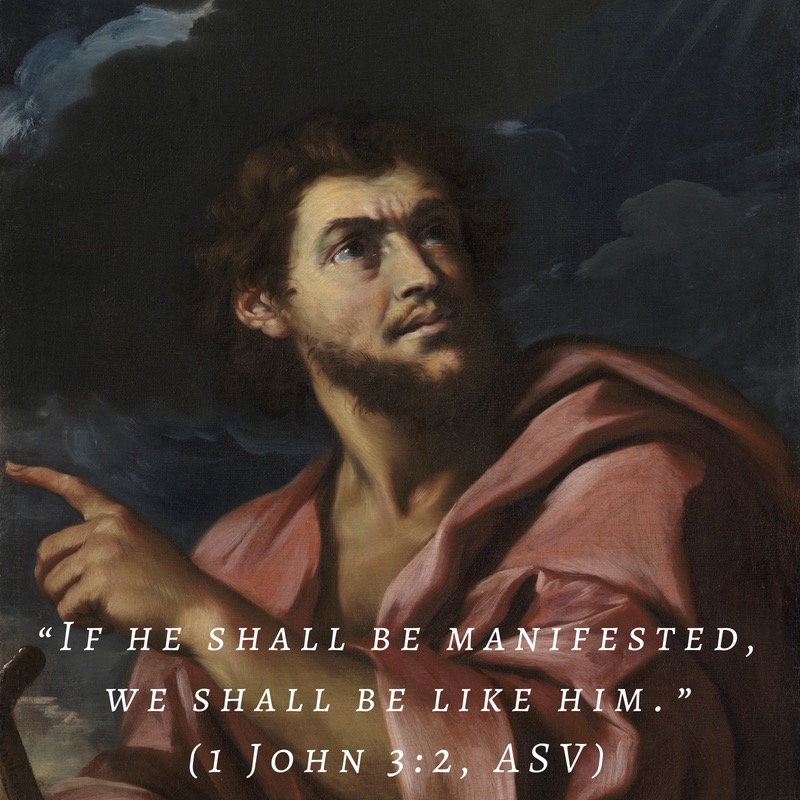
“Beloved, now are we the sons of God, and it doth not yet appear what we shall be: but we know that, when he shall appear, we shall be like him; for we shall see him as he is” (1 John 3:2).
This verse causes some readers to doubt inmillennialism. For example, a dear brother wrote, “1 Jn. 3:2b says, ‘when he shall appear, we shall be like him; for we shall see him as he is.’” After quoting several other passages, he continues. “If Christ does not return in the personal manner as described above, we cannot be saved. It is upon His return that we experience the completion of our salvation – the resurrection and redemption of the body. This is why the matter of His return is of such great importance and there is the need for straightforward biblical thinking and communicating on the subject” (emphasis added).
If this reasoning is correct, inmillennialism faces a significant problem. This prophetic model asserts Jesus’s return occurred during the lifetime of some who heard him speak (Matt 16:27–28). His coming (Gk. parousia) and the Temple’s destruction were inseparable (Matt 24:1–3, 27, 37, 39). Both happened in Jesus’s generation in AD 70 (Matt 24:34).
Inmillennialism states the Lord’s “coming” (Gk. parousia, e.g. Matt 24:27) is the same as his “appearance” (Gk. phaneroō, 1 John 3:2). John1 makes this clear: “And now, little children, abide in him; that, when he shall appear (Gk. phaneroō), we may have confidence, and not be ashamed before him at his coming (Gk. parousia)” (1 John 2:28). Scripture links the “appearance” of Christ to his “coming” and the Temple’s destruction.
Inmillennialism also says to “be like him” means to have a glorified body. Paul said God “shall change our vile body, that it may be fashioned like unto his glorious body, according to the working whereby he is able even to subdue all things unto himself” (Phil 3:21). This will occur in the bodily resurrection.
So, inmillennialism’s problem is clear. If Christ’s appearance and coming were in AD 70, why do we not have glorified bodies? Or, we do not have glorified bodies. How, then, could Christ’s coming and appearance have been first-century events?
How can inmillennialism be true?
Resolution and Reasons
Inmillennialism’s difficulty in 1 John 3:2 revolves around a single word—“when.” To help us talk about this problem, we will refer to “when he shall appear” as the “appearance.” And, we will speak of “we shall be like him; for we shall see him as he is” as our “glorification.” This “when” causes most Christians to make an assumption. Glorification and the Lord’s appearance seem to occur at the same moment.
This assumption is not true. The Greek word for “when” (ean) does not of itself mean “at the same time.” It means “if.”
Factors outside the text itself can, on rare occasions, justify the translation “when.” In these cases ean can imply “as soon as,” “at the same time,” or something similar. Even in these cases, ean still implies an “if.” We argue that 1 John 3:2 is not a place that implies “when.” Here, it means “if.”
This may surprise (or shock) many readers. So, we must hasten to provide our evidence. It will come from several sources.
Literal translations show John does not mean “when.” In Young’s Literal Translation John says, “beloved, now, children of God are we, and it was not yet manifested what we shall be, and we have known that if (Gk. ean) he may be manifested, like him we shall be, because we shall see him as he is” (1 John 3:2). Berry’s interlinear has, “if (ean) he be manifested, like him we shall be.”2 William Norton has “if (ean) he shall be made manifest, we shall be like him.”3 “If” is John’s literal meaning.
Grammarians like Daniel Wallace confirm this definition. “Ei and ean are the major conditional conjunctions. They are translated if.”4 He shows how ean creates an “if” condition. “A conditional sentence has two parts: an ‘if’ part and a ‘then’ part.”5 Ean in passages like 1 John 3:2 creates a “third class” condition.6 This structure “is a common category of conditional clauses, occurring nearly 300 times in the NT.”7 He appears to omit “when” as a meaning for ean.
Lexicons give “if” as the primary (or exclusive) meaning of ean. Here are two examples: “if haply, if”8; “conjunction; if, if at any time, whenever.”9 Ean creates an “if” condition that must be fulfilled before the “then” can happen. It is “a conditional particle, which makes reference to time and to experience, introducing something future.”10 In 1 John 3:2, the saints’ glorification is after Christ’s appearance. This is all ean means.
The translations use “if” to translate ean in a large majority of other passages. This word occurs 275 times in the Received Text—the Greek basis for the Authorized (King James) Version. The translators used “if” in 199 of these. They used “when” only twice, in 1 John 3:2 and 1 Cor 14:16. Other versions—the ESV, NKJV, HCSB, etc.— have “if” in 1 Cor 14:15. So, 1 John 3:2 is a rare—the only?—instance where the versions agree on “when” for ean. The reason for this does not come from the word itself, as we shall see.
John’s other writings suggest he is not thinking of Christ’s appearance and our glorification as simultaneous actions. Below we show the structure of 1 John 3:2 using the American Standard Version. Its “if” comprises ean before a verb in the subjunctive mood. Its “then” is a future-tense verb. We then show three other examples of this structure from John’s writings.
1 John 3:2, ASV — “If (ean) he shall be manifested [subjunctive], we shall be like him [future]; for we shall see [future] him even as he is.”
John 12:32 — “If (ean) I be lifted up [subjunctive] from the earth, [I] will draw [future] all men unto me.”
John 14:3 — “If (ean) I go and prepare [subjunctives] a place for you, I will come again [future], and receive [future] you unto myself.”
John 16:7 — “if (ean) I go [subjunctive] not away, the Comforter will not come [future] unto you.”
In John 12:32, Jesus is not saying he will draw all men at the moment of his crucifixion. He will draw men during the entire messianic age. The final drawing will occur in the resurrection at the end of that age (John 6:44).
In John 14:3, the “if” part—“going” and “preparing”—cannot happen at the same time as the “then” part—“coming again” and “receiving.” Jesus said his “coming again” would occur in his generation (Matt 16:17–18; 24:34). The final “receiving unto himself” will occur in the resurrection at the end of the messianic age (John 5:28–29; 1 Cor 15:23–26).
In John 16:7, the “then” part—the coming of the Holy Spirit—would occur after the “if” part. Simultaneous action for these two events is impossible.
Inmillennialism says 1 John 3:2 follows John’s pattern elsewhere. His “if”—Christ’s appearance—does not occur at the moment of his “then”—the glorification of the saints.
Commentators who deal with the Greek text often admit ean means “if” in 1 John 3:2. One says ean here means “‘if’; expressing no doubt as to the fact, but only as to the time; also implying that on the coming preliminary fact, the consequence follows.”11 Another says, “As in [1 John 2:29] the conditional aspect of ean (“if” or “whenever”) does not cast doubt on the certainty of the event itself, but rather on the exact time of the event.”12 These observations show our glorification does not, of necessity, occur at the time of Christ’s appearance.
Why, then, do most translators and commentators think ean means “when” in this verse? There is one grand reason—their prophetic models need it. One scholar makes this point clear. “We assume, therefore, that [ean phanerōthē—“when he appears”] alludes to the future parousia of Jesus Christ in glory at the end of time.”13 If this assumption is correct, Christ’s parousia will be the last event in history. So, no other meaning for ean in 1 John 3:2 is possible. Glorification must occur “when” Christ appears.
Inmillennialism denies this assumption. The parousia is a state of being, not a point-in-time event. This “presence” of Christ with his churches began in the first century. It will continue throughout the messianic age. If this perspective is true, ean can keep its usual “if” meaning in 1 John 3:2. This occurrence will then match John’s other uses of ean (John 12:32; 14:3; 16:7; et al.).
This is not the place to re-justify inmillennialism. Our goal here is to show that one cannot use the “when” of 1 John 3:2 to invalidate this prophetic model. To do so would be to use circular reasoning.
Conclusion
Inmillennialism accepts 1 John 3:2 without hesitation. But, it rejects “when” as a valid translation of ean in this place. John specified Jesus’s appearance as a condition—if he appears.
Jesus fulfilled this condition. He returned in his generation as he promised. John’s then—our glorification—is certain.
Other Scriptures show when our glorification will occur. We will be like Christ in the resurrection at the end of the messianic age.
Let’s imagine ourselves living in the first century. Here is a way someone might have paraphrased 1 John 3:2. “If Christ appears at his coming in this generation as he promised—the Mosaic age will end. The messianic age will continue. Then—in the new age of resurrection—God will make us like Christ. He will glorify the saints in the resurrection at the end of the messianic age.”
This might have reminded us of Paul’s teaching. God raised Christ as “the firstfruits” of the dead. This first resurrection happened at the beginning of the parousia, or messianic age. “Afterwards,” at the end of the parousia, God will make the saints like Christ in the bodily resurrection (1 Cor 15:23).
Ean in 1 John 3:2 “implies a condition which experience must determine, an objective possibility.”14 Jesus fulfilled that “if” in his generation (Matt 24:34). The “then” is, therefore, certain—“we shall be like him; for we shall see him as he is.”
Footnotes
- The image in this post is The Apostle John by Girolamo Troppa (1637–1710). This file (here) is in the public domain (PD-US).
- George Ricker Berry, The Interlinear Greek-English New Testament With Lexicon and Synonyms (Grand Rapids: Zondervan, 1979), 611. Emphasis added.
- A Translation, in English Daily Used, of the Peshito-Syriac Text and of the Received Greek Text: Greek Translation, trans. William Norton (London: W. K. Bloom, 1889).
- Daniel B. Wallace, Greek Grammar Beyond the Basics: An Exegetical Syntax of the New Testament (Grand Rapids: Zondervan, 1996), 682. Greek transliterated.
- Wallace, Greek Grammar, 682.
- Wallace, Greek Grammar, 689.
- Wallace, Greek Grammar, 696.
- Henry George Liddell et al., A Greek-English Lexicon (Oxford: Clarendon Press, 1996), 465.
- T. Friberg, B. Friberg, and N. F. Miller, Analytical Lexicon of the Greek New Testament (Grand Rapids: Baker, 2000), 124.
- Joseph Thayer and James Strong, Thayer’s Greek-English Lexicon of the New Testament: Coded With Strong’s Concordance Numbers (Milford, MI: Mott Media, 1982), 162. Emphasis added.
- Robert Jamieson, A. R. Fausset, and David Brown, Matthew–John, vol. 3 of A Commentary, Critical, Experimental and Practical on the Old and New Testaments, (Grand Rapids: Eerdmans, 1976), 3:636.
- Daniel L. Akin, 1, 2, 3 John, vol. 38 of The New American Commentary, (Nashville: Broadman & Holman, 2001), 135.
- Stephen S. Smalley, 1, 2, 3 John, vol. 51 of Word Biblical Commentary, eds. David A. Hubbard and Glenn W. Barker (Waco, TX: Word, 1984), 146.
- Spiros Zodhiates, The Complete Word Study Dictionary: New Testament (Chattanooga, TN: AMG Publishers, 2000), s.v. ἐάν eán.


10 comments
Brother Mike, this week’s blog is so logical and fits in so well with the overall narrative of the Bible. Press on!
Thanks for the encouragement! Let’s tell God’s story of redemption as accurately as possible.
Brother Mike,
Thanks for this explanation. I learned something new, which helps expound the beauty of the meaning of this verse in a way I never saw before!
Thank you for such an encouraging comment. Your fellowship in the Lord is a blessing to us.
John saw Jesus before and after the resurrection, yet he still did not know how Jesus would appear. But when he did,
they would be like him. Jesus had not completed his mission at that time as he had 3 positions to fulfill until all thigns
had been completed. Prophet, priest and king. As PRIEST he acted as 3rd party MEDIATOR between god and mankind and the
Virgin Bride as his QUEEN got to sit at the right hand of power (Hebrew idiom meaning 2nd in command as MEDIATOR between two alienated parties). Once the Queen had reigned with Christ he sat down in the midst of the throne as KING of KINGS and LORD of LORDS. Flesh and blood cannot inherit the kingdom of god. God is spirit; spirit begets spirit; The LORD is the spirit. 2 Cor 3:17. He returned to mankind in the same manner he appeared to Adam. ‘No man has ever seen god or can see god.’ Adam had DIRECT access to his father and communed with him without a 3rd party mediator. We have been resurrected. Reconciliation came in AD 70.
Hi Judy,
I agree with several of your observations but cannot agree that Christ’s roles as Prophet, Priest, and King were confined to the generation between AD 30 and AD 70. He and the apostles joined the prophets in proclaiming a long messianic age of gradual kingdom expansion during which the church, through the power of the Holy Spirit, subdues all the Lord’s enemies. The final enemy, bodily death, gives way to this triumphant march in the resurrection at the end of the kingdom era.
I base these sayings on the arguments I make in Inmillennialism: Redefining the Last Days. If you disagree, please show the errors in my arguments there. I make most of the same arguments in the series of blog posts that begin here.
Yours in Christ,
Mike Rogers
WHY WE ARE NOT THE ‘SAINTS’
1) Did you ‘fill up the measure of Christ’s suffering?’ Col 1:24
2) Did you remain faithful until the TELOS? Matt 10:22
3) Did you overcome and keep the works of Jesus? Rev 2:26
4) Did you obey God’s commandments and remain faithful? Rev 14:12
5)Did you ‘work out your own salvation? Phil 2:12
6)Were you martyred for the faith and offered as FIRSTFRUITS of the Fall Harvest so the whole lump would be declared HOLY to the LORD, fulfilling the Law of Firstfruits? Rev 6:9; 17:6;
Rev 14:3And they sang a new song before the throne and before the four living creatures and the elders. And no one could learn the song except the 144,000 who had been redeemed from the earth. 4These are the ones who have not been defiled with women, for they are virgins. They follow the Lamb wherever He goes. They have been redeemed from among men as FIRSTFRUITS to God and to the Lamb. 5And no lie was found in their mouths; they are blameless.…
‘Wherefore gird up the loins of your mind, be sober, and hope to the end for the grace that is to be brought unto you……WHEN?….”at the REVELATION OF JESUS CHRIST.”1 Pet 1:9,13
Last book of the bible: REVELATION OF JESUS CHRIST. Fulfillment first century at the TELOS of all things. 1 Pet 4:7
All distinctions were of the old covenant age that was passing away. Heb 8:13. They were Bondservants to a Master waiting on adoption so they could inherit their Master’s possessions. A slave in the family had to prove himself faithful to receive his Master’s possessions. Such distinctions do not exit in the New Covenant age.
Rev 18:20 The ‘apostles, prophets and SAINTS’ each have clear distinctions, and the QUEEN/Harlot/Jerusalem who fornicated with the other nations (she had synagogues in every city of the Roman Empire) received God’s WRATH for killing them.
Religion has lied to us to keep us in subjection. The ‘end’ is TELOS, the goal/aim/purpose of all the previous ages, which is reconciliation between mankind and their father again and do away with 3rd party mediators. Once Christ Jesus mediated for all mankind, he began his reign as King of Kings and Lord of Lords. All 3rd party priests, prophets, Fathers, Rabbis, Teachers, Preachers, Pastors, and any other distinction that elevates one above the other was eliminated. Matt 23:8-10; 2 Cor 3:17.
Mission accomplished. “No longer will they say, ‘Know the Lord, for they will ALL know me from the least to the greatest.” Jer 31:34; fulfilled Heb 8:11.
…51Listen, I tell you a mystery: We will not all sleep, but we will all be changed— 52in an instant, in the twinkling of an eye, at the last trumpet. For the trumpet will sound, the dead will be raised imperishable, and we will be changed. 53For the perishable must be clothed with the imperishable, and the mortal with immortality
Once the Firstfruits of the Fall Harvest were offered to the Lord the whole lump was declared HOLY to the LORD.
Reconciliation came with the Revelation of Jesus Christ and his judgment on the unfaithful nation of Israel, 70 AD.
Judy,
As I said in another response, I agree with much of what you’re saying. However, your logic breaks down in several places. You say, “If you didn’t do thing X, you’re not a saint.” For example, we’re not saints because we didn’t ”fill up the measure of Christ’s suffering” (Col 1:24). This is arbitrary. The Scriptures nowhere say we must participate in this filling-up activity to be saints. The OT refers to the faithful as “saints” in many places (e.g., Deut 33:2-3; Psa 16:3; etc.). In the NT, at the crucifixion of Christ, “the graves were opened; and many bodies of the saints who had fallen asleep were raised” (Matt 27:52).
My point is that the items in your list are not conditions of sainthood.
All distinctions (without exception) are not eliminated in the messianic age, only those that would exclude full participation in the new covenant. A distinction of roles—husbands and wives, elders and the congregation, etc.—still exists.
I’ve registered my concern about the tendency on the part of some to force the fulfillment of all prophecy into an AD 70 timeframe. I said, “I base these sayings on the arguments I make in Inmillennialism: Redefining the Last Days. If you disagree, please show the errors in my arguments there. I make most of the same arguments in the series of blog posts that begin here.
Yours in Christ,
Mike Rogers
WHEN? Colossians 3:4 When Christ who is your life is revealed, “then” you also will be revealed with him in glory.
Ken,
May I invite you to re-read the post? The word John uses is not “when,” it is “if”! As for Colossians 3:4, please see my post here.
If you see any errors in my thinking, please let me know. I would appreciate it if you followed Mortimer Adler’s recommendation when you did. Say one or more of the following:
Once you do that, please specify how I am uninformed, misinformed, illogical, or incomplete. Your disagreement will then be helpful to me and my readers.
Yours in Christ,
Mike