
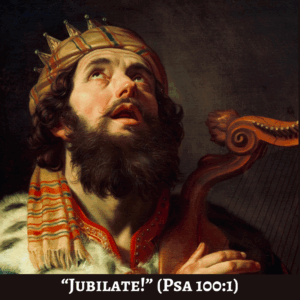
The opening phrase of Psalm 100 in the Authorized Version (KJV) comforts me: “Make a joyful noise unto the LORD.” Even though I am not a gifted singer, I can make a joyful noise!
In this post, I want to make merry using David’s words.1 He issued seven invitations to the nations based on his vision for their future. (These invitations are imperatives, or commands, so I will use the terms “invitations” and “commands” interchangeably.)
Many years ago, I worked for a company that was developing its first vision statement. Their idea was to allow this statement to drive their mission, as well as their long-term, intermediate, and short-term plans.
Our managers explained that a vision statement would describe how our company would exist in the future. They wanted every management employee in the company to take part in this process.
I struggled when asked to develop a personal vision statement. After days of contemplation, I realized that, as a slave of Christ, I am not free to define my future in an absolute sense. I remembered Paul’s questions to the Corinthians:
Do you not know that your body is the temple of the Holy Spirit who is in you, whom you have from God, and you are not your own? For you were bought at a price; therefore glorify God in your body and in your spirit, which are God’s. (1 Cor 6:19–20)
I may construct a secondary vision, but my Master alone may define my future.
David had a vision for the world that moved him to issue seven commands to the nations. He did so creatively.
The Structure of Psalm 100
Speaking of Psalm 100, Bruce Waltke says, “The structure of this psalm interlaces an alternating and a chiastic structure.”2
In a previous post, I said a chiasm (or chiasmus) “is a literary device that presents parallel ideas or terms in a ‘sandwich’ form that resembles the left side of a capital X. This is also the symbol for the Greek capital letter chi, hence the name chiasmus.”3
David arranged his seven parallel commands as follows:
A.
B.
C.
D.
C’.
B’.
A.’
This arrangement draws attention to the central command (D).
David added two other elements to this chiasm: an overarching canopy and a foundation.
The Overarching Canopy: David’s Vision for the Nations
David revealed his audience in the first element of the chiasm. This revelation served as a canopy over all the other statements. He wanted “all the earth” (Psa 100:1 ESV) to obey these commands.
These invitations sprang from David’s vision for the nations. He and his fellow psalm-writers repeatedly defined this vision:
Oh, let the nations be glad and sing for joy! For You shall judge the people righteously, and govern the nations on earth. Let the peoples praise You, O God; let all the peoples praise You. Then the earth shall yield her increase; God, our own God, shall bless us. God shall bless us, and all the ends of the earth shall fear Him. (Psa 67:4–7)4
Sing to God, you kingdoms of the earth; oh, sing praises to the Lord!” (Psa 68:32)
May he have dominion from sea to sea, and from the River to the ends of the earth! May desert tribes bow down before him, and his enemies lick the dust! May the kings of Tarshish and of the coastlands render him tribute; may the kings of Sheba and Seba bring gifts! May all kings fall down before him, all nations serve him!… May his name endure forever, his fame continue as long as the sun! May people be blessed in him, all nations call him blessed! Blessed be the LORD, the God of Israel, who alone does wondrous things. Blessed be his glorious name forever; may the whole earth be filled with his glory! Amen and Amen! (Psalm 72:8—11; 17–19)
Christopher Ash says,
The address to all the Earth … is a bold invitation to the whole world to join the church of God; this invitation is given in the gospel of Christ: “the exhortation presupposes the arrival of those mighty events which occasion is given to the nations of the Earth to shout for joy to the Lord, and to salute him joyfully as their king.”5
David based his invitations on his vision for the nations.
The Invitations
Let’s fill in the chiasm with David’s invitations/commands to the nations. The applications to ourselves will be easy.
“Jubilate!”
The first command—the “A” in our chiasm—is for the nations to “Make a joyful shout to the LORD!” (Psa 100:1). Augustine says it this way:
Jubilate, therefore, unto the Lord, all ye lands.… The whole earth hath heard this voice. All the earth is already jubilant in the Lord; and what is not as yet jubilant, will be so.6
David couples this with another command (A.’): “Bless His name” (Psa 100:4). This desire for the nations to verbally celebrate the Lord permeates David’s writings:
Oh, clap your hands, all you peoples! Shout to God with the voice of triumph! For the LORD Most High is awesome; He is a great King over all the earth. (Psa 47:1–2)
Make a joyful shout to God, all the earth! Sing out the honor of His name; make His praise glorious.… Oh, bless our God, you peoples! And make the voice of His praise to be heard. (Psa 66:1–2, 8)
Our chiasm now looks like this:
A. “Make a joyful shout to the LORD!” (Psa 100:1)
B.
C.
D.
C’.
B’.
A.’ “Bless His name.” (Psa 100:4c)
Application: Are we “jubilating” before God and blessing His name? If not, let us encourage ourselves in the Lord and begin to “make a joyful noise”!
“Serve”
David commanded the nations to serve the Lord—to become His slaves.
Moses provided a good illustration of how this form of slavery works. Under certain situations, slaves could opt for continued service instead of freedom:
If it happens that he [the slave] says to you, “I will not go away from you,” because he loves you and your house, since he prospers with you, then you shall take an awl and thrust it through his ear to the door, and he shall be your servant forever. (Deut 15:16–17)
In such cases, the slave appreciated the goodness of his master and wanted to continue serving him. In like manner, David commanded the nations to be thankful to God and to serve Him as willing servants.
We can update our chiasm:
A. “Make a joyful shout to the LORD!” (Psa 100:1)
B. “Serve the LORD with gladness” (Psa 100:2a)
C.
D.
C’.
B’. “Be thankful to Him.” (Psa 100:4b)
A.’ “Bless His name.” (Psa 100:4c)
Application: Let’s recognize that we are the slaves to someone (or something). We are obedient slaves to either lawlessness or to righteousness (Rom 6:15–23). May we hear and obey David’s commands to “serve the Lord” and “be thankful to Him!”
“Enter”
David commanded the nations to come into God’s house: “Come before His presence with singing” and “Enter into His gates with praise” (Psa 100:2b, 4a). The words “come” and “enter” translate the same Hebrew word. David was thinking of worship in the tabernacle, the house of God in his day.
For us, the church (congregation) is the house of God. The Apostle Paul referred to “the house of God, which is the church of the living God” (1 Tim 3:15). Christopher Ash says, “The invitation and call to come into the presence of God finds it fulfillment when Jesus Christ opens for us ‘the new and living way’ (Heb. 10:20).”7
David commanded the nations to worship the Lord in His house.
A. “Make a joyful shout to the LORD!” (Psa 100:1)
B. “Serve the LORD with gladness” (Psa 100:2a)
C. “Enter his presence with joyful singing (Psa 100:2b NET)
D.
C’. “Enter his gates with thanksgiving” (Psa 100:4a NET)
B’. “Be thankful to Him.” (Psa 100:4b)
A.’ “Bless His name.” (Psa 100:4c)
Application: Do we enter the congregation in this way as we gather to worship? Do we desire that others join us?
“Know”
We’ve reached the focal point of the chiasm: David’s invitation to “know that the Lord” (Psa 100:3). Knowing the Lord involves at least two facts. First, that He is the Creator of all things. From our New Testament perspective, we want “to make all see … [that] God … created all things through Jesus Christ” (Eph 3:9). We also want people to know that “in Christ Jesus” there is “a new creation” (Gal 6:15). In this new creation, those who obey Christ “are His people and the sheep of His pasture” (Psa 100:3).
How does the invitation to “know the Lord” work, considering the New Covenant? Didn’t God say, “No longer shall each one teach his neighbor and each his brother, saying, ‘Know the LORD,’ for they shall all know me, from the least of them to the greatest, declares the LORD” (Jer 31:34)? How can we say, “Know the Lord” when God says His people will all know Him?
The answer lies in the difference between our external call and the internal call of the Holy Spirit. Consider Lydia’s case as an illustration of this distinction. Luke went with Paul to the riverside in Philippi to preach the gospel. He wrote:
One who heard us was a woman named Lydia, from the city of Thyatira, a seller of purple goods, who was a worshiper of God. The Lord opened her heart to pay attention to what was said by Paul. (Acts 16:14)
Paul exhorted Lydia to know the Lord, but the Holy Spirit had to open Lydia’s heart before she could obey the command.
The superstructure of the chiasm is now complete:
A. “Make a joyful shout to the LORD!” (Psa 100:1)
B. “Serve the LORD with gladness” (Psa 100:2a)
C. “Enter his presence with joyful singing (Psa 100:2b NET)
D. “Know that the LORD, He is God” (Psa 100:5)
C’. “Enter his gates with thanksgiving” (Psa 100:4a NET)
B’. “Be thankful to Him.” (Psa 100:4b)
A.’ “Bless His name.” (Psa 100:4c)
Application: Is our passion that “all the lands” know the Lord?
The Foundation
David supported his commands with a threefold foundation: “The LORD is good; His mercy is everlasting, and His truth endures to all generations” (Psa 100:5).
Our New Testament perspective makes these supports even clearer than they were for David. Regarding God’s goodness and mercy, Paul says, “When the goodness and loving kindness of God our Savior appeared, he saved us, not because of works done by us in righteousness, but according to his own mercy, by the washing of regeneration and renewal of the Holy Spirit” (Tit 3:4–5 ESV).
Regarding truth, the Apostle, writing to the same protégé, identifies himself as “A bondservant of God and an apostle of Jesus Christ, according to the faith of God’s elect and the acknowledgment of the truth which accords with godliness, in hope of eternal life which God, who cannot lie, promised before time began, but has in due time manifested His word through preaching” (Titus 1:1–3).
Application: Are we resting on this foundation as our appeals to the nations?
Conclusion
May God bless us to adopt a vision for his kingdom that moves us to invite the nations to praise Him joyfully, serve Him, enter His courts, and know Him. May that vision rest on the firm foundation of His revealed Word.
David’s invitations fit well within the optimism of the inmillennial framework for prophecy. Please consider becoming familiar with it.8
Footnotes
- The image in this file is King David Playing the Harp (1622) by Gerard van Honthorst. It is in the public domain.
- Bruce Waltke, Psalm 100, https://www.biblicaltraining.org/learn/institute/ot561-psalms/ot561-08-psalm-100
- See The X-Factor in the Olivet Discourse.
- The author of Psalm 67 is unknown to us.
- Christopher Ash, The Psalms: A Christ-Centered Commentary (Wheaton: Crossway, 2024), 2:653.
- Augustine of Hippo, Expositions on the Book of Psalms: Psalms 1–150, vol. 4 of A Library of Fathers of the Holy Catholic Church (Oxford; London: F. and J. Rivington; John Henry Parker, 1847–1857), 464.
- Ash, The Psalms, 2:653.
- You can read a summary version here or tackle the full book-length version here. The title of the book—Inmillennialism: Redefining the Last Days—hints at the reason for my suggestion. This model says the “last days” are identical to Peter’s “these days”; both terms refer to the “last days” of the Mosaic age. This perspective sheds light on David’s vision.


2 comments
Thanks Brother for your comments on Psalm 100. I very recently read Psalm 67. This is another Psalm-prophecy concerning the gospel being spread to all the nations and the people rejoicing. Christ’s kingdom will triumph, “Thy kingdom come”. “God shall bless us; and all the ends of the earth shall fear him” (vs.7).
Amen, Brother Dale!