
In this series of posts, we’re verifying Peter’s words—all the prophets foretold his generation (Acts 3:24), its events, and the consequences of those events. In roughly chronological order, we have confirmed that Moses, Samuel, Obadiah, Joel, Amos, Jonah, Hosea, and Micah did so and that their prophecies fit well in our inmillennial model of prophecy.1
My last post (here) reviewed the cycle of redemption Isaiah used in chapter one. God had blessed Israel, yet she had sinned against Him. He announced judgment, but reiterated His promise of future blessings for the nation. Peter is announcing those blessings in his day.
In this post, I aim to show that in chapters two and three, Isaiah combined two elements from this cycle—blessing and judgment—and positioned them “in the latter days” (Isa 2:2). This is the period Peter refers to as “these days” (Acts 3:24).2
I will discuss the blessings in two sections: the Lord’s house and kingdom optimism. A third section will discuss the day-of-the-Lord judgment Isaiah foresaw.
The Lord’s House in the Latter Days
Writing around 700 BC, Isaiah said, “It shall come to pass in the latter days that the mountain of the LORD’s house shall be established on the top of the mountains” (Isa 2:2). Most commentators agree that this refers to God establishing the church. For example, John Gill says the prophet referred to
the kingdom of Christ, which is his church, … called the Lord’s house; … the materials of it are lively stones, or true believers, laid on Christ the foundation; … here Christ is as a Son over his own house; he is the Master of it, the High-priest and Prophet in it.3
Jesus taught Peter about the fulfillment of this promise in an interesting manner. He asked, “Who do men say that I, the Son of Man, am?” Peter answered correctly, “You are the Christ, the Son of the living God.” Jesus responded, “I also say to you that you are Peter, and on this rock I will build My church, and the gates of Hades shall not prevail against it” (Matt 16:16–18). Peter and the other apostles served as foundation stones in the church (Eph 2:20).
So, Christ established His house—the church—in the “last days” of the Mosaic age, fulfilling Isaiah’s prophecy (cf. 1 Tim 3:15).
Kingdom Optimism
Isaiah looked beyond establishing the Lord’s house. That event would start a profound transformation process that would affect the entire world. God would exalt His house
above the hills; and all nations shall flow to it. Many people shall come and say, “Come, and let us go up to the mountain of the LORD, to the house of the God of Jacob; He will teach us His ways, and we shall walk in His paths.” For out of Zion shall go forth the law, and the word of the LORD from Jerusalem. (Isa 2:2–3; emphasis added)
The Old Testament prophets consistently proclaimed this message: God would establish His house and kingdom in the “last days” of the Mosaic age. Afterward, the Gentile nations would come into His house. Eventually, they would all do so.
For example, David said God would set His “King on [His] holy hill of Zion” (Psa 2:6). He would then say to this King (i.e., Jesus), “Ask of Me, and I will give You the nations for Your inheritance, and the ends of the earth for Your possession” (Psa 2:8; emphasis added).
In another place, David viewed this future King as his own Son: “Give the king Your judgments, O God, and Your righteousness to the king’s Son.” The reign of this Son-King would be glorious: “He shall have dominion also from sea to sea, and from the river to the ends of the earth.… Yes, all kings shall fall down before Him; all nations shall serve Him” (Psa 72:1, 8, 11; emphasis added).
We know this King (i.e., Jesus) started reigning in the same “last days” period of which we’ve been speaking—Peter’s generation (cf. Acts 2:30–36; 4:25–26). Because of Jesus’ enthronement, the nations began flowing into God’s house. This process will continue throughout the messianic age until “all nations serve Him.”
The Day of the Lord
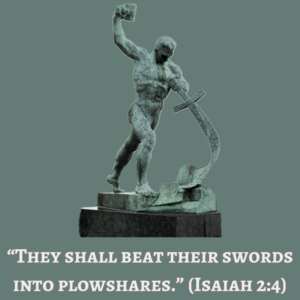
Isaiah placed the construction of God’s house and the start of the nations flowing into it in the “latter days” of the Mosaic age. The King would execute an age-long judgment in which the nations would “beat their swords into plowshares” (Isa 2:4).4
One of the first acts of judgment would be the “day of the Lord” (Isa 2:5–4:1). Our above discussion has prepared us for Matthew Henry’s comment regarding it:
The calling in of the Gentiles was accompanied by rejecting the Jews; it was their fall, and the diminishing of them, that was the riches of the Gentiles; and the casting off of them was the reconciling of the world (Rom. 11:12–15); and it should seem that these verses have reference to that, and justify God therein.5
The New Testament says much about the judgment of Israel that followed the establishment of the Lord’s house. Jesus emphasized this subject during the last week of His life. He told the Jews, “The kingdom of God will be taken from you and given to a nation bearing the fruits of it” (Matt 21:43). And, “See! Your house is left to you desolate” (Matt. 23:38). He foretold destroying the Mosaic-age temple and said it would occur in His generation (Matt 24:1–3, 34).
This “day of the Lord” against Israel would affect other nations, too. For example, through it, God would humble Lebanon, Bashan, and Tarshish (Isa 2:12–16). Still, this day would primarily deal with Israel after the flesh, as the following statements show:
Behold, the Lord GOD of hosts is taking away from Jerusalem and from Judah’s support and supply.… Jerusalem has stumbled, and Judah has fallen, because their speech and their deeds are against the LORD, defying his glorious presence.… The LORD will enter judgment with the elders and princes of his people: “It is you who have devoured the vineyard, the spoil of the poor is in your houses.… The Lord will strike with a scab the heads of the daughters of Zion, and the LORD will lay bare their secret parts. (Isa 3:1, 8, 14, 17; emphasis added)
This day of the Lord occurred in Peter’s generation. He and the other apostles ministered as its approach drew near (e.g., 2 Cor 1:14; Phil 2:16; 1 Thess 5:2; 2 Pet 3:10; et al.).
Conclusion
We have again found Peter to be accurate regarding Isaiah. This prophet foretold that God would establish His house during the “last days” of the Mosaic age. He would also judge Israel after the flesh on the day of the Lord in Peter’s generation. These events initiated the messianic age, during which the nations would flow into the Lord’s house. Jesus is sitting as King and judge at the right hand of the Father until all His enemies become His footstool (Psa 110:1).
Isaiah’s description of these things matches the inmillennial prophetic model we derived from the Olivet Discourse (Matt 24–25; Mark 13; Luke 21:5–38) and 1 Corinthians 15.
Footnotes
- Please consider becoming familiar with the inmillennial view of prophecy. You can read a summary version here or tackle the full book-length version here. The title of the book—Inmillennialism: Redefining the Last Days—hints at the reason for my suggestion. This model says the “last days” are identical to Peter’s “these days”; both terms refer to the “last days” of the Mosaic age. This perspective will shed light on the prophets as we work through them.
- For a discussion of terms like “last days,” see The Last Days in Hebrews.
- John Gill, An Exposition of the Old and New Testaments, 9 vols. (1809–10; repr., Paris, AR: The Baptist Standard Bearer, 1989), 5:12.
- The image in this post is Let Us Beat Swords into Plowshares, a sculpture by Yevgeny Vuchetich, in the garden of the United Nations Headquarters in New York City. This file (here) is licensed under the Creative Commons Attribution-Share Alike 3.0 Unported license.
- Matthew Henry, Matthew Henry’s Commentary on the Whole Bible: Complete and Unabridged in One Volume (Peabody: Hendrickson, 1994), 1080. Emphasis added.


2 comments
Mike your material has been absolute dynamite!! At last the whole of Scripture particularly some confusing areas of prophecy makes sense in a most wonderful way. I especially like how history backs up what you’ve said (Such as the works of Jospehus). Clarity is a wonderful thing.
I’ve been enormously blessed through your work. Keep it up!
Your brother in Christ. Maarten
Thank you, Maarten! Comments like this are very encouraging!