
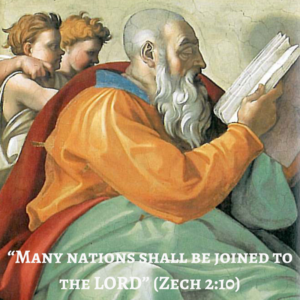
In this series, we’re verifying Peter’s words—all the prophets foretold his generation, its events, and the consequences of those events (Acts 3:24). In roughly chronological order, we have confirmed that Moses, Samuel, Obadiah, Joel, Amos, Jonah, Hosea, Micah, Isaiah, Zephaniah, Nahum, Jeremiah, Habakkuk, Daniel, Ezekiel, Haggai did so. Now, let’s look at Zechariah. Did he, too, speak about the days in which Peter lived?1
Zechariah, along with Haggai and Malachi, spoke the word of God to Israel after their return from Babylon. The first wave of Jewish exiles had returned in 538 BC. Haggai encouraged the people to finish the temple, but Zechariah concentrated on its future. This emphasis makes it easy to find prophecies that relate to Peter’s day. (It also validates the inmillennial prophetic model.2)
God’s Presence and the Nations
Through Zechariah, God made promises that the New Testament shows He has fulfilled. For example, the Lord said,
“Sing and rejoice, O daughter of Zion! For behold, I am coming and I will dwell in your midst,” says the LORD. “Many nations shall be joined to the LORD in that day, and they shall become My people. And I will dwell in your midst. Then you will know that the LORD of hosts has sent Me to you.” (Zech 2:10–11)
The presence of God with his people is one of the central elements of the New Covenant:
Moreover I will make a covenant of peace with them, and it shall be an everlasting covenant with them; I will establish them and multiply them, and I will set My sanctuary in their midst forevermore. My tabernacle also shall be with them; indeed I will be their God, and they shall be My people. The nations also will know that I, the LORD, sanctify Israel, when My sanctuary is in their midst forevermore. (Ezek 37:26–28)
In addition, the Lord often linked His future dwelling among His people with the effect it would have on the nations. Zechariah emphasized this point throughout his book. In the above passage, the Lord’s future presence with Israel would be during a period (“that day”) in which “many nations shall become [His] people.”
According to the inmillennial prophetic model, this presence of God is the parousia of Christ with His people during the messianic age. Because of it, the church will successfully complete the Great Commission, in which Jesus said,
All authority has been given to Me in heaven and on earth. Go therefore and make disciples of all the nations … and lo, I am with you always, even to the end of the age. (Matt 28:18–20)
The New-Covenant presence of God with His people will result in the conversion of the nations. It began in Peter’s generation, and, because of it, “many nations shall be joined to the Lord.”
The Branch and Cleansing
Through Zechariah, God also described this future era as the time when a special Servant of the Lord would come:
Hear now, O Joshua the high priest, you and your friends who sit before you, for they are men who are a sign: behold, I will bring my servant the Branch. For behold, on the stone that I have set before Joshua, on a single stone with seven eyes, I will engrave its inscription, declares the LORD of hosts, and I will remove the iniquity of this land in a single day. (Zech 3:8–9)
John Gill says that many of the ancient Jewish writers understood this title (“the Branch”) to refer to the future Messiah. He then says,
The name of the Branch is given him elsewhere, Isa. 4:2; Jer. 23:5 and designs his descent as man, and the meanness of it; and yet his fruitfulness in himself, and to his people: the bringing him forth intends his incarnation; and shews that he existed before, and was with God, and is brought forth by him as an instance of his grace and love to men.3
As the Branch, Jesus “[removed] the iniquity of this land in a single day.” Israel and its physical land were types (or pictures) of the messianic-age people of God and the territory they labor to subdue (i.e., the whole world). Therefore, John the Baptist said, “Behold, the Lamb of God, who takes away the sin of the world!” (John 1:29). The Apostle John said, “He is the propitiation for our sins, and not for ours only but also for the sins of the whole world” (1 John 2:2).
This removal of iniquity took place “in a single day,” the day Jesus Christ our Lord hung on the cross. Thus, Zechariah spoke of Peter’s day.
The Branch, the Temple, and the Nations
I believe the Scriptures teach the building of a third temple. However, it is not the temple envisioned in fictitious stories like the “Left Behind” books.4 Zechariah foretold another kind of temple when God told him to write,
Behold, the man whose name is the Branch: for he shall branch out from his place, and he shall build the temple of the LORD. It is he who shall build the temple of the LORD and shall bear royal honor, and shall sit and rule on his throne.… And those who are far off shall come and help to build the temple of the LORD. (Zech 6:12–13, 15)
Peter himself shows the fulfillment of this prophecy. He says David also prophesied of the Lord sitting on His throne: “David did not ascend into the heavens, but he himself says, ‘The Lord said to my Lord, “Sit at my right hand, until I make your enemies your footstool”’” (Acts 2:34–35). Jesus has been “[sitting] and [ruling] on his throne” since His ascension into heaven.
Peter also describes the temple the Lord Jesus is building—the third temple:
You yourselves like living stones are being built up as a spiritual house, to be a holy priesthood, to offer spiritual sacrifices acceptable to God through Jesus Christ. For it stands in Scripture: “Behold, I am laying in Zion a stone, a cornerstone chosen and precious, and whoever believes in him will not be put to shame.” (1 Peter 2:5–6)
Paul concurs, saying,
Do you not know that you are the temple of God and that the Spirit of God dwells in you? If anyone defiles the temple of God, God will destroy him. For the temple of God is holy, which temple you are. (1 Cor 3:16–17)
Jesus said God designed the original two (physical) temples for the nations: “Then He taught, saying to them, ‘Is it not written, “My house shall be called a house of prayer for all nations”’?” However, apostate Israel had “made it a ‘den of thieves’” (Mark 11:17). The third building is unique—the nations come to it, then “help to build the temple of the Lord.”
Construction on this temple began during the days of which Peter spoke in Acts 3:24, and the nations have been flowing into it ever since.
Kingdom Optimism
As you may have sensed, the inmillennial prophetic model envisions the kingdom of God in very optimistic terms. Jesus came to establish the kingdom in Peter’s generation (e.g., Matt 4:17), and it has been growing ever since. Zechariah repeatedly mentions its ultimate goal, as the Scriptures above show. The subsequent excerpts demonstrate that he maintained this positive outlook for the remainder of the book.
Thus says the LORD of hosts: “Peoples shall yet come, / Inhabitants of many cities; / The inhabitants of one city shall go to another, saying, / ‘Let us continue to go and pray before the LORD, / And seek the LORD of hosts. / I myself will go also.’ / Yes, many peoples and strong nations / Shall come to seek the LORD of hosts in Jerusalem, / And to pray before the LORD.” (Zech 8:20–22)
He shall speak peace to the nations; his rule shall be from sea to sea, and from the River to the ends of the earth. (Zech 9:10)
And on that day I will seek to destroy all the nations that come against Jerusalem. (Zech 12:9)
On that day living waters shall flow out from Jerusalem.… And the LORD will be king over all the earth. On that day the LORD will be one and his name one. (Zech 14:8–9)
Then everyone who survives of all the nations that have come against Jerusalem shall go up year after year to worship the King, the LORD of hosts, and to keep the Feast of Booths. (Zech 14:16)
Given this, it is quite fitting that the Apostle John concluded that, during his era, “The kingdoms of this world have become the kingdoms of our Lord and of His Christ, and He shall reign forever and ever!” (Rev 11:15).
Conclusion
Jonathan Menn provides a table listing several prophecies in Zechariah that I haven’t mentioned.5 I include it here to reinforce the point of this post—Zechariah spoke of Peter’s generation.
| Event | Zechariah | Gospels |
|---|---|---|
| Entry into Jerusalem on a donkey | Zech 9:9 | Matt 21:1–9; Mark 11:1–10; Luke 19:29–38; John 12:12–16 |
| Covenant established by blood | Zech 9:11 | Matt 26:27–28; Mark 14:23–24; Luke 22:20; 1 Cor 11:25 |
| Sheep without a shepherd | Zech 10:2 | Matt 9:36; Mark 6:34 |
| The flock | Zech 11:11 | Luke 12:32 |
| 30 pieces of silver | Zech 11:12 | Matt 26:15 |
| Money thrown to the potter | Zech 11:13 | Matt 27:3–10 |
| Jerusalem is a heavy stone/trampled | Zech 12:3 | Luke 21:24; Rev 11:2 |
| They will look on Me whom they have pierced | Zech 12:10 | John 19:34, 37 |
| Mourning (especially by the women) | Zech 12:10–14 | Luke 23:27 |
| Forgiveness of sin | Zech 13:1 | Matt 1:21; Mark 2:10; John 1:29 |
| Shepherd struck; sheep scattered | Zech 13:7 | Matt 26:31, 56; Mark 14:27, 50; John 16:32 |
| They are my people; I am their God | Zech 13:9 | Luke 22:20; 2 Cor 6:16; Heb 8:10 |
| The Lord on the Mount of Olives | Zech 14:4 | Matt 24:3; Mark 13:3; Acts 1:12 |
| Earthquake; appearance of holy ones | Zech 14:4–5 | Matt 27:51–53 |
| Continual light | Zech 14:7 | John 1:4, 9; 3:19–21; 8:12; 12:46 |
| Living water at the feast of Tabernacles | Zech 14:8, 16–19 | John 7:37–38 |
| Cleansing the temple | Zech 14:20–21 | Matt 21:12–13; Mark 11:15–17; Luke 19:45–46; John 2:13–16 |
Footnotes
- The image in this post is Zacharias by Michelangelo (1475–1512). This file (here) is in the public domain (PD-US).
- Please consider becoming familiar with the inmillennial view of prophecy. You can read a summary version here or tackle the full book-length version here. The title of the book—Inmillennialism: Redefining the Last Days—hints at the reason for my suggestion. This model says the “last days” are identical to Peter’s “these days”; both terms refer to the “last days” of the Mosaic age. This perspective will shed light on the prophets as we work through them.
- John Gill, An Exposition of the Old and New Testaments 9 vols. (1809–10; repr., Paris, AR: The Baptist Standard Bearer, 1989), 6:692.
- See, for example, Tim LaHaye and Jerry B. Jenkins, Left Behind: A Novel of the Earth’s Last Days, 1st ed. (Wheaton: Tyndale House, 1995).
- Jonathan Menn, Biblical Eschatology (Eugene, OR: Resource Publications, 2013), 436–37.

.jpg)