
In this series of posts, we’re verifying Peter’s words—all the prophets foretold his generation, its events, and the consequences of those events (Acts 3:24). In roughly chronological order, we have confirmed that Moses, Samuel, Obadiah, Joel, Amos, Jonah, Hosea, Micah, Isaiah, and Zephaniah did so and that their prophecies fit well in our inmillennial model of prophecy. This post will examine Nahum’s prophecy.1
Nahum wrote around 644 BC.2 His prophecy deals almost exclusively with God’s soon-coming judgment of Nineveh, Assyria’s capital city. Jonah (ca. 793–53 BC) had visited Nineveh with fantastic results, but the time of that city’s repentance was long past. Assyria had taken Israel (i.e., the ten northern tribes) captive about seventy years before Nahum wrote. Now, it threatened Judah—the southern kingdom—with extinction.
To see how Nahum spoke of the apostles’ generation, we need to briefly survey his prophecy, its background, and how the Apostle Paul later quoted it.
Nahum’s Prophecy
Nahum’s oracle against Nineveh was an unlikely prediction. Assyria was the most powerful empire in the world, standing unrivaled among the nations. The city itself was impressive, with an inner wall about 8 miles long, 50 feet thick, and 100 feet tall.3
Nineveh seemed impregnable, yet God’s prophet spelled out its doom in counterintuitive detail: “Nahum said the siege of Nineveh would be lengthy. The Ninevites would be drunk. They would be destroyed by flood. They would be destroyed by fire. Their temples would be destroyed. The queen and her maidens will die as sacrifices. The people would never return. The city of Nineveh would be completely and totally destroyed and would never be rebuilt.”4
God used the Babylonians to destroy Nineveh in 612 BC—in the prophet’s generation. Archeologists continue to find evidence that the destruction occurred just as Nahum had predicted and that the details of his prophecy were accurate.
Nahum took a single glance beyond Nineveh’s destruction. He assured Judah (the southern kingdom) that its future was secure:
Behold, on the mountains the feet of him who brings good tidings, who proclaims peace! O Judah, keep your appointed feasts, perform your vows. For the wicked one shall no more pass through you; he is utterly cut off. (Nah 1:15)
Messengers would announce Nineveh’s defeat and the removal of the Assyrian threat. The people could continue serving God through His appointed feasts. Her future was secure.
Isaiah as Background
Writing 50 to 75 years before Nahum, Isaiah had also linked Assyria to Israel’s future at least twice. First, he linked the blessings of the messianic age to the fall of Assyria:
And though the Lord gives you the bread of adversity and the water of affliction, yet your teachers will not be moved into a corner anymore, but your eyes shall see your teachers. Your ears shall hear a word behind you, saying, “This is the way, walk in it,” whenever you turn to the right hand or whenever you turn to the left. (Isaiah 30:20–21)
John Gill says the term “your teachers”
may be applied to John the Baptist, Christ, and his apostles, and other Gospel ministers.… This voice behind … intends the Spirit of God, and his grace; though it seems best to understand it of the Scriptures of truth, the word of God, the only rule of faith and practice.… It directs to Christ the way, and who is the only way of life and salvation to be walked in by faith … which is the right way.5
Isaiah follows this description of the age-to-come (i.e., the messianic age) with a prophecy about God’s judgment of Assyria: “Through the voice of the LORD Assyria will be beaten down, as He strikes with the rod” (Isa 30:31; cf. Isa 30:27–33). For Isaiah, the destruction of Assyria was connected to the arrival of the messianic age.
This relationship becomes clearer in a second passage:
Awake, awake! Put on your strength, O Zion; put on your beautiful garments, O Jerusalem, the holy city! For the uncircumcised and the unclean shall no longer come to you.… For thus says the Lord GOD: “My people went down at first into Egypt to dwell there; then the Assyrian oppressed them without cause.…” Therefore My people shall know My name; therefore they shall know in that day that I am He who speaks: ‘Behold, it is I.’ ” How beautiful upon the mountains are the feet of him who brings good news, who proclaims peace, who brings glad tidings of good things, who proclaims salvation, who says to Zion, “Your God reigns!” (Isa 52:1–7)
Neither enslavement by Egypt nor the threats of destruction by Assyria would hinder the arrival of the promised messianic age and its King. Judah would survive until that happened.
So, Nahum was following Isaiah’s lead in his prophecy regarding Assyria—Judah would survive this threat, and the messianic age would arrive in God’s appointed time.
Paul’s Quotation of Nahum (and Isaiah)
Writing to the Romans six centuries later (ca. 57 AD), Paul quotes Nahum in a way that seems at first out of context. He says,
How then shall they call on Him in whom they have not believed? And how shall they believe in Him of whom they have not heard? And how shall they hear without a preacher? And how shall they preach unless they are sent? As it is written: “How beautiful are the feet of those who preach the gospel of peace, who bring glad tidings of good things!” But they have not all obeyed the gospel. For Isaiah says, “LORD, who has believed our report?” So then faith comes by hearing, and hearing by the word of God. (Romans 10:14–17)
To see Paul’s rationale for this quotation, we must recognize the parallels between his situation and Nahum’s. Paul lived in the “last days” of the Mosaic age, the time of transition to the messianic age. Like Nahum, Paul faced a strong opponent to the age that was about to come. In his case, the opposition came from apostate Israel.
We see evidence of this struggle in the New Testament. Immediately after his conversion, “the Jews plotted to kill him” (Acts 9:23). At Antioch in Pisidia, “the Jews stirred up the devout and prominent women and the chief men of the city, raised up persecution against Paul and Barnabas, and expelled them from their region” (Acts 13:50). And so it went throughout the rest of Paul’s life.
However, Paul, like the prophet(s) before him, had a word from God. The Lord Jesus had foretold what would happen to this opponent. God would destroy those murderers and burn up their city, Jerusalem (Matt 21:7). He would judge them for “all the righteous blood shed on the earth, from the blood of righteous Abel to the blood of Zechariah, son of Berechiah” (Matt 23:35). The preeminent symbol of the persecuting nation—the temple—would lie in ruins in Paul’s generation (Matt 24:1–3). Paul wrote to the Thessalonians about this destruction of apostate Israel: “Wrath has come upon them to the uttermost” (1 Thess 2:16).
Conclusion
Paul quotes Nahum in his discussion of Israel’s response to the gospel of Christ (Rom 9–11). The majority of the Jews were opposing the kingdom of God and attempting to thwart God’s promised blessings to His people. Just as Nahum (and Isaiah) had known Nineveh could not obliterate those promises, so Paul knew apostate Israel couldn’t either.
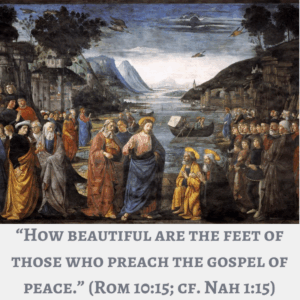
The opposition of Egypt, Nineveh, and apostate Israel could not keep the Lord’s people from exclaiming, “How beautiful are the feet of those who preach the gospel of peace, who bring glad tidings of good things!” The apostles and other messengers sent by God proclaimed that the glorious messianic age would arrive despite all their efforts to prevent it.6
In this way, Nahum spoke about the days of the kingdom’s arrival, the days to which Peter referred when he said, “Yes, and all the prophets, from Samuel and those who follow, as many as have spoken, have also foretold these days” (Acts 3:24).
Nahum was no exception.
Footnotes
- Please consider becoming familiar with the inmillennial view of prophecy. You can read a summary version here or tackle the full book-length version here. The title of the book—Inmillennialism: Redefining the Last Days—hints at the reason for my suggestion. This model says the “last days” are identical to Peter’s “these days”; both terms refer to the “last days” of the Mosaic age. This perspective will shed light on the prophets as we work through them.
- Walter A. Maier, The Book of Nahum: A Commentary, (1900; repr., Minneapolis, MN: James Family, 1977), 36.
- T. G. Pinches, “Nineveh,” in The International Standard Bible Encyclopaedia, ed. James Orr et al. (Chicago: The Howard-Severance Company, 1915) 2148–50.
- Carolyn Hurst, God’s Wrath Destroys Nineveh, https://www.passiontoknowmore.com/post/2018/12/31/gods-wrath-destroys-nineveh#:~:text=What%20makes%20this%20so%20remarkable,survive%20a%2020%2Dyear%20siege.
- John Gill, An Exposition of the Old and New Testaments, 9 vols. (1809–10; repr., Paris, AR: The Baptist Standard Bearer, 1989), 5:175.
- The image in this file is Vocation of the Apostles, a fresco in the Sistine Chapel by Domenico Ghirlandaio, 1481–82. It is in the public domain.

