
Please check out my new podcast, This is the Day with Mike Rogers. You can see it on my blog (here), or at Apple Podcasts, Spotify, Podbean, Amazon Music, and iHeart. I extend many thanks to Collin Brittain for integrating the podcast into the website.

In this series of posts, we’re verifying Peter’s words—all the prophets foretold his generation, its events, and the consequences of those events (Acts 3:24). In roughly chronological order, we have confirmed that Moses, Samuel, Obadiah, Joel, Amos, Jonah, Hosea, Micah, Isaiah, Zephaniah, Nahum, Jeremiah, Habakkuk, Daniel, and Ezekiel did so. Now, let’s look at Haggai. Did he, too, speak about the days in which Peter lived?
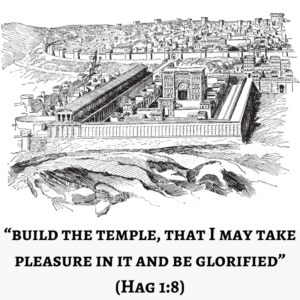
Haggai, along with Zechariah and Malachi, spoke the word of God to Israel after their return from Babylon. The first wave of Jewish exiles had returned in 538 BC. They had not finished the temple almost 20 years later, and were no longer working on it.
Haggai encouraged the people to finish the work. Some of them became discouraged because of the inferiority of the second temple, compared to the first (Hag 2:1-3). Still, God wanted the people to overcome their disappointment and be strong in the work (Hag 2:4). He reminded them He had been and would remain faithful to his covenant promise (Hag 2:5–9).
To show how this last passage related to Peter’s day, I want to divide it into three parts: 1.) the Lord’s past (typical) covenant work; 2.) the Lord’s future (antitypical) covenant work; and His promise that the latter would be greater than the former.
Combined, these statements point to the events Peter had in mind when he said, “All the prophets … foretold these days” (Acts 3:24).
The Typical Work
I need to clarify my perspective in this section. The Lord told the Jews, “According to the word that I covenanted with you when you came out of Egypt, so My Spirit remains among you; do not fear!” (Hag 2:5).
I doubt Haggai would use the word “typical” to describe Israel’s deliverance from Egypt. When I do so, I’m taking Peter’s and the other apostles’ perspective. They understood the Exodus this way. Paul said, “These things [in the Exodus] as types did happen to those persons, and they were written for our admonition” (1 Cor 10:11 YLT; cf. 1 Cor 10:1–10).
This typical Exodus was cosmic in scale. The Psalms looked back to Israel’s founding as a cosmic event, a de-creation:
When Israel went out of Egypt … Judah became His sanctuary.… The sea saw it and fled; Jordan turned back. The mountains skipped like rams, the little hills like lambs. What ails you, O sea, that you fled? O Jordan, that you turned back?” (Psa 114:1–5)
It was also a new creation. Through Isaiah, God said to Israel,
I am the LORD your God, who divided the sea whose waves roared—the LORD of hosts is His name. And I have put My words in your mouth; I have covered you with the shadow of My hand, that I may plant the heavens, lay the foundations of the earth, and say to Zion, “You are My people.” (Isa 51:15–16)
John Gill says “the dividing of the Red sea” here refers to the Exodus.1
The Exodus from Egypt pointed forward to an even greater cosmic event.
The Antitypical Work
To motivate the Jews to resume work on the Second Temple, the Lord turns from a look at the past and points toward the future, to the antitype (or fulfillment) of the type:
Thus says the LORD of hosts: “Once more (it is a little while) I will shake heaven and earth, the sea and dry land; and I will shake all nations.… (Hag 2:6–7a)
Commentators provide at least two options for how to understand this passage. First, the Lord may have meant,
“It is yet only a little while”—lit., one little—i.e., a single brief space—till a series of movements is to begin—viz., the shakings of nations, soon to begin, which are to end in the advent of Messiah, “the Desire of all nations” (Moore).2
My framework of prophecy, inmillennialism,3 insists on taking the Bible’s time statements seriously, so I appreciate this view. Still, I’m inclined to understand these words another way.
The second option is to follow the Septuagint here. An English translation says,
Thus saith the Lord Almighty; Yet once I will shake the heaven, and the earth, and the sea, and the dry land; and I will shake all nations, and the choice portions of all the nations shall come: and I will fill this house with glory, saith the Lord Almighty. (Hag 2:7–8)4
This translation omits the temporal reference of “a little while.”
My main reason for preferring this wording is that it is how the apostles understood this passage. The author of Hebrews quotes it after speaking about what was happening in the “last days” of the Mosaic age (Heb 1:2). The old covenant age was “becoming obsolete and growing old [and] ready to vanish away” (Heb 8:13). Christ would come in “a little while” to complete the transition to the new covenant age (Heb 10:37). In this context, the writer quotes our passage in Haggai:
See that you do not refuse Him who speaks. For if they did not escape who refused Him who spoke on earth, much more shall we not escape if we turn away from Him who speaks from heaven, whose voice then shook the earth; but now He has promised, saying, “Yet once more I shake not only the earth, but also heaven.” Now this, “Yet once more,” indicates the removal of those things that are being shaken, as of things that are made, that the things which cannot be shaken may remain. (Heb 12:25–27)
The fulfillment of this prophecy would happen in the apostles’ near future; it had not happened in Haggai’s immediate future. The prophet was speaking of Peter’s day.
The Surpassing Glory of the Antitype
Some of the older Jews wept when they saw the foundation of the new temple. They knew it would not be as magnificent as the one Solomon had built (Hag 2:3). Still, the Lord said to them,
“They [i.e., all nations] shall come to the Desire of All Nations, and I will fill this temple with glory,” says the LORD of hosts. “The silver is Mine, and the gold is Mine,” says the LORD of hosts. “The glory of this latter temple shall be greater than the former,” says the LORD of hosts. “And in this place I will give peace,” says the LORD of hosts. (Hag 2:7b–9)
The glory of the rebuilt temple would surpass that of Solomon’s because in it the nations would begin to come to Christ. Haggai uses a beautiful name for our Savior—“The Desire of All Nations.” (I’m sure Charles Wesley was thinking of it when he wrote the third verse of Hark, the Herald Angels Sing.)
Peter himself took this perspective. He wrote to his contemporaries about this surpassing glory:
Of this salvation the prophets have inquired and searched carefully, who prophesied of the grace that would come to you, searching what, or what manner of time, the Spirit of Christ who was in them was indicating when He testified beforehand the sufferings of Christ and the glories that would follow. (1 Pet 1:10–11)
Haggai’s glory was a reality in Peter’s day!
Conclusion
I’m glad the Jews finished rebuilding the temple in Haggai’s day. It was still standing when Joseph and Mary brought Jesus to have him circumcised. What a glorious sight! The Maker of Heaven and Earth was entering His sufferings, but praise God, that’s not the end of the story!
Come, Desire of nations, come,
Fix in us Thy humble home;
Rise, the woman’s conqu’ring Seed,
Bruise in us the serpent’s head.
Now display Thy saving power,
Ruined nature now restore;
Now in mystic union join
Thine to ours, and ours to Thine.
Hark! the herald angels sing,
“Glory to the newborn King!”
Footnotes
- John Gill, An Exposition of the Old and New Testaments 9 vols. (1809–10; repr., Paris, AR: The Baptist Standard Bearer, 1989), 5:302.
- A. R. Fausset, A Commentary, Critical, Experimental, and Practical, on the Old and New Testaments: Jeremiah–Malachi (London; Glasgow: William Collins, Sons, & Company, Limited, n.d.), 655.
- Please consider becoming familiar with the inmillennial view of prophecy. You can read a summary version here or tackle the full book-length version here. The title of the book—Inmillennialism: Redefining the Last Days—hints at the reason for my suggestion. This model says the “last days” are identical to Peter’s “these days”; both terms refer to the “last days” of the Mosaic age. This perspective will shed light on the prophets as we work through them.
- The LXX’s versification differs from the English translations.
