
Announcement
Please check out my new podcast, This is the Day with Mike Rogers. You can see it on my blog (here), or at Apple Podcasts, Spotify, Podbean, Amazon Music, and iHeart. Many thanks to Collin Brittain for integrating the podcast into the website.

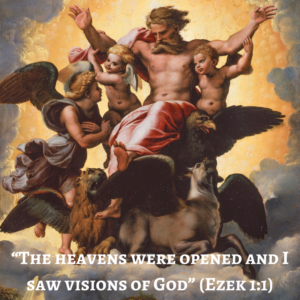
In this series of posts, we’re verifying Peter’s words—all the prophets foretold his generation, its events, and the consequences of those events (Acts 3:24). In roughly chronological order, we have confirmed that Moses, Samuel, Obadiah, Joel, Amos, Jonah, Hosea, Micah, Isaiah, Zephaniah, Nahum, Jeremiah, Habakkuk, and Daniel did so. Now, let’s look at Ezekiel. Did he too speak about the days in which Peter lived?1
We might regard Ezekiel as the “audio-visual aids prophet” because of his graphic imagery. He was born in the eighteenth year of King Josiah’s reign, the year the king began his reforms (ca. 621 BC). The prophet’s name means “God strengthens” or “God is strong.” His ministry comprises two phases: in Judah from age 30 to the fall of Jerusalem in 586 BC, and afterwards in Babylon ministering to the Jews in captivity.
In interpreting this book, we should consider observations like the following:
While Ezekiel has been neglected by the church at large, it has come to be the happy hunting ground of cultists, critics and curiosity mongers. The modern negative critics regard Ezekiel as pivotal in their topsy-turvy reconstruction of Old Testament history which views the tripartite priesthood as a scribal concoction from Babylon rather than a divine revelation from Sinai. Ezekiel is cited by self-styled “students of prophecy” as proof that God’s plan for the future includes the modern Zionist movement (Jews returning to Palestine in unbelief), an imminent Russian invasion of Israel, and the reinstitution of the Old Testament animal sacrificial system in a Temple shortly to be constructed in Jerusalem. Science fiction buffs have scoured this book in search of spaceships and extra-terrestrial beings who pawned themselves off as God. Mormons regard Ezekiel 37:15–23 as the prophetic allusion to the Book of Mormon (stick of Ephraim) being joined to the Bible (stick of Judah).2
Still, these sensational misuses of this prophecy should not rob us of seeing the clear lessons God has for us here.
Perhaps the Apostle Peter was thinking of passages like the following when he spoke the words in Acts 3:24.
The New Heart
Ezekiel said that in his future, God would do a marvelous work. The Lord said,
Then I will give them one heart, and I will put a new spirit within them, and take the stony heart out of their flesh, and give them a heart of flesh, that they may walk in My statutes and keep My judgments and do them; and they shall be My people, and I will be their God. (Ezek 11:19–20; cf. Ezek 36:26–27)
Much of Ezekiel’s message deals with God’s promise to regather Israel from Babylon, and this section (Ezek 11:14–24) is no exception. However, through the use of protensive language, the prophet moves from “I will gather you from the peoples” (i.e., Babylon; Ezek 11:17) to “I will give them one heart” (Ezek 11:19).
The New Testament shows that this promise of heart-work belongs to the messianic age that God was establishing in Peter’s generation. The Apostle Paul describes it:
The word is near you, in your mouth and in your heart (that is, the word of faith which we preach): that if you confess with your mouth the Lord Jesus and believe in your heart that God has raised Him from the dead, you will be saved. For with the heart one believes unto righteousness. (Rom 10:8–10)
Peter and the other apostles witnessed God giving His people a new heart as they preached the gospel of the kingdom (cf. Acts 16:15).
The Land
There is another hint in this passage that Ezekiel was speaking of the Apostles’ day. Through Ezekiel, God said he would regather Israel from Babylon to the land he had promised to Abraham. He said, “Thus says the Lord GOD … ‘I will give you the land of Israel’” (Ezek 11:17).
The New Testament shows that this physical land was a picture (or type) of the true inheritance of God’s people. The Old Testament saints in the Hall of Faith “[desired] a better, that is, a heavenly country. Therefore God is not ashamed to be called their God, for He has prepared a city for them” (Heb 11:16).
God revealed the “inheritance incorruptible and undefiled and that does not fade away, reserved in heaven” to Peter and the men of his generation (1 Pet 1:4).
The Good Shepherd
Ezekiel said that God would one day do the work of a shepherd. He would have one fold:
Thus says the Lord GOD: “Indeed I Myself will search for My sheep and seek them out.… I will establish one shepherd over them, and he shall feed them—My servant David. He shall feed them and be their shepherd. (Ezek 34:11, 23)
Jesus declared Himself to be that Shepherd:
I am the good shepherd. The good shepherd gives His life for the sheep.… And other sheep I have which are not of this fold; them also I must bring, and they will hear My voice; and there will be one flock and one shepherd. (John 10:11, 16)
In this way, Ezekiel spoke of Peter’s days.
The First Resurrection
At the risk of getting into controversial territory, I’ll mention Ezekiel’s vision of the valley of dry bones (Ezek 37:1–28). Ezekiel wrote the following: “Thus says the Lord GOD to these bones: ‘Surely I will cause breath to enter into you, and you shall live’” (Ezek 37:5). This statement pertains to the “whole house of Israel” (Ezek 37:11).
Using the inmillennial prophetic model,3 I understand this passage to be about Israel as defined in the New Testament. Under the New Covenant, Paul says,
He is not a Jew who is one outwardly, nor is circumcision that which is outward in the flesh; but he is a Jew who is one inwardly; and circumcision is that of the heart, in the Spirit, not in the letter; whose praise is not from men but from God. (Rom 2:28–29)
Paul says God has resurrected Israel, thus defined:
God, who is rich in mercy, because of His great love with which He loved us, even when we were dead in trespasses, made us alive together with Christ (by grace you have been saved), and raised us up together, and made us sit together in the heavenly places in Christ Jesus.… (Eph 2:4–6)
The Apostle John speaks of two resurrections: the first is the saints’ resurrection with Christ, and the second is the resurrection of our mortal bodies at the end of history (cf. John 5:21–29; Rev 20:5–6).
The first resurrection occurred in Peter’s day.
The New House of God
In the vision of dry bones, God told Ezekiel about the temple in which resurrected Israel would worship:
Moreover I will make a covenant of peace with them, and it shall be an everlasting covenant with them; I will establish them and multiply them, and I will set My sanctuary in their midst forevermore. My tabernacle also shall be with them; indeed I will be their God, and they shall be My people. (Ezek 37:26–27)
The apostles said God had established that temple in their generation. Paul said to the Corinthians, “And what agreement has the temple of God with idols? For you are the temple of the living God. As God has said: ‘I will dwell in them and walk among them. I will be their God, and they shall be My people’” (2 Cor 6:16).
Peter agreed, saying to Christians, “You also, as living stones, are being built up a spiritual house, a holy priesthood, to offer up spiritual sacrifices acceptable to God through Jesus Christ” (1 Pet 2:5).
Conclusion
Once again, Peter was right; Ezekiel joined the other Old Testament writers in speaking of essential events in the apostles’ generation.
Footnotes
- The image in this post is Ezekiel’s Vision by Raphael (1483–1520). This file (here) is in the public domain (PD-US).
- James E. Smith, The Major Prophets, Old Testament Survey Series (Joplin, MO: College Press, 1992), 353–54.
- Please consider becoming familiar with the inmillennial view of prophecy. You can read a summary version here or tackle the full book-length version here. The title of the book—Inmillennialism: Redefining the Last Days—hints at the reason for my suggestion. This model says the “last days” are identical to Peter’s “these days”; both terms refer to the “last days” of the Mosaic age. This perspective will shed light on the prophets as we work through them.


1 comment
Thank you for these thoughts, brother. I always appreciate your analyses.
I would push back just a bit on your understanding of “heart-work” being something exclusive to the messianic age. What you see as heart work in that age, I see as accomplished after the exile (which does not preclude it from being something of a precursor to a greater work in the messianic age).
You said, “The New Testament shows that this promise of heart-work belongs to the messianic age that God was establishing in Peter’s generation. The Apostle Paul describes it:…” and you go on to quote Romans 10:8-10.
I agree that the Messianic age brought an increase of the Spirit’s work on the heart. However, I’m not sure the passages in Romans or Ezekiel refer to a heart-work that is exclusive to the messianic age. I think the messianic age did have unique promises of heart-work, but those were particularly described in Jeremiah 31 and reiterated in Hebrews.
In Romans 10, Paul quoted Deuteronomy 30:14, which said that even then at the time of Deuteronomy, the word was “in your heart.”
The context of Ezekiel 11 and 36 seems to put that heart-work in the time right after the exile. It was future to Ezekiel, but it happened after they returned to their land, well before the messianic age.
Ezekiel 11 mentions several things, but describes one general time period in which they would happen. V.17 is their return to the land, v.18 is the removal of idolatry, and v.19 is their renewal as the people of Yahweh, so that, v.20, they could be His people, obeying Him, etc.
We know that by the time of Christ, idolatry was no longer a problem (at least, not the kind of idolatry in Ezekiel). Since the idolatry had been removed as predicted, we should conclude that the heart-work had taken place as well.
Ezekiel 36 is similar. The context describes their exile and their return. Vv.16-21 describe the reason for the exile, while vv.22-38 describe what would happen after the exile. As is typical for the prophets, hyperbolic language is used. Because of the hyperbole, many understandably associate the blessings with the time of the Messiah. It’s hard to see how returning from the exile and God blessing the land again could be described as, “This land that was desolate has become like the garden of Eden, and the waste and desolate and ruined cities are now fortified and inhabited.” (v.35) However, if vv.22-38 happen in the messianic age, then physical Jerusalem gets destroyed right away, and the waste, desolate, ruined cities aren’t rebuilt; which makes v.36 difficult to explain: “Then the nations that are left all around you shall know that I am the LORD; I have rebuilt the ruined places and replanted that which was desolate. I am the LORD; I have spoken, and I will do it.” If this happens right at the beginning of the messianic age, it’s the desolation of Jerusalem instead of its rebuilding and replanting, etc. Even though it stretches our minds, the rebuilding and replanting hyperbole seems to be better explained by the restoration of the land after the exile. (Although I will admit the possibility of a “spiritual interpretation” of Ezekiel, similar to the rebuilding of the tent of David mentioned in the Acts 15 council.)
I wonder if we conflate the blessings mentioned in Ezekiel to the messianic age. The judgments prophesied by Ezekiel and Jesus certainly sound similar. In Jesus’ day, Israel was again about to be punished, just like in Ezekiel’s day. Because there were looming judgments in both times, we naturally recognize the similarities of judgment. But what about the blessings in each age? Perhaps because they are blessings, and we naturally associate so much blessing with the Messiah, we unintentionally transpose all the blessings to the messianic age only. By doing this, we miss seeing the real blessings after the exile.
I would appreciate your thoughts as you have time.