
In Matthew 24, Jesus sits on the Mount of Olives after foretelling the destruction of the temple. The disciples have asked about the destruction of the temple and “the end of the age” (Matt 24:3). In response, Jesus has given a series of signs—some unsettling, some glorious—all connected to the fall of Jerusalem and the close of the Mosaic age.
His next two signs stand out for their emotional force and theological depth. One is a picture of widespread mourning in the land. The other is a breathtaking image of a trumpet blast and a worldwide gathering of God’s elect. Together, they show both judgment and hope, sorrow and salvation, the end of one covenantal order and the flourishing of another.
Let’s look at each in turn.
The Mourning Tribes
After describing cosmic upheaval—the collapse of Israel’s “universe”—Jesus says:
Then the sign of the Son of Man will appear in heaven, and then all the tribes of the earth will mourn, and they will see the Son of Man coming on the clouds of heaven with power and great glory. (Matt 24:30)
This sign of mourning is not random. It completes a carefully structured set of signs in the Olivet Discourse and pairs with the earlier image of vultures gathering over a corpse (Matt 24:28). Both point to intense suffering in Israel during the “great tribulation” that would precede the temple’s destruction.
But who exactly is mourning?
“The Tribes of the Land”
Some modern translations read “all the tribes of the earth,” which can sound like a global, end-of-the-world lament. But the Greek word gē can mean either “earth” or “land.” Context determines which meaning is correct.
Here, the context strongly favors “land”—specifically, the land of Israel.
Jesus is talking about Jerusalem being surrounded by armies (Luke 21:20) and the temple being destroyed. He is not describing something happening simultaneously in every nation on earth. He is describing what would take place in Judea.
This is where the Old Testament becomes crucial.
Jesus is clearly echoing Zechariah 12:10–14:
The inhabitants of Jerusalem … will look on Me whom they pierced. Yes, they will mourn for Him.… In that day there shall be a great mourning in Jerusalem.… And the land shall mourn … all the families that remain.
Notice the emphasis: Jerusalem. The land. The families of Israel.
As R. T. France observes in his commentary on Matthew, Zechariah identifies the mourners specifically as “the house of David and … the inhabitants of Jerusalem,” even listing families by name. This is tribal, covenantal language. It belongs to Israel.
John Gill makes the same point: other lands were not divided into tribes as Judea was. When Jesus speaks of “all the tribes of the earth [or land],” the natural reference is to Israel’s tribes in their covenant homeland.
So the mourning sign is not about the nations of the world lamenting a distant cosmic catastrophe. It is about Israel grieving in her own land as judgment falls.
Mourning in Zechariah and the Fall of the Temple
Zechariah’s prophecy strengthens this connection.
In Zechariah 11:1, the prophet says, “Open your doors, O Lebanon, / That fire may devour your cedars.” Some Jewish interpreters identified “Lebanon” with the temple, built with cedars from Lebanon. If that association is correct, then Zechariah was foretelling the destruction of the temple itself.
Soon after, Zechariah describes the howling of Israel’s shepherds (Zech 11:3). That image fits the crisis Jesus describes in Matthew 24—the collapse of the leadership and the devastation of the nation.
Even more striking, just forty-eight hours after giving the Olivet Discourse, Jesus quotes another part of Zechariah:
Then Jesus said to them, “All of you will be made to stumble because of Me this night, for it is written: ‘I will strike the Shepherd, And the sheep of the flock will be scattered.” (Matt 26:31; cf. Zech 13:7).
The same prophetic section that speaks of mourning also speaks of the striking of the Shepherd—Christ himself. Zechariah and Jesus are describing the same covenantal turning point: the end of the Mosaic age.
Sorrow and Repentance
The mourning in Zechariah is complex. At times, it looks like deep repentance—grief over having pierced the Lord’s Anointed. At other times, it looks like bitter anguish over devastating loss.
Both realities were present in Jesus’ generation.
Some in Israel repented and turned to Christ. Others hardened their hearts and experienced only the anguish of judgment. When Jerusalem fell, and the temple burned, sorrow filled the land—just as Jesus said it would.
The tribes of Israel mourned in their land during the “great tribulation” that led to the temple’s destruction. That is the sign.
The Angelic Gathering
But the signs in the Olivet Discourse do not end in mourning.
Immediately after describing judgment, Jesus gives a breathtaking promise:
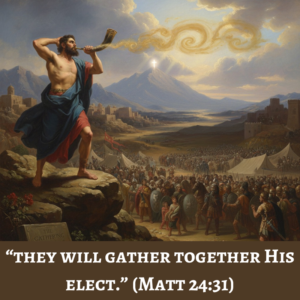
And He will send His angels with a great sound of a trumpet, and they will gather together His elect from the four winds, from one end of heaven to the other. (Matt 24:31)
If the mourning sign shows the pain of the Mosaic age ending, the gathering sign reveals the glory of the messianic age continuing.
Instead of vultures and falling stars, we now see angels and a trumpet. Instead of lament, we see ingathering.
Who Are the “Angels”?
The Greek word angelos simply means “messenger.” It does not always refer to heavenly beings. In both biblical and Greek literature, an “angel” can be a human envoy.
Sam Storms argues that this passage describes Christ’s ingathering of his people into the Church throughout the present age, following the judgment that fell on national Israel in A.D. 70. George L. Murray likewise saw these “angels” as Christ’s ministers—his commissioned messengers—sent out with the gospel.
This interpretation is not forced. It fits the broader biblical pattern.
Paul told the Galatians they received him “as an angel of God” (Gal 4:14). Gospel ministers, as Christ’s sent ones, function as messengers who gather the elect through preaching.
The trumpet imagery supports this. In the Old Testament, trumpets summoned assemblies, announced festivals, and proclaimed the year of Jubilee (Num 10:1–10). The gospel is that kind of trumpet—calling people to freedom, rest, and inheritance in Christ.
As John Gill explains, the “great sound of a trumpet” is a figurative description of the gospel proclamation. Through that proclamation, accompanied by the Spirit’s power, Christ gathers his elect from every direction under heaven.
A Theme Rooted in the Old Testament
This gathering is not a new idea introduced in Matthew 24. It is a dominant theme across the Law, the Writings, and the Prophets.
Gathering in the Law. In Genesis 49:10, Jacob prophesied:
The sceptre shall not depart from Judah… until Shiloh come; and unto him shall the gathering of the people be. (KJV)
The Messiah would be a gatherer.
Later, in Numbers 10, silver trumpets summoned Israel to assemble. The imagery of trumpet and gathering was already embedded in Israel’s story.
By the time Jesus speaks in Matthew 24, Israel is in her “last days”—the end of the Mosaic age. It is entirely fitting that He would announce a climactic gathering to Himself.
Gathering in the Writings. Psalm 50 portrays the Lord coming in judgment:
Our God shall come, and shall not keep silent; / A fire shall devour before Him, / And it shall be very tempestuous all around Him. (Psa 50:3)
Then, after the judgment, comes a command:
Gather My saints together to Me. (Psa 50:5)
John Gill connects this directly to Matthew 24:31: after judging the Mosaic-age people, the Messiah gathers his saints through the ministry of the gospel.
Gathering in the Prophets. The prophet Isaiah is especially rich in gathering promises.
He speaks of a great trumpet being blown and individuals being gathered “one by one” (Isa 27:12). But, again, this comes after a judgment, after withered branches are broken off (Isa 27:11).
Isaiah 40 depicts the glory of the Lord revealed, and then says:
He will feed His flock like a shepherd; He will gather the lambs with His arm. (Isa 40:11)
Isaiah 43 promises protection through judgment, followed by gathering “from the east… from the west” (Isa 43:5).
Over and over, the pattern is the same:
- Judgment on unfaithful Israel.
- Preservation of the faithful remnant.
- A global gathering in the messianic age.
The prophet Jeremiah also echoes this theme. In Jeremiah 31, the Lord who scattered Israel promises to gather them “as a shepherd does his flock” (Jer 31:10). This promise is embedded in the prophecy of the new covenant (Jer 31:31–34), later cited in Hebrews 8.
The disciples knew these texts. They had heard John the Baptist speak of wheat gathered into the barn and chaff burned with unquenchable fire (Luke 3:16–17). They had heard Jesus say, “He who does not gather with Me scatters.” (Luke 11:23). They had heard him promise to bring “other sheep” into one fold (John 10:16).
Even the High Priest, Caiaphas, unwittingly prophesied that Jesus would die not for that nation only, “but also that He would gather together in one the children of God who were scattered abroad” (John 11:52).
The gathering was not an afterthought. It was central to Jesus’ mission.
Judgment and Continuity
Many interpreters assume Matthew 24:31 refers to a future, point-in-time event—either the rapture or the final resurrection. But nothing in the text requires us to separate the gathering from the temple’s fall.
In fact, everything about the context ties it to that moment.
Jesus is answering questions about the temple and the end of the age. He moves from tribulation, to cosmic collapse, to mourning in the land, and finally to gathering. The sequence is coherent and covenantal.
When the temple fell, the Mosaic age formally ended. The old order passed away. But the messianic age did not end—it advanced.
Freed from the structures of Judaism, the gospel went forth more powerfully among the nations. Christ’s messengers went out “from one end of heaven to the other,” gathering the elect through the proclamation of the good news.
The mourning tribes marked the end of the old covenant order. The trumpet-gathering marked the flourishing of the new.
Conclusion
Taken together, these two signs—mourning and gathering—capture the heart of the Olivet Discourse.
There is real judgment. Real sorrow. Real historical devastation in the land of Israel.
But there is also real hope. Real ingathering. Real expansion of the kingdom.
The same Lord who said, “Your house is left unto you desolate” (Matt 23:38) also promised to gather his elect from the four winds.
The Mosaic age would end in fire and lamentation.
The messianic age would continue in proclamation and joy.

2 comments
This is marvellous Mike.
Thank you, Ian!