
In this series, The Great Commission and Biblical Prophecy, we’re considering Jesus’ prophecy about the temple’s destruction (Matt 24:1–2), the disciples’ questions regarding the timing and the signs related to it (Matt 24:3), and Jesus’ response to their questions. We’re in the section where the Lord gives the signs (Matt 24:4–31).
The last post in this series went up over a year and a half ago! So I want to list the signs covered so far. First, Jesus gave some preliminary signs (Matt 24:4–14). The first group would affect people in general: the presence of religious deceivers, social unrest, and physical disturbances. Jesus described these as “the beginning of the birth pains” (Matt 24:8 ESV). The next group of preliminary signs was specific and related directly to the early Christians: widespread persecution, a great apostasy, and the preaching of the gospel as a witness to the nations.
The second group of signs (Matt 24:15–26) would come later, much closer to the temple’s demise. They would include events the Lord called the “great tribulation,” including the abomination of desolation, the days of vengeance, and the deliverance of the elect from destruction.
Jesus linked the last group of signs directly to God’s destruction of the temple (Matt 24:27–31). In my last two posts in this series (here and here), I dealt with His first sign: “As the lightning comes from the east and flashes to the west, so also will the coming of the Son of Man be” (Matt 24:27).
Now, I want to consider His next sign.
Vultures
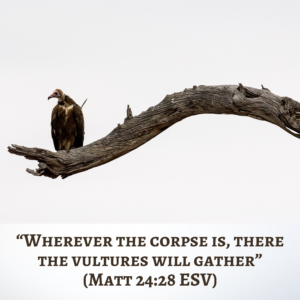
Now, Jesus says, “Wherever the corpse is, there the vultures will gather” (Matt 24:28 ESV).
When Jesus talks about vultures gathering around a corpse in Matthew 24, He’s not being poetic just for the sake of imagery. He’s describing something horrific, concrete, and deeply rooted in the prophetic language of Scripture. In this passage, Jesus reveals the traumatic results of the events surrounding the fall of the temple. When this would happen, all the tribes of the earth (or land) would mourn (Matt 24:30b).
The “lightning” of His judgment against the temple would produce many literal corpses—so many that real vultures would be drawn to feast on them. The dead bodies in Israel, especially in Jerusalem, would provide carrion enough for their gathering. This is not a metaphor detached from reality; it is prophetic imagery grounded in physical devastation.
This picture of birds consuming the flesh of the dead wasn’t new. It was an old prophetic symbol of divine judgment against Israel. Ahijah used it when announcing God’s judgment on Jeroboam’s house: “The dogs shall eat whoever belongs to Jeroboam and dies in the city, and the birds of the air shall eat whoever dies in the field” (1 Kgs 14:11). Hosea spoke of a vulture over the house of the Lord because Israel had broken God’s covenant (Hos 8:1). Jeremiah described Jerusalem’s judgment in similar terms when Babylon would burn the city and leave the dead bodies for the birds and beasts (Jer 34:2, 20). Over and over, the prophets used this image to describe what happens when God hands His people over to invading armies.
Jesus had used this vulture imagery before. In Luke 17, when He said the kingdom of God would not come with observation, He also described a time of sudden judgment: people going about normal life, some taken, some left. When the disciples asked, “Where, Lord?” He answered, “Where the corpse is, there the vultures will gather” (Luke 17:37 ESV).
The elect Jews (i.e., Christians) would escape the destruction by obeying Jesus’ command to flee when Roman armies surrounded Jerusalem (Luke 21:20–21). They would be left to serve God in the messianic age after the Temple fell. Those who ignored Jesus’ warning would be taken to destruction and become vulture food.
This vulture image has a massive kernel of physical reality. “Meat unto the fowls of the heaven” was the prophetic shorthand for a city or nation utterly devastated under God’s judgment. In the Olivet Discourse, Jesus is using this sign to say plainly that God would give Israel over to destruction, so many dead that vultures would feast on them in abundance.
Josephus, an eyewitness to the Roman devastation, confirms just how literal this was. He describes the Temple Mount as a place where the quantity of blood was larger than the fire and corpses covered the ground so completely that soldiers had to walk over heaps of bodies to chase those who were fleeing.
That account makes Jesus’ vulture-sign chillingly appropriate. He wasn’t inventing a dramatic metaphor. He was drawing on an ancient prophetic image to describe the very real and very catastrophic fall of the temple.
Conclusion (and Quiz)
The signs Jesus listed to this point have a tangible feel to them. Most people can relate to religious charlatans, revolutions, and earthquakes. However, the same is not true for what comes next—cosmic collapse! I want to consider that sign in its own post, or set of posts.
In the meantime, how about a little quiz? How many of the following questions can you answer? Scroll down to see the answers below. (No fair peeking!)
Questions:
1. What preliminary signs did Jesus give in Matthew 24:4–14?
2. What is the second group of signs in Matthew 24:15–26?
3. What is the last group of signs in Matthew 24:27–31 linked to?
4. What does Jesus mean by “Wherever the corpse is, there the vultures will gather” (Matt 24:28)?
5. How does the vulture imagery relate to Old Testament prophetic language?
6. Where else did Jesus use this vulture imagery?
7. Who are described as “the elect” in this passage?
8. What would happen to those who ignored Jesus’ warning?
9. What does the phrase “meat unto the fowls of the heaven” signify in prophetic language?
10. How does Josephus confirm the literal fulfillment of Jesus’ prophecy?
Answers:
1. Religious deceivers, social unrest, and physical disturbances, which Jesus called “the beginning of the birth pains,” along with persecution of Christians, apostasy, and the preaching of the gospel to the nations.
2. Events close to the temple’s destruction, including the abomination of desolation, the days of vengeance, and the deliverance of the elect from destruction.
3. They are directly connected to God’s destruction of the temple.
4. Jesus is describing literal devastation and mass death resulting from God’s judgment on Jerusalem, not merely symbolic or poetic imagery.
5. The prophets used birds consuming corpses as a symbol of divine judgment, such as in 1 Kings 14:11, Hosea 8:1, and Jeremiah 34.
6. In Luke 17:37, where He spoke of sudden judgment and explained that vultures gather where there is a corpse.
7. The elect Jews, early Christians, who would escape destruction by fleeing Jerusalem when surrounded by Roman armies.
8. They would be taken to destruction and become food for vultures, symbolizing their judgment.
9. It is shorthand for total devastation of a city or nation under God’s judgment.
10. He described massive bloodshed and bodies covering the Temple Mount, so numerous that soldiers had to walk over heaps of corpses.
