
There is something undeniably beautiful about the structure of the Olivet Discourse in Matthew 24–25. It is not a random collection of apocalyptic sayings or disconnected warnings. It has unity. It has symmetry. It has flow. Jesus answers the disciples’ questions in an orderly, deliberate way.
He begins with a startling prediction: the temple will fall (Matt 24:1–2). The disciples respond with two questions: When will these things be? And what will be the sign of their fulfillment? Jesus answers the sign question first (Matt 24:4–31), building to a dramatic crescendo. Then he turns and answers the when question (Matt 24:32–36). Finally, he closes with a series of exhortations: observe, watch, be ready (Matt 24:37–25:46).
We are now standing at that pivotal moment in the discourse, where Jesus answers the disciples’ question about time.
After describing wars, tribulation, false prophets, cosmic imagery, and the coming of the Son of Man, Jesus does something unexpected. He slows down. He tells a simple parable.
A Fig Tree and a Time Frame
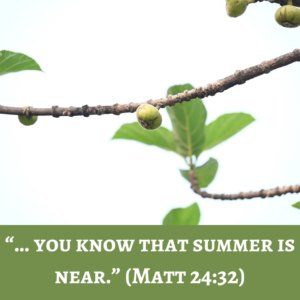
“Now learn this parable from the fig tree,” he says (Matt 24:32–33). When a fig tree’s branch becomes tender and puts out leaves, you know summer is near. In the same way, when you see all these things, know that it is near—right at the doors.
Notice the phrase “all these things.” It reaches back over everything Jesus has just said—the signs, the tribulation, the desolation, the coming. The parable links the time question directly to the signs already given.
The lesson is straightforward. Just as the budding of a tree signals the approach of summer, the progression of signs would signal the nearness of the temple’s fall. Some signs would not mean the end was immediate. Some would be the beginning of birth pains. But as they intensified, the disciples would know the end of the Mosaic age was approaching.
And Jesus makes this personal: “When you see all these things…” (Matt 24:33). The lesson was for them. He had addressed them from the beginning. He warned them against deception (Matt 24:4). He told them they would hear of wars (Matt 24:6). They would suffer affliction (Matt 24:9). The Olivet Discourse is not abstract theology about a distant era. It is instruction for first-century disciples facing a coming crisis.
Parables typically press one main point. This one emphasizes nearness. The fulfillment would not unfold in a remote age thousands of years away. It would happen in their lifetime. They would see the leaves. They would recognize the season. They would know it was “at the doors.”
Any prophetic model that ignores that emphasis misses the tone Jesus himself sets.
“This Generation”
Jesus now leaves parable and speaks plainly:
“Assuredly, I say to you, this generation will by no means pass away till all these things take place.” (Matt 24:34)
The question had been simple: “Tell us, when will these things be?” (Matt 24:3). The answer is equally simple: within this generation.
The Greek word genea ordinarily means a generation of contemporaries—people living at the same time. Scholars across theological lines acknowledge this. It is the natural meaning in the Synoptic Gospels. It is the meaning that fits here. As D. A. Carson observes, it can only with the greatest difficulty be made to mean anything else.
And this statement fits with something Jesus had said earlier in his ministry: “There are some standing here who shall not taste death till they see the Son of Man coming in His kingdom” (Matt 16:28). The timeline is consistent. Some of his hearers would live to see the fulfillment.
Then Jesus adds a solemn affirmation: “Heaven and earth will pass away, but My words will by no means pass away” (Matt 24:35). In other words, this timestamp is not tentative. It is certain.
This certainty sustained the apostles in their mission. They preached that “the end of all things is at hand” and that judgment would begin at the house of God (1 Pet 4:7, 17). They spoke of scoffers who mocked the promise of his coming (2 Pet 3:4). But they were not shaken. They had his word.
History confirms what Jesus foretold. In AD 70, roughly forty years after this discourse, the Roman armies destroyed Jerusalem and the temple. As recorded by Flavius Josephus and other historians, the city endured a terrible tribulation. False prophets deceived the people. Abominations preceded desolation. A remnant fled. The temple stones were torn down, just as Jesus said (Matt 24:2).
Nothing he predicted failed to occur.
If we take his words at face value, the timeline is not mysterious. “All these things” happened in that generation.
Known Limits, Unknown Day
But Jesus does not stop there. He adds another statement:
“But of that day and hour no one knows, not even the angels of heaven, but My Father only.” (Matt 24:36).
Here we see a progression. First, he gives a broad timeframe—this generation. Then he narrows the focus, saying the exact day and hour are unknown.
As a man, Jesus did not know the precise moment of the temple’s fall. The disciples would live within the known timeframe, but they would not have a calendar date circled in red.
That combination—certainty about the generation, uncertainty about the exact moment—created urgency.
Their situation resembled that of Noah. Noah knew judgment was coming in his lifetime. He did not know the precise day the rain would begin. So he built the ark in faith. Meanwhile, others scoffed.
The apostles ministered with the same tension. They said, “the time is short” (1 Cor 7:29). They spoke of “the ends of the ages” having come (1 Cor 10:11). They urged believers to encourage one another as they saw “the day” approaching (Heb 10:25). John wrote, “It is the last hour” (1 John 2:18). Paul declared, “The night is far spent; the day is at hand” (Rom 13:12).
Interestingly, they did not speak of another generation. They knew theirs was the generation in view. What they did not know was the exact day and hour.
The signs Jesus gave—especially the rise of false christs—would indicate that the moment was near. But the precise timing remained in the Father’s authority.
This twofold answer—certainty about the generation, uncertainty about the day—perfectly addresses the disciples’ question.
Little Foxes in the Vineyard
But here we encounter a problem—not in Jesus’ words, but in the assumptions many bring to them.
The Song of Solomon warns about “the little foxes that spoil the vines” (Song 2:15). In prophetic interpretation, there are foxes that slip in quietly—assumptions that reshape the text before we realize it.
Several of these assumptions dominate modern discussions of the Olivet Discourse:
- That Christ’s “coming” (erchomai) and “presence” (parousia) are identical and refer exclusively to a visible, end-of-world event in our future.
- That the coming must be visible to the natural eye.
- That “the end of the age” means the end of the church age.
- That cosmic-collapse imagery refers to the literal destruction of the physical universe.
If these assumptions are treated as unquestionable, then Jesus’ words create a crisis. The cosmos did not literally collapse in the first century. The physical world did not end. Therefore, many conclude, “this generation” cannot mean what it seems to mean.
At that point, interpreters begin searching for alternative explanations.
Some argue that “generation” means “race.” Jesus, they say, was promising the Jewish race would not disappear. But this ignores the normal meaning of genea in the Gospels and fails to answer the disciples’ timing question.
Others say “this generation” refers to a future generation alive at the end of the church age. In this view, Jesus silently shifts topics without warning and begins discussing events thousands of years removed from the disciples’ question. But that reading requires us to believe he ignored their question about the temple’s fall.
Still others appeal to “double fulfillment”—the idea that prophecy commonly has two or more fulfillments. Yet this interpretive tool is often undefined and inconsistently applied. Which parts have double fulfillment? How many fulfillments? By what rule? As Milton Terry argued, the theory of a double sense unsettles sound interpretation.
Finally, some adopt a slice-and-dice method—dividing the chapter into two subjects, often at verse 36. Before that verse: Jerusalem. After that verse: the end of the world. But parallel passages such as Luke 17 complicate that neat division.
Behind these efforts lies a desire to protect Jesus from the charge of error. And that desire is understandable. History records that thinkers like Bertrand Russell rejected Christianity partly because they believed Jesus predicted the end of the world within his generation and was mistaken.
Yet the problem does not lie in Jesus’ words. It lies in the assumptions brought to them.
A Better Perspective
When we understand that Jesus was speaking about the end of the Mosaic age—not the end of the physical world—the tension dissolves.
In this framework:
- The coming (erchomai) of Christ was a point-in-time event within the lifetime of some disciples.
- The parousia signifies his royal presence with his churches in the messianic age.
- The coming of the Son of Man was not visible to natural eyes; it was discerned through the judgment God executed on Jerusalem (cf. Matt 26:64; Luke 17:20).
- “The end of the age” refers to the end of the Mosaic age, symbolized by the temple.
- Cosmic-collapse language reflects prophetic imagery long used to describe divine judgment on nations.
With these propositions in place, we no longer need to redefine “generation,” invent multiple fulfillments, or fracture the discourse into unrelated parts.
Jesus was not speaking about the last days of the church age. He was speaking about the last days of the Mosaic age.
And when he said, “This generation shall not pass, till all these things be fulfilled,” he meant exactly what it sounds like.
A Sobering Lesson
There is a sobering parallel in the prophecy of Ezekiel. Five hundred years before Jesus, God warned of a coming judgment on the temple in Ezekiel’s own generation (Ezek 12:23–27). False prophets dismissed the warning. They said the vision concerned “times far off.” God pronounced woe upon them for contradicting his timestamp (Ezek 13).
The lesson is clear. When God assigns a timeframe to his judgment, we must be cautious about pushing it into the distant future.
Jesus did not specify a day or hour. But he restricted the fulfillment of “all these things” to his generation. And history confirms that within forty years, the temple fell, just as he said.
The Olivet Discourse is not a tangle of failed predictions or theological evasions. It is a unified, beautiful prophecy about the end of an age—the Mosaic age—and the vindication of the Son of Man in judgment.
When we let Jesus’ words stand as they are, the vine bears fruit. The wine is sweet. And the unity of his discourse shines.
He spoke. It came to pass. And not one of his words fell to the ground.

2 comments
Masterful rendering of the Olivet Discourse! Best I ever read.
Thank you, Ian!