
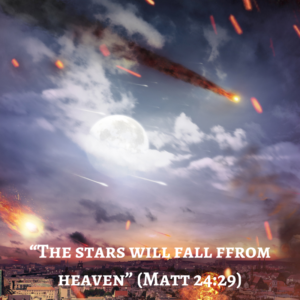
When Jesus predicted the destruction of the temple, he used some of the most dramatic language in the Bible. In Matthew 24:29, he spoke of the sun going dark, the moon refusing to shine, stars falling from the sky, and the powers of the heavens being shaken. To many readers, this sounds like the end of the universe. But is that what Jesus meant?
Short answer: no.
Long answer: Jesus was speaking in the rich, symbolic language of the Old Testament prophets. He wasn’t predicting the end of the physical cosmos; he was describing the end of Israel’s covenantal world—the collapse of the Mosaic age and the continuation of the messianic age.
Let’s unpack that.
The Climactic Sign in Jesus’ Prophecy
In the structure of Jesus’ Olivet Discourse, the cosmic-collapse imagery sits at the center of his list of signs. It’s the climax—the crescendo. Everything has been building toward this moment.
The earlier signs (wars, famines, persecution, lightning, vultures) describe earthly events. But now Jesus moves beyond the earth and describes a universe in meltdown. Why? Because the destruction of the temple wasn’t just another political or military disaster. It was the end of an entire covenantal order. Israel’s world was about to collapse.
But that collapse was theological and historical—not astronomical.
Cosmic Collapse: A Prophetic Way of Speaking
When modern readers see language about stars falling and the heavens shaking, we instinctively think of astrophysics. But the prophets weren’t writing science textbooks. They were poets, preachers, and theologians who used the most powerful imagery to describe God’s judgment in history.
Ezra P. Gould made this point long ago. He noted that cosmic-collapse imagery is standard prophetic language and doesn’t predict literal cosmic events. It’s not about eclipses, meteors, or the destruction of the solar system. It’s a vivid way of saying: God is intervening in history in a decisive, world-shaking way.
David Brown agreed. He noted that the prophets repeatedly used this language in national judgments—Babylon, Edom, Egypt, Israel—and that Jesus was doing the same.
So when Jesus said the sun would be darkened, and the stars would fall, he wasn’t switching topics from the temple to the end of the universe. He was turning up the prophetic volume.
Babylon: When a World Collapsed
Let’s start with Babylon.
Isaiah predicted Babylon’s destruction using cosmic language: “The stars of heaven and their constellations / Will not give their light; / The sun will be darkened in its going forth, / And the moon will not cause its light to shine” (Isa 13:10).
That sounds apocalyptic. But what happened?
In 539 BC, the Medes and Persians conquered Babylon. Babylon’s political, religious, and cultural universe collapsed. But the sun rose the next day. The stars didn’t vanish. The moon kept shining. Two thousand years later, Copernicus still had a functioning solar system to study.
Isaiah wasn’t predicting the end of the cosmos. He was describing the end of Babylon’s world.
Edom: The Heavens Rolled Up Like a Scroll
Isaiah used even more dramatic language about Edom (Idumea): “All the host of heaven shall be dissolved, / And the heavens shall be rolled up like a scroll; / All their host shall fall down / As the leaf falls from the vine, / And as fruit falling from a fig tree” (Isa 34:4).
That’s about as intense as it gets. Yet Edom’s destruction didn’t involve the literal dissolution of the heavens. Edom simply faded from history under God’s judgment. Their world collapsed.
Interestingly, this passage also includes imagery Jesus uses in the Olivet Discourse: God’s sword, the day of vengeance, and cosmic collapse. Isaiah even describes God’s sword appearing in heaven and coming down in judgment—language that parallels Jesus’ imagery of lightning and divine intervention.
The pattern is clear: cosmic collapse language = covenantal and national judgment, not astrophysical catastrophe.
Egypt: Lights Going Out
Ezekiel used similar imagery for Egypt: “When I put out your light, / I will cover the heavens, and make its stars dark; / I will cover the sun with a cloud, / And the moon shall not give her light” (Ezek 32:7).
What happened? Babylon invaded Egypt. Egypt’s power crumbled. Their “lights” went out—politically, militarily, and culturally. But the physical heavens kept working just fine.
Again, cosmic collapse = theological significance, not literal cosmic destruction.
Israel: Darkness at Noon
The prophets even used cosmic imagery for Israel itself.
Amos predicted judgment on the northern kingdom: “‘And it shall come to pass in that day,’ says the Lord God, ‘That I will make the sun go down at noon, / And I will darken the earth in broad daylight’” (Amos 8:9).
When Assyria destroyed Israel in 722 BC, the sun didn’t literally set at noon. But Israel’s world ended. Their covenantal identity, institutions, and national life collapsed.
The prophets consistently used the strongest cosmic metaphors to describe important historical judgments.
Psalm 97: Cosmic Imagery and the Messianic Kingdom
Psalm 97 describes the coming of the Messiah and his kingdom with similar imagery:
- Clouds and darkness surround him
- Fire goes before him
- Lightning enlightens the world
- Hills melt like wax
Nobody thinks the literal hills melted when Jesus came. This is poetic, symbolic language describing the overwhelming power and glory of God’s reign.
The same language shows up in the Olivet Discourse. The same interpretive rules apply.
What Jesus Meant by Cosmic Collapse
So when Jesus says the sun will be darkened, the moon won’t give its light, and the stars will fall, what is he saying?
He is saying: Israel’s world is about to end.
The temple was the center of Israel’s religious, political, and cultural universe. It was the place where heaven and earth met. Destroy the temple, and Israel’s cosmos collapses.
This is why Jesus uses cosmic language. He’s not predicting astrophysical disaster. He’s interpreting historical events theologically.
Apocalyptic Language as Theological Interpretation
N. T. Wright captures this perfectly: “As a literary genre, apocalyptic is a way of investing space-time events with their theological significance.”
In other words, apocalyptic language doesn’t remove events from history. It loads history with meaning. It says, “This isn’t just politics. This is God acting in judgment and redemption.”
When Jerusalem fell in AD 70, Rome didn’t just destroy a city. God judged apostate Israel, ended the Mosaic age, and confirmed the authority of the Messiah.
That’s cosmic significance. So Jesus used cosmic language.
End of the Age, Not End of the Cosmos
A key confusion in eschatology is mixing up “end of the age” with “end of the universe.”
In the Olivet Discourse, the disciples asked about the end of the age—the Mosaic age centered on the temple. Jesus answered their question. He never said the physical universe would end.
In fact, he implies the opposite. He says there will never be a greater tribulation than the one associated with Jerusalem’s fall. That statement only makes sense if history continues afterward.
The New Testament repeatedly speaks of the end of the Mosaic age. It does not clearly speak of the end of the physical cosmos in the way modern futurism assumes.
Cosmic Collapse as Covenant Collapse
Every society has a “world.” It has institutions, beliefs, identity, sacred spaces, and shared meaning. When that collapses, people say things like, “My world ended.”
That’s exactly what happened to Israel.
The temple wasn’t just a building. It was the heart of the Mosaic covenant system. Sacrifices, priesthood, festivals, purity laws—everything revolved around it. When Rome destroyed it, the Mosaic world collapsed.
So Jesus describes it as a cosmic collapse. Israel’s sunset. Their moon went dark. Their stars fell. Their heavens were shaken.
But the physical universe kept going. And something new began.
The Continuation of the Messianic Age
Here’s the irony: cosmic collapse language often accompanies not just judgment, but renewal. When one age ends, another begins.
The Mosaic age ended. The messianic age continued.
Jesus didn’t destroy creation. He inaugurated a kingdom that would fill the Earth. History didn’t stop in AD 70. It entered a new covenantal era.
His apocalyptic imagery didn’t announce the annihilation of creation; it announced the transformation of Israel’s covenantal order.
Why This Matters
This isn’t just an academic debate. It shapes how we read the Bible, understand prophecy, and view history.
If we assume this cosmic imagery predicts literal cosmic destruction, we misunderstand the prophets and Jesus. We turn poetry into physics and theology into astronomy.
But if we read Scripture in its prophetic idiom, we see something richer:
- God judges nations in history.
- God ends covenantal systems.
- God inaugurates new ages.
- God remains sovereign over space and time.
The destruction of Jerusalem was one of the most theologically significant events in history. Jesus used cosmic language because nothing less could capture its meaning.
Conclusion
When Babylon, Edom, and Egypt fell, their world ended. When Israel fell in AD 70, their world ended.
But the physical cosmos remained. History continued. The kingdom advanced.
Cosmic collapse imagery is prophetic shorthand for God’s decisive intervention in history. It is not a forecast of stellar extinction.
So when you read Matthew 24:29, don’t imagine stars crashing into Earth. Imagine a covenantal world collapsing and a messianic world rising.
God had meant for Israel to bless the nations (e.g. Gen 12:2–3; Deut 4:5–8). She had failed. As her world collapsed, He would turn to another nation, the church (Matt 21:42–43), and enable it to “make disciples of all the nations” (Matt 28:19).
