Paul’s teaching in 1 Corinthians 15 does more than defend bodily resurrection. It reveals something crucial about how he understood Christ’s kingdom: he believed Christ’s reign would progressively triumph in history until every enemy was subdued.1
Embedded in Paul’s resurrection argument are two major truths that must shape our prophetic understanding:
- Kingdom Optimism
- Kingdom Gradualism
These ideas are not speculative additions to Scripture. They arise naturally from Paul’s use of Psalm 110:1 and from his understanding of Christ’s present reign.
Kingdom Optimism:
Christ’s Reign Will Succeed
Paul writes:
“He must reign till He has put all enemies under His feet.” (1 Cor 15:25)
This is not a pessimistic vision of history. It is not a picture of Christ merely preserving a remnant while evil spirals out of control until history collapses.
It is the declaration of a conquering King.
Christ reigns for a purpose: to subdue His enemies.
That means history is moving toward victory, not defeat. In history, before the resurrection.
Paul’s kingdom optimism reflects the entire prophetic witness of the Old Testament. The prophets consistently describe the messianic age as a time when:
- The Lord becomes King over all the earth (Zech. 14:9)
- All nations flow to the mountain of the Lord (Isa. 2:2–3)
- The false gods perish (Jer. 10:10–11)
- The Gentiles come from the ends of the earth to worship God (Jer. 16:19)
- The earth is filled with the knowledge of the Lord (Isa. 11:9)
Paul believed those prophecies were being fulfilled through Christ’s present reign.
The Kingdom Advances Gradually
Yet Paul also shows that Christ’s victory unfolds progressively.
Psalm 110:1 does not depict instant conquest. It describes an enthroned Messiah reigning until His enemies are made His footstool.
There is a process.
Hebrews makes this explicit:
“But now we do not yet see all things put under him.” (Heb 2:8)
Christ has been enthroned, but the visible subjugation of all things is still underway.
This is kingdom gradualism.
The kingdom grows over time until it reaches its appointed fullness.
Old Testament Pictures of Gradual Growth
The prophets repeatedly describe the kingdom in developmental terms.
A Growing Government
Isaiah says of the Messiah:
“Of the increase of His government and peace there will be no end.” (Isa 9:7)
Notice carefully: the prophecy does not merely say His government will endure forever. It says His government will increase.
Christ’s rule expands.
A Growing Mountain
Daniel interprets Nebuchadnezzar’s dream by describing God’s kingdom as a stone that becomes a great mountain filling the whole earth (Dan. 2:35).
The kingdom begins small and grows until it dominates the world.
The Nations Learn Submission
Psalm 2 portrays kings being warned to submit to the Son as His judgments unfold in history.
That assumes a progressive conquest. Kings witness His rule advancing and are called to repent.
Jesus Taught the Same Gradualism
Jesus’ kingdom parables mirror this prophetic expectation.
The Mustard Seed
The kingdom begins like the smallest seed but grows into a great tree (Matt. 13:31–32).
Jesus is not describing corruption or abnormality. He is describing triumph through growth.
The Leaven
The kingdom is like leaven hidden in dough until the whole lump is leavened (Matt. 13:33).
Its influence spreads quietly but comprehensively.
The kingdom permeates everything.
The Church’s Role in Kingdom Growth
How does this gradual conquest happen?
Through the mission Christ gave His church.
After His resurrection, Jesus declared:
“All authority has been given to Me in heaven and on earth. Go therefore and make disciples of all the nations.…” (Matt 28:18–19)
Because Christ possesses universal authority, His people are commissioned to disciple the nations.
This is how the kingdom advances.
The Great Commission is not merely about extracting individuals from the world before history collapses. It is about discipling nations so that all peoples serve the reigning Messiah.
Daniel had foretold this very thing:
“All peoples, nations, and languages should serve Him.” (Dan 7:14)
Kingdom Warfare Is Spiritual Warfare
Scripture often describes Christ’s conquest in military language, but the weapons are spiritual.
Paul explains:
“The weapons of our warfare are not carnal.…” (2 Cor 10:4)
Christ conquers through:
- Gospel proclamation
- Spirit-empowered preaching
- The discipling of nations
- The bringing of thoughts captive to Christ
This is not conquest by sword but by truth.
The church participates in Christ’s kingdom warfare through faithful obedience to His commission.
Why This Changes Everything
A pessimistic prophetic outlook produces retreat.
If Christians believe history must inevitably worsen until Christ intervenes catastrophically, they will naturally lower their expectations for what the gospel can accomplish in the world.
But Paul’s framework teaches the opposite.
Christ reigns now. His kingdom is growing now. His enemies are being subdued now. And the church is the appointed instrument through which much of that conquest occurs.
That gives present obedience eternal significance.
Our labor matters because it participates in the expansion of Christ’s kingdom.
Resurrection Is the Final Victory
Paul’s optimism is not naïve. He knows the conquest is incomplete.
The final enemy remains: death.
But because Christ reigns until all enemies are subdued, resurrection is guaranteed.
The bodily resurrection is the climactic moment when the kingdom’s gradual conquest reaches completion.
Everything moves toward that end.
Conclusion
Paul’s argument in 1 Corinthians 15 offers more than a defense of the resurrection. It gives us a vision of history.
Christ is reigning now. His kingdom is advancing now. His enemies are being subdued now. And one day, death itself will fall.
That vision should transform how Christians live.
We do not work merely to survive until the end. We labor to advance the kingdom of the reigning Christ. We preach, disciple, build, and pray with confidence because the King has promised victory.
This is the apostolic vision of the kingdom. It is optimistic. It is gradual. And it ends in resurrection glory.
Footnotes
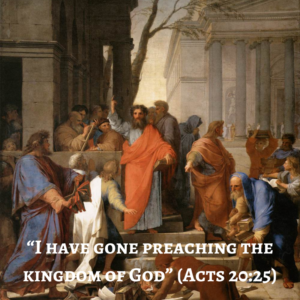
- The image in this post is The Preaching of St Paul at Ephesus by Eustache Le Sueur (1616–1655). This file (here) is in the public domain (PD-US).


2 comments
(Lk 16:16)
The law and the prophets were until John: since that time the kingdom of God is preached, and every man presseth into it.
When do believers enter the Kingdom: at regeneration, conversion, baptism or some other event?
Hi George,
Thank you for your comment! I invite you to explore the following posts to get an idea of my thinking about the kingdom:
1. Israel: God’s Church Kingdom.
2. Meditations in Matthew Sixteen: Church and Kingdom.
3. The Seven Mystic Figures — Part 2: Exodus.
4. False Jews and Their Persecutions.
5. Can God’s Kingdom Grow?
My answer to your question is that a person can only enter the kingdom after regeneration, that is, the new birth.
They are fully or properly in the kingdom when they are members of a faithful local church. That is where God exercises His government over His people in the fullest sense. Anything short of that (after regeneration), I would call being in the kingdom in an improper or incomplete sense.
I hope that helps!
Mike