In 1 Corinthians 15, Paul addresses one of the most serious doctrinal problems in the church at Corinth: some among them were denying the resurrection of the dead. To Paul, this was not a minor theological mistake. It struck at the very heart of the Christian faith.
He responds with remarkable force. If there is no resurrection of the dead, Christ has not been raised. If Christ has not been raised, apostolic preaching is empty, faith is futile, sins remain unforgiven, and Christians are, of all people, the most miserable (1 Cor 15:12–19). For Paul, bodily resurrection is not a secondary doctrine—it is essential to the gospel itself.
Yet Paul’s argument in this chapter is often misunderstood. Many Christians treat 1 Corinthians 15:1–6 as though it were the entirety of Paul’s gospel: Christ died for our sins, was buried, rose again, and appeared to witnesses. These truths are certainly central, but Paul’s full argument in this chapter shows that his gospel was broader than that summary alone. He preached the gospel of the kingdom.
That matters because Paul’s defense of bodily resurrection depends not merely on the fact of Christ’s resurrection, but on the kingdom message that framed his preaching.
The Problem at Corinth: Physical Resurrection
The resurrection Paul defends in 1 Corinthians 15 is not merely spiritual renewal or metaphorical new life. The Corinthians were not denying spiritual resurrection. In fact, their problem seems to have been quite the opposite—they were fascinated with spiritual gifts and supernatural manifestations, even overemphasizing them (1 Cor 12–14).
Paul addresses them as people who had received the Spirit of God (1 Cor 2:12). They understood spiritual transformation. Their error was in denying the future bodily resurrection of believers.
Paul’s argument makes this plain when he calls Christ “the firstfruits” of those who have fallen asleep (1 Cor 15:20). Firstfruits imply a harvest of the same kind. Christ’s resurrection was physical and bodily. Therefore, the resurrection of believers must be bodily as well. As Robert Strimple notes, Paul sees Christ’s resurrection and ours as two stages of the same resurrection event. The firstfruits and harvest must be of the same crop.
Paul is therefore defending a future bodily resurrection.
Paul’s Argument Depends on the Gospel of the Kingdom
What is striking is that Paul does not defend bodily resurrection by introducing some new revelation unrelated to his prior teaching. Instead, he argues that resurrection is required by the gospel he had already preached to them.
That gospel was the gospel of the kingdom of God.
Throughout Acts, Paul’s ministry is repeatedly summarized as preaching the kingdom:
- In Ephesus, he reasoned and persuaded concerning the kingdom of God (Acts 19:8).
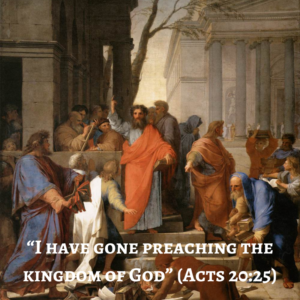
- He later reminded the Ephesian elders that he had gone among them preaching the kingdom of God (Acts 20:25).1
- In Rome, while under house arrest, he expounded and testified concerning the kingdom of God from morning till evening (Acts 28:23).
The apostolic gospel was not merely a message about personal salvation detached from redemptive history. It was the proclamation that the Messiah had been enthroned, that the kingdom had come, and that Christ now reigns.
This kingdom-centered gospel is essential to understanding Paul’s logic in 1 Corinthians 15.
The Kingdom Requires the Defeat of Death
Paul’s reasoning hinges on Psalm 110:1, the most frequently cited Old Testament verse in the New Testament:
“The Lord said to my Lord, ‘Sit at My right hand, Till I make Your enemies Your footstool.’”
Paul applies this directly to Christ’s reign:
“For He must reign till He has put all enemies under His feet. The last enemy that will be destroyed is death.” (1 Cor 15:25–26)
This is the heart of Paul’s argument.
Christ’s resurrection guarantees the resurrection of believers because Christ is reigning as King, and His reign has a defined purpose: the subjugation of all His enemies. Death is one of those enemies. And in fact, it is the final enemy.
Paul’s reasoning is straightforward:
- Christ will defeat all His enemies during His reign.
- Death is one of His enemies.
- Therefore, Christ will defeat death during His reign.
That defeat of death requires bodily resurrection.
Without bodily resurrection, Christ would fail to destroy death fully. And if death remains undefeated, then Psalm 110:1 remains unfulfilled. Paul’s gospel of the kingdom would collapse.
Psalm 110 Matters!
Psalm 110:1 is foundational to apostolic preaching. Christopher Beetham notes that it is quoted or alluded to twenty-three times in the New Testament. C. H. Dodd calls it one of the fundamental texts of apostolic proclamation.
Why?
Because it summarizes the messianic mission:
- Christ is enthroned at the Father’s right hand.
- He reigns during a period in which His enemies are progressively subdued.
- His reign culminates in total victory.
Paul’s resurrection argument depends on this framework. Resurrection is not an isolated promise floating disconnected from the rest of biblical theology. It is the necessary conclusion of Christ’s victorious kingdom reign.
Paul’s Prophetic Framework
Paul’s logic in 1 Corinthians 15 assumes the same prophetic framework Jesus established in the Olivet Discourse.
Throughout 1 Corinthians, Paul writes as one living in the closing days of the Mosaic age:
- He says the present age was passing away (1 Cor 2:6).
- He says the appointed time had grown very short (1 Cor 7:29).
- He says the end of the ages had come upon them (1 Cor 10:11).
He also teaches that the church is now the temple of God (1 Cor 3:16–17), indicating that the old temple order was giving way to the new covenant temple made of living stones.
This matches Jesus’ own teaching that His coming in judgment would end the Mosaic age and establish the visible reality of His kingdom.
Paul therefore sees Christ’s reign as already underway. The kingdom has begun. The Messiah is enthroned. The defeat of His enemies is in progress.
And because death is among those enemies, resurrection must come.
Resurrection in Christ’s Presence
Paul also adds another critical detail: believers are raised “at his coming” (1 Cor 15:23). But the Greek term here is parousia, often translated “coming,” though more literally meaning “presence.”
Within this prophetic framework, Christ’s parousia is not merely a momentary future event but the reality of His royal presence with His people during the messianic age.
The resurrection occurs in His parousia—during the era of His reign and presence with His church.
This fits Paul’s kingdom logic perfectly. Christ reigns in the midst of His people, subduing His enemies until the final victory over death in the resurrection.
A Matter of Importance for the Church Today
Paul’s argument is not abstract theology. It shapes how Christians understand history, mission, and hope.
If Christ is reigning now, and if His reign is directed toward the defeat of all enemies, then Christians live in an age of advancing kingdom victory—not defeat.
The resurrection is not merely a source of personal comfort for grieving believers, though it is certainly that. It is also the climactic proof that Christ’s kingdom will succeed.
Death itself will not survive His reign.
This gives Christians profound confidence.
We do not labor for a losing cause. We do not preach a kingdom destined for failure. We do not await a Messiah who may someday begin to reign.
He reigns now.
And because He reigns now, death’s defeat is certain.
Conclusion
Paul’s defense of bodily resurrection in 1 Corinthians 15 rests on far more than the bare fact that Christ rose from the dead. It rests on the gospel of the kingdom—the proclamation that the risen Christ now reigns until every enemy is subdued beneath His feet.
That is why bodily resurrection is non-negotiable.
If the dead are not raised, then death wins. But if death wins, then Christ has failed. And if Christ has failed, then the gospel is false.
But Christ has not failed.
He is risen. He reigns. And because He must reign until all enemies are subdued, death itself will be destroyed.
That is Paul’s logic. And that is Christian hope.
Footnotes
- The image in this post is The Preaching of St Paul at Ephesus by Eustache Le Sueur (1616–1655). This file (here) is in the public domain (PD-US).

