
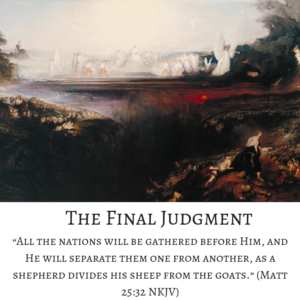
In the previous post, I promised to deal specifically with the final judgment described in Matthew 25:31–46—the well-known “sheep-and-goats” passage. It is one of the most sobering and majestic scenes in all of Scripture: the Son of Man seated in glory, all nations gathered before him, and an eternal division made between the righteous and the wicked.1
For most of church history, Christians have understood this to be the final judgment at the end of history. Yet in the last two centuries, that consensus has been challenged from two very different directions. On one side, some futurists have pushed the judgment forward into a supposed future millennium. On the other, some preterists have pulled it back into the first century, identifying it exclusively with events surrounding the fall of Jerusalem.
Both approaches, however, create serious problems. And more importantly, both fail to do justice to the unity and clarity of Jesus’ teaching in the Olivet Discourse. What we will see is that the inmillennial model preserves both the time statements of Jesus and the church’s historic confession: that there will be a final judgment and a resurrection of the body.
Why This Matters
This is not a minor interpretive detail. The meaning of this passage touches the very heart of the Christian faith.
When I first encountered J. Stuart Russell’s full-preterist interpretation,2 I found it deeply unsettling. He argued that the sheep-and-goats judgment referred only to Israel in the first century, during the events leading up to the destruction of the temple. According to this view, the “everlasting punishment” and “life eternal” of Matthew 25 were assigned in that historical crisis.
The implications are enormous. If that is true, then the final judgment as traditionally understood disappears. And if that disappears, so does the future resurrection of the body—a truth confessed by the church for two thousand years: “I believe in … the resurrection of the body.”
This is why we must look carefully at the passage. The question is not merely academic—it is foundational.
Is This a Parable?
Russell begins by suggesting that the sheep-and-goats judgment is a parable, grouping it with the three parables that precede it. At first glance, that might seem plausible. But on closer inspection, it does not hold.
This passage does not function like a parable. It is not introduced as one, nor does it unfold as one. The only figurative element is the brief comparison to a shepherd separating sheep from goats—and that is simply a single illustration, not the structure of the whole passage.
This matters because of where it appears. In the Olivet Discourse, Jesus alternates between real historical references and parables. He begins with the days of Noah—a real event. Then he gives three parables. Now, at the climax of the discourse, he returns to a straightforward description.
This view of the passage reinforces the symmetry in the exhortations I mentioned in the last post: the first (flood) and last (final judgment) deal with all people while the middle three (servants, virgins, and talents) deal with those in covenant with God. That fact is significant. Just as the flood was a real judgment, so this final scene is not imaginary or symbolic—it is a real, future event.
The “Coming” of the Son of Man
Russell’s second argument centers on the “coming of the Son of Man.” He connects Matthew 25:31 directly to Matthew 24:30 and insists that both must refer to the same first-century event, since Jesus says, “This generation shall not pass.”
Here is where inmillennialism offers a crucial clarification. It agrees that the “coming” language is tied to the fall of Jerusalem. But it recognizes that Jesus consistently speaks of two related realities:
- His coming in judgment against Israel
- His reign in glory at the right hand of God
These are not identical actions, even though they are closely connected.
In Matthew 16:27, Jesus says he will come and reward (judgment).
In Matthew 25:31, he says he will come and sit on his throne (reign).
Those are not the same emphases. One highlights judgment within history; the other points to Christ’s royal authority and the culmination of His reign.
Russell treats these as identical. But they are not. And that distinction is critical. When Jesus describes the sheep-and-goats judgment, he is not describing the judgment of Israel—he is describing the conclusion of his reign.
“All Nations” Means What It Says
One of the most important questions in this passage is simple: who is being judged?
Jesus says, “All nations.”
Russell argues that this should be restricted to Israel. But this requires a major linguistic leap. The New Testament does not use the plural of ethnos (“nations”) to mean Israel alone. It consistently refers either to the Gentiles or to all peoples broadly.
By contrast, when Jesus speaks of Israel specifically, he uses terms like “tribes” (phulē) or speaks of individuals within that covenant nation.
This creates a clear distinction:
- In Matthew 16:27: “every man” (a term often used within Israel)
- In Matthew 25:32: “all nations” (a term never limited to Israel)
Russell’s interpretation collapses this distinction. But the language itself resists that move. Jesus is expanding the scope—from a judgment within Israel to a judgment of all humanity.
The Basis of Judgment
Another objection Russell raises concerns the basis of judgment. In Matthew 25, people are judged according to how they treated Christ’s disciples. He argues that this cannot be the final judgment because it seems to conflict with justification by faith.
But this objection misunderstands the relationship between faith and works.
Scripture consistently teaches that works reveal the reality of faith. They are not the cause of salvation, but they are the evidence of it. As Paul says, we are created in Christ Jesus unto good works. As James says, faith without works is dead.
Jesus is not teaching salvation by charity to others. He is teaching that how people respond to his followers reveals how they respond to him.
This principle runs throughout Scripture. When Saul persecuted Christians, Jesus said, “Why are you persecuting Me?” The connection is direct. To touch God’s people is to touch God himself.
So the judgment is just. It is not arbitrary or misplaced. It exposes the true condition of the heart.
Why Russell’s View Falls Short
When all of Russell’s arguments are considered together, several serious problems emerge.
His interpretation:
- Turns a clear description into a parable
- Blurs the distinction between Christ’s judgment of Israel and his reign in glory
- Redefines “all nations” in a way the New Testament never does
- Ignores that Christ has sheep outside Israel
- Treats a universal judgment as if it were covenantal and local
- Leaves no final resolution to sin in history
- Eliminates judgment for all who lived after AD 70
- Undermines the doctrine of the resurrection
In short, it asks too much of the text—and gives too little in return.
A Better Way: The Protensive View
So how do we honor Jesus’ statement about “this generation” without falling into these difficulties?
The answer lies in what Ken Gentry calls a protensive view of prophecy.
This is a pattern found throughout Scripture. It links near events with distant outcomes—showing the end result without detailing the entire timeline in between.
The prophets often do this. They see the “cluster” and speak of the “new wine” that will come from it (Isa 65:8). They connect cause and outcome without pausing to describe the intervening centuries.
The New Testament writers do the same. Paul repeatedly uses an “if–then” structure:
- If Christ is raised, then we will be raised (Rom 6:4–5)
- If he died and rose, then we will stand before his judgment (Rom 8:11)
- If God raised the Lord, then he will raise us also (1 Cor 6:14)
- If Christ rose from the dead, so will we (1 Cor 15:20–23)
These statements connect past events to future realities without filling in every step between.
Jesus is doing the same thing in the Olivet Discourse.
The “coming of the Son of Man” in that generation is the cluster.
The final judgment of all nations is the new wine.
He brings them into direct connection—not because they happen at the same moment, but because one guarantees the other.
The Glory of the Final Judgment
When we read Matthew 25 in this light, everything falls into place.
This is not a local judgment of Israel.
It is not a symbolic parable.
It is not a temporary sorting before a future millennium.
It is the final judgment.
The Son of Man, now enthroned in glory, will bring history to its conclusion. All nations will stand before him. Every person will be revealed for who they truly are. And the division will be final.
The sheep—those who belong to Christ—will enter into eternal life.
The goats—those who do not—will go away into everlasting punishment.
This is the end toward which all redemptive history moves.
Conclusion: Holding Fast to Hope
Inmillennialism allows us to hold together everything Jesus teaches:
- The real significance of the events in his generation
- The present reality of his reign
- The future certainty of the final judgment
- The unshakable hope of the resurrection
It does not force us to choose between them.
And that matters. Because the Christian hope is not merely that Christ came, but that he will complete what he began.
The Judge is already on the throne.
The kingdom is already established.
But the final word has not yet been spoken.
One day, it will be.
Footnotes
- The image in this post is The Last Judgement by John Martin (1789–1854). This file (here) is in the public domain (PD-US).
- J. Stuart Russell, The Parousia: The New Testament Doctrine of Our Lord’s Second Coming (Grand Rapids: Baker, 1999).


2 comments
“Russell redefines “all nations” in a way the New Testament never does”?
The KJV translates Strong’s G1484 in the following manner: Gentiles (93x), nation (64x), heathen (5x), people (2x).
a multitude (whether of men or of beasts) associated or living together
a company, troop, swarm
a multitude of individuals of the same nature or genus. the human family
a tribe (Mat 24:30, Rev 1:7), people group (e.g., Judeans, Galileans, Samaritans)
“Russell ignores that Christ has sheep outside Israel”? No. The disciples had not yet been sent to those outside Israel!
“Treats a universal judgment as if it were covenantal and local”? But for the listeners (the disciples) being Jewish, it was certainly covenantal and local. Just as everything in this discourse. It’s Jewish through and through.
The Olivet Discourse runs from Matthew 24:1 to Matthew 25:46. Just as we see in other Matthew discourses.
“Leaves no final resolution to sin in history” That’s hardly relevant for these disciples.
“Russell eliminates judgment for all who lived after AD 70”?. Well, The NT was written before AD 70!
I cannot see how Russell undermines the doctrine of the resurrection. (1Cor 15:51-57, Phil 1:21-23 , 3:9-11, 1Thes 4:16f). Then there is the irrefutable testimony of thousands of people who have had near-death experiences.
Why would Jesus be telling his 4 disciples something irrelevant to first-century followers? What would they take away from what he said? He is still answering their questions raised (Mat 24:1-2).
“Russell’s objection misunderstands the relationship between faith and works.” I agree with you on this, Mike.
In this final ‘parable’ (what’s in a name?). I believe Jesus gave encouragement to the disciples that there will be times when people will take care of them, like giving them a cup of water when thirsty or a visit when in prison. (Cf Mat 10:40-42)
I replied to Ian in a post, Was James S. Russell Right Regarding the Sheep and Goats Judgment?