In the previous posts in this series, I have been walking through Jesus’ Olivet Discourse in Matthew 24–25. Step by step, I have followed the flow of Jesus’ prophecy about the destruction of the Jerusalem temple and the transition from the Mosaic age to the messianic age.
To keep our bearings, I have been using the following outline of the discourse. At this point, we have reached its final major division:
I. Jesus’ prediction of the temple’s destruction (Matt 24:1–2)
II. The disciples’ two questions: regarding when and the sign (Matt 24:3)
III. Jesus’ response to the sign question (Matt 24:4–31)
A. Phase 1: preliminary signs (Matt 24:4–14)—the beginning of birth pains (v. 8)
B. Phase 2: later sign (Matt 24:15–26)—the period of “the end” (v. 14)
C. Phase 3: immediate signs (Matt 24:27–31)—the end itself (v. 29)
IV. Jesus’ response to the when question (Matt 24:32–36)
V. Jesus’ exhortations to watchfulness (Matt 24:37–25:46)
We are now entering this final section—Jesus’ exhortations.
Before moving through them, however, it is helpful to again notice something about the structure of the entire discourse. Matthew presents it in an ordered pattern, a chiasm, which highlights the central themes of Jesus’ teaching:
A. Exhortation: observe!—the temple will fall (Matt 24:1–2)
B. When question: what will be the time? (Matt 24:3a)
C. Sign question: what will be the sign? (Matt 24:3b)
C’. Sign answer: the signs of associated events (Matt 24:4–31)
B’. When answer: this is the time (Matt 24:32–36)
A’. Exhortation: observe! watch! (Matt 24:37–25:46)
The discourse begins and ends with exhortations. Jesus does not merely give prophetic information—he calls his disciples to vigilance.
This final section adds an important element to the prophetic model: the sheep-and-goats judgment (Matt 25:31–46). I will deal with that passage in detail in the next post, since it deserves careful attention of its own. I will mention it here to demonstrate the Lord’s overall flow of thought.
For now, my focus is on the four exhortations that lead up to it.
Matthew arranges these warnings in another chiastic structure:
A. Flood: event (distant past); all mankind — a creation judgment (Matt 24:37–42)
B. Two servants: parable (immediate); household — a covenantal judgment (Matt 24:43–51)
C. Ten virgins: parable (immediate); personal — a covenantal judgment (Matt 25:1–13)
B’. Talents: parable (immediate); household — a covenantal judgment (Matt 25:14–30)
A’. Sheep-and-goats judgment: event (distant future); all mankind — a creation judgment (Matt 25:31–46)
These five exhortations form a carefully balanced unit.
The outer pair (the flood and sheep-and-goats judgments) are historical events involving all humanity. These are what we might call creation judgments. They are based on the simple fact that all people are creatures accountable to their Creator. In both cases, some people belong to God, and others do not.
The inner three are parables that focus on people who share a common covenant identity—servants in a household or virgins awaiting a bridegroom. These represent people who live in covenant with God.
In each story, an authority figure separates one group from another. This idea lies at the heart of the biblical concept of judgment. The Greek word often translated “judge” (krinō) means to separate, distinguish, or divide (Liddell et al.).
That is exactly what happens in each exhortation: an authority figure distinguishes the faithful from the unfaithful.
These parables concern the great judgment Jesus has just described. It would come upon Jerusalem, its leaders, and its temple within that generation, and vindicate Jesus and his followers as the true Israel.
Between Jesus’ ministry and the destruction of Jerusalem lay a short but intense period. During that time, his followers would preach the gospel, endure persecution, and face deception from false messiahs. But ultimately their vindication would come.
Jesus’ exhortations address that very moment.
The Flood Judgment
The first exhortation looks back to a familiar event: the flood in the days of Noah (Matt 24:37–44).
Jesus compares the coming judgment on Israel to that ancient catastrophe. In Noah’s day, life went on as usual. People ate, drank, married, and continued their ordinary routines—until the flood suddenly swept them away.
They had ignored Noah’s warnings.
Just as Noah proclaimed the coming judgment, the disciples were to proclaim the gospel message. Many would ignore it. When judgment came, those who rejected the message would be swept away, while those who believed would remain to enter the new kingdom age (cf. Luke 17:25–26).
Jesus emphasizes both the certainty and the unexpected timing of this event:
“Watch therefore, for you do not know what hour your Lord is coming.” (Matt 24:42).
The timing is the same as earlier in the discourse. It would occur within that generation, yet at an unknown “day and hour” (Matt 24:34, 36).
The flood comparison also widens the perspective. The flood was a worldwide judgment that cleansed the earth but did not eliminate sin. Likewise, the judgment on Israel would purge sinners from the kingdom community, but it would not remove sin from the world.
That ultimate purging will require another universal judgment, which Jesus will describe at the end of the discourse.
Thus, the flood and the final (sheep-and-goats) judgment form the bookends around the three central parables.
The Two Servants
The second exhortation comes in the form of a parable about two servants in a household (Matt 24:45–51).
Both images would have been familiar to the disciples.
In the Old Testament, Israel was frequently called God’s servant. Nehemiah prayed for “the children of Israel Your servants” (Neh 1:6). Solomon praised God for showing mercy to “Your servants” (2 Chr 6:14).
Likewise, the temple was often called God’s house.
Taken together, these images describe Israel’s covenant responsibility. The nation served as God’s household servants, entrusted with the care of his house.
Jesus’ parable addresses these very servants.
In the story, a master leaves his household in the care of a servant. One servant remains faithful; another abuses his authority and neglects his duties.
When the master returns unexpectedly, the unfaithful servant faces severe judgment.
Jesus had already hinted at this transfer of authority in earlier parables. In Matthew 21, he warned Israel’s leaders that tax collectors and prostitutes were entering the kingdom ahead of them, and that the kingdom would be taken from them and given to another nation (Matt 21:31, 43).
The Olivet Discourse brings that warning to its climax.
When the Son of Man came in judgment, unfaithful servants—apostate Israel—would be cast out. Faithful servants—those who believed in Christ—would inherit responsibility in the messianic kingdom.
All of this, Jesus insists, would occur within that generation.
The Ten Virgins
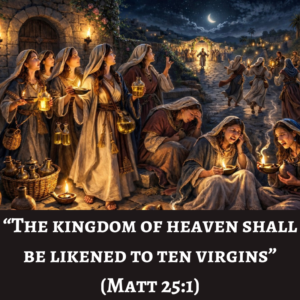
The third exhortation, and the center of the structure, is the parable of the ten virgins (Matt 25:1–13).
The imagery again comes from Israel’s covenant life.
In the Old Testament, God often referred to Israel as a virgin (e.g., 2 Kgs 19:21; Jer 18:13).
All ten virgins in the parable, therefore, represent Israelites—members of the covenant community.
Yet within that group, there is a division.
Five virgins are wise and prepared for the bridegroom’s arrival. Five are foolish and unprepared.
All possess lamps, but only the wise possess sufficient oil.
When the bridegroom arrives, the prepared virgins enter the wedding feast. The others are shut out.
The imagery fits the historical moment perfectly. The Mosaic covenant was fading away. The lamps of the foolish virgins were sputtering and going out—a picture of the fading power of outward religion.
Those who possessed only the old covenant found themselves unprepared for the arrival of the bridegroom. Only those who embraced the new-covenant reality in Christ were ready.
This parable describes a situation unique to the disciples’ generation. They lived at the intersection of two ages—the fading Mosaic age and the dawning messianic age.
Some Israelites belonged only to the old covenant. Others embraced the new.
The coming of the Son of Man would reveal which was which.
The Talents
The fourth exhortation returns to the household imagery with the parable of the talents (Matt 25:14–30).
Again, servants are entrusted with resources while their master is away. Each must use what he has been given.
When the master returns, he evaluates their work.
Some servants prove faithful and are rewarded with greater responsibility. One servant proves unfaithful and is cast into “outer darkness,” where there is “weeping and gnashing of teeth.”
The timing in the parable matches the rest of the discourse.
Jesus says the master returned “after a long time.” Some interpreters assume this must refer to centuries. But within the story itself, the master returns within the servants’ lifetimes—exactly the timeframe Jesus had already established.
The phrase “a long time” can simply describe a period that feels long from a human perspective. Jeremiah used similar language about the seventy-year exile in Babylon (Jer 29:10, 28).
The meaning of the parable is straightforward.
Some of God’s Mosaic-age servants would faithfully respond to the revelation given to them. Others would bury their responsibilities and remain spiritually unproductive.
When judgment came, the faithful would enter the kingdom age. The unfaithful would be cast out.
Conclusion
Taken together, these exhortations paint a vivid picture of the crisis facing Israel in the first century.
Jesus’ generation stood at a historic crossroads.
The old covenant age was drawing to a close. The messianic kingdom was dawning. And the preaching of the gospel was dividing Israel into two groups.
Some would embrace the Messiah and enter the kingdom.
Others would reject him and face judgment.
The flood illustration looks backward to a great creation judgment. The parables in the middle describe the covenantal judgment unfolding in Israel’s generation.
And the discourse will soon look forward again—to the final judgment of all humanity.
That final scene, recorded in Matthew 25:31–46, brings the entire discourse to its ultimate conclusion.
We will examine that passage in the next post.

2 comments
Thank you for this post. I appreciated how you pointed out the parallel with the judgment in Noah’s day. The flood created a new world in a way, and those God saved inherited that world, like the Christians inherited the Kingdom of God.
You’re welcome! I think the distinction you mentioned is very important, and I will emphasize it in the next post.
May the Lord continue to bless your preaching of the gospel of the kingdom!