
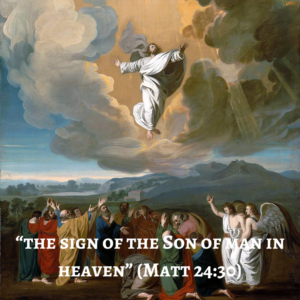
When Jerusalem fell in AD 70, and the temple was torn down stone by stone, it was not merely a political tragedy. It was the collapse of an entire covenantal world. Israel’s universe—centered on the temple, sacrifices, priesthood, and the Mosaic order—came crashing down. But in its place stood something greater and more enduring: the kingdom of God in its messianic fullness.
In the Olivet Discourse, recorded in Matthew 24, Jesus described this transition in vivid prophetic language. One of the most debated statements comes in verse 30:
“Then shall appear the sign of the Son of man in heaven… and they shall see the Son of man coming in the clouds of heaven with power and great glory.”
To understand this correctly, we need to answer two crucial questions:
1. What is “the sign of the Son of Man in heaven”?
2. What does it mean to “see the Son of Man coming”?
These two questions sit at the heart of any serious prophetic model. And how we answer them shapes our reading of the rest of the Olivet Discourse.
What Is the Sign?
This is the first time in Matthew 24 that Jesus uses the word sign in direct response to the disciples’ question. Back in verse 3, they had asked:
“What will be the sign of Your coming, and of the end of the age?”
Jesus’ answer in verse 30 is striking:
“Then shall appear the sign of the Son of man in heaven.”
New Testament scholar Robert H. Gundry makes an important observation:
Matthew substitutes “the sign of the Son of man” for the earlier phrase “the sign of Your coming and of the end of the age.” In other words, the sign of Christ’s coming and the sign of the Son of Man are the same.1
But it goes even deeper.
The disciples had asked about three interconnected realities:
•The destruction of the temple
•The end of the age (the Mosaic age)
•Christ’s coming (his royal presence in the messianic age)
Jesus wraps all three into one climactic answer: the Son of Man in heaven is the sign.2
The sign is not merely an event. It is a Person.
A Person as a Sign
Earlier in his ministry, Jesus had already used this kind of language. When the scribes and Pharisees demanded a sign, he said the only sign they would receive was “the sign of the prophet Jonah” (Matt. 12:38–41).
The sign of Jonah was not a spectacle in the sky. It was Jonah himself—his three days in the fish, his deliverance, his preaching, and Nineveh’s response.
Jonah was the sign.
In the same way, the “sign of the Son of Man in heaven” is Jesus himself—his death, resurrection, ascension, enthronement, and the historical consequences that flowed from them.
This theme reaches back even further. In Luke 2:34, the aged Simeon held the infant Christ in the temple and said:
“This Child is destined for the fall and rising of many in Israel, and for a sign which will be spoken against.”
From the very beginning of his life, Jesus was a sign.
Now, near the end of his earthly ministry, he speaks of himself again as a sign—but this time as a sign in heaven.
After his resurrection and ascension, Jesus would sit at the right hand of the Father. From that position of royal authority, he would bring judgment upon the temple-centered system that had rejected him. Jerusalem would fall. The temple stones would be cast down. The Mosaic age would end.
That catastrophe would not mean Jesus had failed. It would mean he had been enthroned.
The destruction of the temple would be the public, historical evidence that the Son of Man was reigning in heaven.
That is the sign.
Seeing the Son of Man Coming
But what about the next phrase? Jesus says:
“They shall see the Son of man coming in the clouds of heaven with power and great glory.”
Many readers assume three things about this statement:
1. That “coming” here refers to a distant future event.
2. That it describes a visible appearance in the sky.
3. That it is identical in meaning to every other reference to Christ’s coming.
Those assumptions shape entire prophetic systems. But are they required by the text?
Let’s focus on the key issue: visibility.
Did Jesus mean that people would literally look up and see him riding clouds over Jerusalem?
I suggest the answer is no.
Old Testament Background
The language Jesus uses is deeply rooted in the Old Testament. When the prophets described God judging nations, they often spoke of him “coming on the clouds” or darkening the sun and stars.
For example, in Daniel 7:13–14, Daniel writes:
“One like the Son of man came with the clouds of heaven … and there was given him dominion, and glory, and a kingdom.”
This is not a vision of the Son of Man descending to earth. It is a vision of him ascending to the Ancient of Days to receive a kingdom.
Cloud-coming imagery is royal, judicial, and covenantal. It is about authority and judgment—not atmospheric travel.
Throughout the Old Testament, when God “came” in judgment, he did so through historical agents—often invading armies. The people “saw” God act, not by physically seeing him, but by witnessing the events he brought to pass.
When Babylon destroyed Jerusalem, Israel “saw” God’s judgment. Not because they saw him in the sky, but because they experienced his sovereign hand through Babylon’s army.
Jesus is speaking that same prophetic language.
A Question of Consistency
There is also a theological tension to consider.
In Matthew 16:28, Jesus said:
“There are some standing here who will not taste death till they see the Son of Man coming in his kingdom.”
If this refers to a visible, sky-splitting event, then Jesus’ words would not have been fulfilled within the lifetime of his hearers. But if “seeing” refers to perceiving his royal authority manifested in historical judgment, then it makes perfect sense.
Even more striking, in Luke 17:20–21, Jesus says the kingdom of God does not come “with observation.” It is not something people can point to and say, “Here it is!” or “There it is!”
It would be contradictory for the same coming to be both openly observable in the sky and not observable in that way.
The solution? The “seeing” is not optical; it is covenantal and historical. It is recognition.
Jesus Before Caiaphas
This becomes even clearer when Jesus stands before Caiaphas.
In Matthew 26:64, Jesus tells the high priest:
“From now on you will see the Son of Man seated at the right hand of Power and coming on the clouds of heaven.”
Notice two things.
First, Jesus says this will begin “from now on.” Not thousands of years later.
Second, Caiaphas could not literally see Jesus seated at God’s right hand. That reality is invisible to natural sight.
Yet Jesus says he will see it.
How?
Through its effects.
When Jerusalem fell, Caiaphas (if still alive) and the entire Jewish leadership would see that the crucified Jesus had been vindicated. They would see that he truly had ascended, received dominion, and exercised judgment.
They would “see” the Son of Man in heaven by experiencing the consequences of his reign.
The same is true of the “coming on the clouds.” It is part of the same statement. Jesus does not divide the seeing into two different kinds—one invisible and one visible. Both refer to the same kind of recognition.
The destruction of the temple would be the visible evidence of an invisible enthronement.
The Song of Moses
There is yet another layer. In Deuteronomy 32, the Song of Moses declares that the Lord will judge his people. Afterward, he says:
“See now that I, even I, am he.”
The word “see” there does not mean physical sight. It means understand. Grasp. Recognize.
Israel would “see” that the Lord alone is God by witnessing his acts of judgment and salvation.
Jesus’ language in Matthew 24 echoes this covenantal pattern. The generation that rejected him would “see” that the Son of Man was indeed enthroned—by the collapse of the very system that had condemned him.
False Christs and the True King
This understanding also explains Jesus’ warning about false prophets.
He said some would say, “Here is the Christ!” or “There he is!” (Matt. 24:23). They would promise visible, localized manifestations.
But Jesus’ true coming in judgment would not be like that. It would not be a spectacle that could be geographically located.
His disciples would not say, “Look, there!” because his royal presence would be manifested in the sweeping historical events surrounding Jerusalem’s fall.
False christs would claim physical visibility.
The true Christ would be revealed in sovereign authority.
The End of One Age, the Continuation of Another
What, then, does this sign ultimately teach?
It teaches that the fall of Jerusalem marked the end of the Mosaic age and the confirmation of the messianic age.
When the temple fell, it was not the end of the world. It was the end of a world—the covenantal world centered on the old system.
At the same time, the Son of Man was seated in heaven, ruling in an everlasting kingdom. The messianic age did not collapse with the temple. It continued.
So the sign has two sides:
• The Son of Man in heaven—the continuing messianic reign.
• The Son of Man coming in the clouds—the judicial end of the Mosaic order.
Both were fulfilled in the same generation.
Both reveal the same reality: Jesus reigns.
Conclusion: The Theological Significance
This reading preserves the theology of the passage without turning it into a failed prediction or a postponed hope.
It shows that Jesus was not predicting a distant cosmic catastrophe detached from his hearers. He was explaining the meaning of events some of them would live to witness.
They would see stones fall.
They would see armies surround Jerusalem.
They would see tribulation unlike anything before it.
And in those events, they would understand: the Son of Man is in heaven. The crucified one now reigns. The Mosaic age has ended. The kingdom of God stands firm.
The sign of the Son of Man in heaven was not a spectacle in the sky. It was the historical vindication of Jesus Christ as enthroned King.
And that sign still speaks today, especially as we see the Son of Man in heaven, waiting until all His enemies become His footstool (Psa 110:1). How will that happen? Through the Holy Spirit blessing the church to obey the Great Commission, and make disciples of all nations (Matt 28:18–20).
Footnotes
- Robert H. Gundry, Matthew: A Commentary on His Literary and Theological Art (Grand Rapids: Eerdmans, 1982), 488. Gundry is a futurist; I am not implying he would agree with inmillennialism. His observation regarding the sign is valid regardless of the prophetic model used to interpret the Olivet Discourse.
- The image in this post is Ascension by John Singleton Copley (1738–1815). This file (here) is in the public domain (PD-US).

