In this series of posts, we’re verifying Peter’s words—all the prophets foretold his generation, its events, and the consequences of those events (Acts 3:24). In roughly chronological order, we have confirmed that Moses, Samuel, Obadiah, Joel, Amos, Jonah, Hosea, Micah, Isaiah, Zephaniah, Nahum, Jeremiah, and Habakkuk did so and that their prophecies fit well in our inmillennial model of prophecy.1 This post will examine the first vision in Daniel’s prophecy.
As we saw in our previous post, God told Habbakkuk that the Babylonians would take Judah (Israel) into captivity (Hab 1:5–6). In fulfillment of this prophecy, the Babylonians took Daniel to Babylon in 605 BC and overthrew Jerusalem in 587 BC. Daniel found favor with Nebuchadnezzar, the Babylonian king, who exalted him to a strategic position in his government.
All this prepared Daniel to wage spiritual war against the pagan deities of his captors.2 His warfare took the form of repeated prophecies in which his God would establish a kingdom at some future date. That kingdom would then overwhelm the pagan gods and cause the nations to worship the one true God—Daniel’s God. These prophecies included descriptions of events in Peter’s generation. God had Daniel write several of them (Dan 2:4–7:28) in Aramaic to ensure the Gentiles, especially the Babylonians, would know what the future held for them, their gods, and Israel.
This post will consider the first of these prophetic battles, one that occurred because Nebuchadnezzar had a dream.
The Pagan Gods’ Failure
God often directly confronts the pagan gods and their spokesmen. He gives them opportunities to display their power, and then shows His total superiority over them. He did this to the Egyptian gods and their wise men, sorcerers, and magicians (Exod 7:11). The ten powerful signs He performed through Moses humiliated the would-be deities (Exod 7:8–11:10; 12:29–30).
Similarly, God confronted the Babylonian divinities through Daniel (Dan 2:1–13). He caused Nebuchadnezzar to have a disturbing dream. The next day, the king summoned his magicians, enchanters, sorcerers, and master astrologers, demanding they interpret the dream. These servants of the gods were eager to help, so they asked the king to tell them what he had seen.
The king’s response created a significant problem for the magicians—he could not remember the dream! After giving the magicians multiple chances to tell him both the dream and its interpretation, Nebuchadnezzar sentenced them to death. They had failed in their role of providing the king with deep knowledge of essential matters.
Daniel’s Victory
God gave Daniel a stunning victory over the magicians. He described the king’s dream (Dan 2:14–35), giving the magicians a reprieve from the death sentence. Here is what Daniel told the king he saw:
You, O king, were watching; and behold, a great image!… This image’s head was of fine gold, its chest and arms of silver, its belly and thighs of bronze, its legs of iron, its feet partly of iron and partly of clay. You watched while a stone was cut out without hands, which struck the image on its feet of iron and clay, and broke them in pieces.… And the stone that struck the image became a great mountain and filled the whole earth. (Dan 2:31–35)
This was enough to expose the magicians’ impotence, but the Lord wanted to expand the victory; He wanted to show His complete dominance over all pagan gods for the rest of history. He did so by revealing to Daniel the meaning behind the four parts of the statute and the stone (Dan 2:36–42). As we shall see, one element of this explanation makes it clear that this prophecy includes Peter’s generation.
Daniel said the head of gold represented Nebuchadnezzar, the representative of the Babylonian empire:
You, O king, are a king of kings. For the God of heaven has given you a kingdom, power, strength, and glory; and wherever the children of men dwell, or the beasts of the field and the birds of the heaven, He has given them into your hand, and has made you ruler over them all—you are this head of gold. (Dan 2:37–38)
Babylon was ancient: “The date of its foundation is unknown, but it certainly went back to primitive times,” possibly as early as 8,000 BC.3 Nebuchadrezzar completed many architectural projects that enhanced the city’s defenses and its beauty. “He made Babylon the mistress of the civilized world.”4 As Daniel stood before the king early in the sixth century BC, it’s easy to see how he was the “head of gold.”
The identities of the other empires represented by the statue were not so evident because they lay in Daniel’s future. Only the omniscient God could reveal to the prophet who would rule over Israel during the next five centuries. His description of them was so accurate that modern critics assume the prophecy was written after the fact. Those of us who believe the Bible’s testimony are content to relish in God’s revelations to Daniel:
He accurately prophesied the rise of the Medo-Persian, Greek and Roman empires even at a time when the Babylonian Empire, which preceded them all, was at its height. He accurately predicted the fortunes, conflicts, wars and conspiracies of the two kingdoms of Syria and Egypt between the fracturing of the Greek Empire and the conquest by Rome. He prophesied the role of the Maccabees during this period. It is Daniel’s detailed accuracy in his prophecies that has caused many critics to try to give a late date to the book of Daniel, although no evidence has been discovered that would negate the book’s composition at the time that it claims to have been written. At the very latest, the book was completed around 530 B.C.E.5
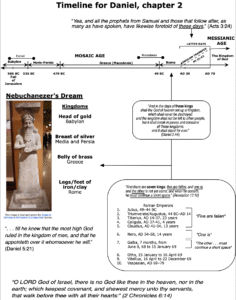
So, the statue’s “chest and arms of silver” represented the Medo-Persian Empire, “its belly and thighs of bronze” stood for the Greek Empire, and the “legs of iron” and “feet partly of iron and partly of clay” were the Roman Empire. (Please see the diagram below.)
To see how this prophecy relates to the Apostle Peter’s statement in Acts 3:24, we need to mention a few aspects of the Roman dynasty. Daniel said the stone represented the kingdom God would establish: “In the days of these [Roman] kings the God of heaven will set up a kingdom” (Dan 2:44). Interestingly, the Romans were organized into a republic that did not have kings until just before Jesus was born. Then, in 49 BC, Julius Caesar crossed the Rubicon River against the orders of the Roman Senate. He became the first Roman “king.”6 Jesus was born during the reign of the second “king,” Augustus Caesar (Luke 2:1). Julius needed to disobey to pave the way for the Lord to fulfill Daniel’s prophecy.
Conclusion
Jesus established the kingdom (Matt 16:18–19), gave it to His people (Matt 21:43), and sent forth the announcement of its arrival (Matt 24:14) “in the days of these kings.” He also said that everything necessary to move His people from the Mosaic age to the messianic (kingdom) age would be finished in His generation (Matt 24:34). This was also Peter’s generation, the “these days” of which he spoke in Acts 3:24. That kingdom is destined to fill the earth with the knowledge of the Lord and conquer (through spiritual weapons) all kingdoms. Daniel and his people will triumph over all the pagan gods.
The following diagram shows Daniel’s historical relationship to the four empires the statue represented and to Peter’s generation, the “last days” of the Mosaic age:
Footnotes
- Please consider becoming familiar with the inmillennial view of prophecy. You can read a summary version here or tackle the full book-length version here. The title of the book—Inmillennialism: Redefining the Last Days—hints at the reason for my suggestion. This model says the “last days” are identical to Peter’s “these days”; both terms refer to the “last days” of the Mosaic age. This perspective will shed light on the prophets as we work through them.
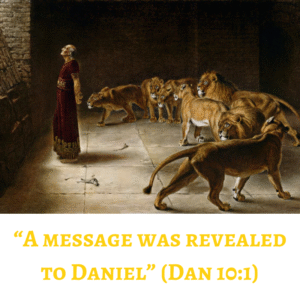
- The image in this post is Daniel’s Answer to the King by Briton Rivière (1840–1920). This file (here) is in the public domain (PD-US).
- A. T. Clay and T. G. Pinches, “Babel, Babylon,” in ISBE, ed. James Orr et al. (Chicago: The Howard-Severance Company, 1915), 1:350.
- A. T. Clay, “Babylonia,” in ISBE, ed. James Orr et al. (Chicago: The Howard-Severance Company, 1915), 1:367.
- Arnold G. Fruchtenbaum, The Messianic Time Table According to Daniel the Prophet, https://jewsforjesus.org/learn/the-messianic-time-table-according-to-daniel-the-prophet, viewed Nov. 24, 2025.
- Scholars debate who started the line of Roman kings, Julius or Augustus. I’m following Suetonius, The Twelve Caesars, trans. Robert Graves, Revised ed. (New York: Penguin Classics, 2007), 1.

