In this series of posts, we’re verifying Peter’s words—all the prophets foretold his generation, its events, and the consequences of those events (Acts 3:24). In roughly chronological order, we have confirmed that Moses, Samuel, Obadiah, Joel, Amos, Jonah, Hosea, Micah, Isaiah, Zephaniah, Nahum, and Jeremiah did so and that their prophecies fit well in our inmillennial model of prophecy.1 This post will examine Habakkuk’s prophecy.
Habakkuk ministered within Jeremiah’s ministry for a much shorter time: nine years versus fifty years. “It is evident from the situation described in his book that he must have been writing sometime after the fall of Nineveh to the Babylonians2 in 612 B.C. (as prophesied by Nahum) and before the fall of Jerusalem to the Babylonians in 587 B.C.… The dreaded Assyrians have already faded from view and the Babylonians, or Chaldeans, are spoken of as ‘being raised’ up.”3
Habakkuk had seen good times under Josiah turn to bad. A description of Babylon’s soon-coming destruction of Jerusalem and the temple consumed almost every line in His prophecy. It “utterly astounded” the prophet (Hab 1:5).
Even after learning of this devastating future, Habakkuk made a confident statement: “Are You not from everlasting, O LORD my God, my Holy One? We shall not die. O LORD, You have appointed them for judgment; O Rock, You have marked them for correction” (Hab 1:12). He knew God had a plan for Israel’s future.
God gave insight regarding that future:
Then the LORD answered me and said: “Write the vision and make it plain on tablets, that he may run who reads it. For the vision is yet for an appointed time; but at the end it will speak, and it will not lie. Though it tarries, wait for it; because it will surely come, it will not tarry.” (Hab 2:2–3)
We should remember an important fact as we consider this vision:
The Jews divided the religious history of the world into “this age” and “the future age.” The “future age” was the one which was to begin at the coming of the Messiah, whose days were spoken of by the Rabbis as “the last days.”4
So, Habakkuk’s vision “for an appointed time,” even “the end,” was not about the end of history or the eternal state. It was about the end of the Mosaic age and the messianic age that would follow the Messiah’s (Jesus’) coming.
This book revealed three realities of that future: living by faith, filling the earth, and reviving the work. These elements work together, mutually reinforcing one another.
Living by Faith
God said to Habakkuk, “Behold the proud [Babylon], His soul is not upright in him; but the just shall live by his faith” (Hab 2:4). Babylon would demolish Jerusalem, but those whom God approved would live by faith in God’s revelation: Israel would not die because God had a glorious future for her.
Interestingly, the three New Testament books that quote this statement—Romans, Galatians, and Hebrews—share a central theme: the relationship between the people of God in the Mosaic age and the people of God in the messianic age. The Apostle Paul calls the former “Israel after the flesh” (1 Cor 10:18) and the latter “the Israel of God” (Gal 6:16).
In Romans, Habakkuk 2:4 becomes “the thematic verse for the whole exposition of the gospel.”5 After quoting it in Romans 1:17, Paul defines the New Testament people of God as those who have “the law written in their hearts” (Rom 2:15). He explains further that,
He is not a Jew who is one outwardly, nor is circumcision that which is outward in the flesh; but he is a Jew who is one inwardly; and circumcision is that of the heart, in the Spirit, not in the letter; whose praise is not from men but from God. (Rom 2:28–29)
The apostle later makes an essential point about the people of God as defined in the Old Testament: “They are not all Israel who are of Israel” (Rom 9:6). Not all outward Jews were inward Jews. Only the elect remnant in Israel believed in God’s future for Israel (Rom 9:27; 11:5). They knew that the night of the Mosaic age was “far spent” and the day of the messianic age was “at hand” (Rom 13:12).
This theme pervades Galatians, too. Paul begins the letter by proclaiming that Jesus had delivered His people “from this present [to him] evil age” (Gal 1:4). He then quotes Habakkuk 2:4 in his description of those who inherit God’s promises to Abraham in the new age:
Therefore know that only those who are of faith are sons of Abraham. And the Scripture, foreseeing that God would justify the Gentiles by faith, preached the gospel to Abraham beforehand, saying, “In you all the nations shall be blessed.” So then those who are of faith are blessed with believing Abraham. For as many as are of the works of the law are under the curse; for it is written, “Cursed is everyone who does not continue in all things which are written in the book of the law, to do them.” But that no one is justified by the law in the sight of God is evident, for “the just shall live by faith.” (Gal 3:7–11)
He concludes this letter by saying, “In Christ Jesus neither circumcision nor uncircumcision avails anything, but a new creation. And as many as walk according to this rule, peace and mercy be upon them, and upon the Israel of God” (Gal 6:15–16). The new creation—the Israel of God—stands before God justified by faith, not works of the Mosaic-age legal covenant.
The book of Hebrews was written in the “last days” of the Mosaic age (Heb 1:2). It encourages Jewish Christians not to return to the temple-based system designed for that age. It was soon to perish, making way for the messianic age in which Christ would make all His enemies His footstool (Heb 1:11–13; 10:12–13).
The writer quotes Habakkuk 2:4 in a context that makes the timing of this age transition clear:
You have need of endurance, so that after you have done the will of God, you may receive the promise: “For yet a little while, and He who is coming will come and will not tarry. Now the just shall live by faith; but if anyone draws back, My soul has no pleasure in him.” (Heb 10:36–38)
Jesus had said He would come in Peter’s generation to destroy the temple and end the Mosaic age (Matt 24:1–3, 34). Now, around AD 66, Hebrews says that the coming would be in “a very, very little while.”6
Filling the Earth
Habakkuk’s vision described a second feature of the future (to him) age: “The earth will be filled with the knowledge of the glory of the LORD, as the waters cover the sea” (Hab 2:14).
As we have just seen, our Lord Jesus sat on the throne of His kingdom in Peter’s generation. During His reign, He will overcome all His enemies (Heb 1:11–13; 10:12–13; Psa 110:1). The Scriptures that support this statement depict gradualism. Christ will not subdue all enemies at once, but over an extended period within the new messianic age.
The Scriptures depict the incremental victory of God’s kingdom in various ways. It is like a stone that becomes a great mountain and fills the whole earth as it defeats all opposing kingdoms (Dan 2:35, 44). It resembles a small seed becoming a large tree, or a small amount of leaven “hid in three pecks of flour until it [is] all leavened” (Matt 13:31-33 NASB).
Before the end of the messianic age, the mountain fills the whole earth, the tree provides shelter, the meal is ready to bake, Christ’s enemies (less death) lie at His feet, and the knowledge of the glory of the LORD fills the earth.
This gradual conquest began in Peter’s generation and will end when Christ defeats death in the resurrection of our bodies (1 Cor 15:25–26).
Reviving the Work
Even though Babylon threatened to destroy Israel, Habakkuk knew God had a glorious future for His nation. That future involved nothing less than the reversal of God’s curse on Adam due to his disobedience. Habakkuk also knew that this future involved a pivotal period—a fullness of time when Israel’s experience would undergo a radical transformation. He said,
O LORD, I have heard Your speech and was afraid; O LORD, revive Your work in the midst of the years! In the midst of the years make it known; in wrath remember mercy. (Hab 3:2)
This would be the time of age transition, when the Mosaic age would give way to the messianic age. John Gill says this refers “to the great work of the Lord in the times of the Gospel.” One possibility is that it relates to the time
between the years of the Old and of the New Testament; the former was the year of God’s long suffering and forbearance, the time when the Jewish church, like children, were under governors and tutors, until the time appointed of the Father; the latter is the acceptable year of the Lord, and the year of the redeemed; and between these two years, at the end of the one, and the beginning of the other, the Messiah came, was cut off or died, and was quickened and raised again.7
In the words of Hebrews, the transition was in the “last days” (Heb 1:2) of the Mosaic age.
Gill prefers a different explanation, but this one is superior. God revived His work of redemption in an unprecedented manner in Peter’s generation.
Conclusion
These three elements work together. God has established the messianic age in which Israel comprises all those who “live by faith.” During this period, the kingdom of God will grow until the earth will be “filled with the knowledge of the glory of the LORD.” The transition to this glorious age occurred “in the midst of the years,” or, as Paul said, “in the fullness of time” (Eph 1:10).
Peter was right! Habakkuk spoke of the day during which he lived (Acts 3:24).
Footnotes
- Please consider becoming familiar with the inmillennial view of prophecy. You can read a summary version here or tackle the full book-length version here. The title of the book—Inmillennialism: Redefining the Last Days—hints at the reason for my suggestion. This model says the “last days” are identical to Peter’s “these days”; both terms refer to the “last days” of the Mosaic age. This perspective will shed light on the prophets as we work through them.
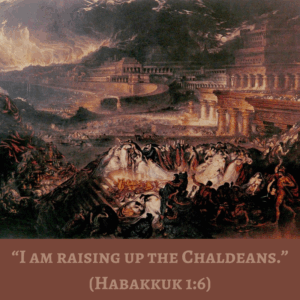
- The image in this file is The Fall of Nineveh by John Martin (1829). This file is licensed under the Creative Commons Attribution-Share Alike 4.0 International license.
- James Montgomery Boice, The Minor Prophets: An Expositional Commentary (Grand Rapids: Zondervan, 1986), 76.
- F. W. Farrar, The Epistle of Paul the Apostle to the Hebrews, ed. J. J. S. Perowne (Cambridge: Cambridge University Press, 1893), 54.
- R. C. Sproul, “Justification by Faith Alone: Martin Luther and Romans 1:17,” Ligonier Updates, 18 August 2025, https://www.ligonier.org/posts/justification-faith-alone-martin-luther-and-romans-117?srsltid=AfmBOoqRnSP0UQeIqsM1ZetMnRZTsHfLm6A7AG9l-oNS_HdtaTvnhcyT.
- William Gouge, Commentary on Hebrews (1866; repr., Grand Rapids: Kregel, 1980), 366.
- John Gill, An Exposition of the Old and New Testaments, 9 vols. (1809–10; repr., Paris, AR: The Baptist Standard Bearer, 1989), 6:629–30.

