In this series of posts, we’re verifying Peter’s words—all the prophets foretold his generation, its events, and the consequences of those events (Acts 3:24). In roughly chronological order, we have confirmed that Moses, Samuel, Obadiah, Joel, Amos, Jonah, Hosea, Micah, Isaiah, Zephaniah, and Nahum did so and that their prophecies fit well in our inmillennial model of prophecy.1 This post will examine Jeremiah’s prophecy.
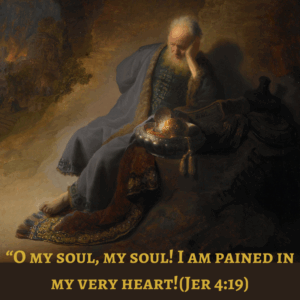
Jeremiah contributes around 125 quotes (or allusions) to seventeen New Testament books. It is the second-longest book in the Bible, behind only Psalms. The prophet wrote from around 627 BC “until sometime after the destruction of Jerusalem in 586.”2 His laments over God’s judgment for his nation’s sins have earned him the title of “the weeping prophet.”3
Still, promises of Judah’s restoration permeate Jeremiah’s descriptions of her woes. Four of them occur near the heart of the book (chapters 30 and 31). For example, God promised that Israel would again be His people in Jeremiah 30:22; 31:1, 9, 33. Paul refers to these promises in passages like 2 Corinthians 6:16–18.
This cluster of promises serves our purposes well. They each begin with a period of bondage, and place the future restoration in Jesus and the Apostles’ generation.
From Babylon to the Davidic Kingdom
Jeremiah gave the first promise of restoration (Jer 30:1–9) after telling the captives in Babylon about the length of their bondage. He wrote, “Thus says the LORD: After seventy years are completed at Babylon, I will visit you and perform My good word toward you, and cause you to return to this place” (Jer 29:10). Jeremiah then said,
“Behold, the days are coming,” says the LORD, “that I will bring back from captivity My people Israel and Judah,” says the LORD. “And I will cause them to return to the land that I gave to their fathers, and they shall possess it.” (Jer 30:3)
After seventy years, the captives returned under the leadership of Ezra, Nehemiah, and others, just as Jeremiah had foretold. Still, they continued to live in subjection to a series of empires: Babylon, the Medes and Persians, the Greeks, and the Romans.
But the promised restoration looked beyond this oppression: “‘It shall come to pass in that day,’ Says the LORD of hosts, ‘That I will break his yoke from your neck, and will burst your bonds; foreigners shall no more enslave them” (Jer 30:8).
Jeremiah describes two events that must precede this glorious liberty. These events put this restoration in Peter’s generation. The first would be a time of distress:
Ask now, and see, whether a man is ever in labor with child? So why do I see every man with his hands on his loins like a woman in labor, and all faces turned pale? Alas! For that day is great, so that none is like it; and it is the time of Jacob’s trouble, but he shall be saved out of it. (Jer 30:6–7)
This is a clear reference to the “great tribulation” Jesus said would precede the temple’s fall in His generation. “The prophetic Scriptures are replete with references to this unique time of Jacob’s distress; e.g., ‘There is none like it’ (cf. Matt 24:21 with the earlier prediction in Dan 12:1…).”4
The second event is the coming of the Messiah, the promised Davidic King: “They [Israel] shall serve the LORD their God, and David their king, Whom I will raise up for them” (Jer 30:9). John Gill says, “Christ is called David, not only because he is his son, but because he is his antitype.”5 This, too, occurred in the “these days” to which Peter refers.
Inmillennialism6 claims that the New Testament reveals the order of events in this restoration: (1) the coming of Christ as the true (antitypical) David, (2) the time of Jacob’s trouble and the temple’s fall, and (3) the Israel of God (Gal 6:16) serving their King in the messianic age.
From Babylon to the “Latter Days”
Jeremiah’s second promise of Israel’s restoration (Jer 30:10–31:1) also begins in Babylon:
“Therefore do not fear, O My servant Jacob,” says the LORD, “Nor be dismayed, O Israel; for behold, I will save you from afar, and your seed from the land of their captivity. Jacob shall return, have rest and be quiet, and no one shall make him afraid.” (Jer 30:10)
Matthew Poole paraphrases this promise: “For I will assure you, that though I have for your sins sent you afar off, yet you are not beyond the reach of my saving arm; you shall return out of the captivity of Babylon.”7
Jeremiah places the terminal point of this restoration in Peter’s generation, the “last days” of the Mosaic age: “The fierce anger of the LORD will not return until He has done it, and until He has performed the intents of His heart. In the latter days you will consider it” (Jer 30:24). For a discussion of this period as Peter’s “these days,” see The Last Days In Hebrews.8
God would cause Judah to return from the Babylonian captivity, then, in her “latter days” (i.e., Peter’s generation), she would recognize the restoration He had achieved.
From Egypt to Rachel Weeping
Jeremiah’s third promise of restoration (Jer 31:2–17) starts in a different place but ends in the same period as the first two. This time, he begins with Israel’s Egyptian captivity: “Thus says the LORD: ‘The people who survived the sword found grace in the wilderness—Israel, when I went to give him rest’” (Jer 31:2). John Gill says these words pertain to those Israelites “which were not consumed by the sword of Pharaoh, who perished not through his cruel edicts, and by his sword, when drawn at the Red sea; nor by the sword of the Amalekites and Amorites.…”9
The prophet described Israel’s restoration in several ways, including an announcement to the nations: “Hear the word of the LORD, O nations, and declare it in the isles afar off, and say, ‘He who scattered Israel will gather him, and keep him as a shepherd does his flock’” (Jer 31:10).
As with the first promise, however, this restoration would involve a time of sorrow: “Thus says the LORD: ‘A voice was heard in Ramah, lamentation and bitter weeping, Rachel weeping for her children, refusing to be comforted for her children, because they are no more’” (Jer 31:15).
The New Testament connects this time of weeping to Herod’s slaughter of the innocents at the birth of the Davidic King:
Then Herod, when he saw that he had been tricked by the wise men, became furious, and he sent and killed all the male children in Bethlehem and in all that region who were two years old or under, according to the time that he had ascertained from the wise men. Then was fulfilled what was spoken by the prophet Jeremiah: “A voice was heard in Ramah, weeping and loud lamentation, Rachel weeping for her children; she refused to be comforted, because they are no more.” (Matt 2:16–18)
This massacre happened in Peter’s generation.
From Assyria to the New Covenant
God’s fourth promise of restoration in this passage (Jer 31:18–34) begins with the Assyrian captivity of the ten northern tribes: “I have surely heard Ephraim bemoaning himself: ‘You have chastised me, and I was chastised … restore me, and I will return …’” (Jer 31:18).
Gill says, “Ephraim intends Israel, or the ten tribes, and even all the people of the Jews; and the prophecy seems to respect the conversion of them in the latter day.”10 In this section, “Jeremiah … addresses the returning exiles of the northern kingdom. They are to make ample preparation for their homeward journey.”11
In this case, the restoration following their return involves a glorious new covenant for Israel:
“Behold, the days are coming, says the LORD, when I will make a new covenant with the house of Israel and with the house of Judah—not according to the covenant that I made with their fathers in the day that I took them by the hand to lead them out of the land of Egypt, My covenant which they broke, though I was a husband to them, says the LORD. But this is the covenant that I will make with the house of Israel after those days, says the LORD: I will put My law in their minds, and write it on their hearts; and I will be their God, and they shall be My people. No more shall every man teach his neighbor, and every man his brother, saying, ‘Know the LORD,’ for they all shall know Me, from the least of them to the greatest of them, says the LORD. For I will forgive their iniquity, and their sin I will remember no more.” (Jer 31:31–34)
Praise the Lord that He established this covenant through our Lord Jesus Christ! Israel—all the children of Abraham by faith (Gal 3:7)—now lives under this covenant, and we have done so since the days of Peter.
Conclusion
“God, who at various times and in various ways spoke in time past to the fathers by the prophets [including Jeremiah!], has in these last days [of the Mosaic age] spoken to us by His Son, whom He has appointed heir of all things” (Heb 1:1–2). God has kept His promise to restore us from all slavery, whether to Egypt, Assyria, Babylon, or to sin itself (Rom 6:1–23).
We have seen that Peter was right again. Jeremiah also spoke of the days in which Christ and the apostles lived (Acts 3:24).
Footnotes
- Please consider becoming familiar with the inmillennial view of prophecy. You can read a summary version here or tackle the full book-length version here. The title of the book—Inmillennialism: Redefining the Last Days—hints at the reason for my suggestion. This model says the “last days” are identical to Peter’s “these days”; both terms refer to the “last days” of the Mosaic age. This perspective will shed light on the prophets as we work through them.
- The Holy Bible: English Standard Version (Wheaton, IL: Crossway Bibles, 2016), Jer.
- The image in this file is Jeremiah Lamenting the Destruction of Jerusalem by Rembrandt (1606–69). It is in the public domain.
- Charles L. Feinberg, “Jeremiah,” in The Expositor’s Bible Commentary: Isaiah, Jeremiah, Lamentations, Ezekiel, ed. Frank E. Gaebelein (Grand Rapids: Zondervan, 1986), 560.
- John Gill, An Exposition of the Old and New Testaments, 9 vols. (1809–10; repr., Paris, AR: The Baptist Standard Bearer, 1989), 5:563.
- You can read a summary here.
- Matthew Poole, Annotations upon the Holy Bible (New York: Robert Carter and Brothers, 1853), 584. Emphasis added.
- Also see my book, Inmillennialism: Redefining the Last Days (here).
- Gill, “Exposition,” 5:568.
- Gill, “Exposition,” 5:573. Gill held that “the latter day” is in our future, whereas I take this term to mean Peter’s generation, the “last days” of the Mosaic age.
- Feinberg, “Jeremiah,” 570.

