In this series of posts, we’re verifying Peter’s words—all the prophets foretold his generation, its events, and the consequences of those events (Acts 3:24). In roughly chronological order, we have confirmed that Moses, Samuel, Obadiah, Joel, Amos, Jonah, Hosea, Micah, and Isaiah did so and that their prophecies fit well in our inmillennial model of prophecy.1
This post will examine Zephaniah’s prophecy. He “prophesied during the reforms of King Josiah (640–609 B.C.), who brought spiritual revival to Judah after the long and disastrous reign of Manasseh. Zephaniah pronounced God’s judgment on corruption and wickedness but also his plan to restore Judah.”2
The New Testament does not quote Zephaniah, but it alludes to it in several places. I will mention two examples. First, the NT uses the term “King of Israel” only twice to refer to the Messiah. Nathaniel uses it to address Jesus (John 1:49), and the crowd uttered it on Palm Sunday (John 12:13; 18:39; 19:6). Interestingly, Zephaniah is the only prophet who used this precise term, and he seems to have used it for the future Messiah (Zeph 3:15).
Second, only Zephaniah described messianic-age Israel in the following manner: “The remnant of Israel shall do no unrighteousness and speak no lies, nor shall a deceitful tongue be found in their mouth” (Zeph 3:13). The apostle John alludes to this in his description of New Testament saints: “In their mouth was found no deceit, for they are without fault before the throne of God” (Rev 14:5).
Such allusions show Zephaniah was speaking of Peter’s day, and that is the main point of this series of posts. However, I want to use this book to reinforce the prophetic framework that I call inmillennialism.
That framework rests on two New Testament passages: the Olivet Discourse (Matt 24–25; Mark 13; Luke 21:5–38) and 1 Corinthians 15. The first passage deals with God’s judgment of the temple and Jerusalem in Jesus’ generation. In the second, Paul discusses the course of the messianic age that follows that judgment. He explains that Christ’s reign will subdue all His enemies, the last of which is physical death (1 Cor 15:15–26).
Zephaniah’s prophecy divides along similar lines. He describes God’s judgment of Judah in his generation and her subsequent restoration. Specific markers in both sections reinforce the inmillennial model as it depicts “the sufferings of Christ and the glories that would follow” (1 Pet 1:11).
Judgment
Zephaniah’s description of God’s judgment on Israel (Zeph 1:1–2:3) contains elements Jesus used in the Olivet Discourse.3
Timing
In my previous post (here), I demonstrated that Isaiah spoke of Israel’s judgment in the “latter days” of the Mosaic age (Isa 2:3). This would result in the destruction of the Second Temple and the end of the Mosaic age in Peter’s generation.
Now, we learn that Zephaniah said, “The day of the LORD is at hand” (Zeph 1:7). He was referring to the judgment that God was about to bring upon Israel through the Babylonians, which occurred in 587 BC.
Both prophets used time stamps with great care and accuracy.
Jesus followed their example. The judgment of which He spoke would occur in His generation, at an unspecified day and hour (Matt 24:34, 36).
Zephaniah and Jesus were describing events that their contemporaries would see.
Extent
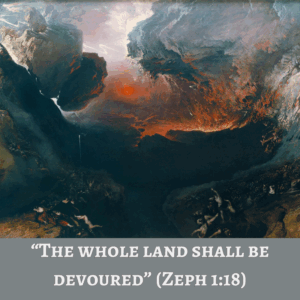
Did Zephaniah foresee a global judgment? Some translations point us in that direction. For example, the ESV reads, “‘I will utterly sweep away everything from the face of the earth,’ declares the LORD” (Zeph 1:2; emphasis added). However, the prophet was not speaking about a global event. He was describing the judgment in the land of Israel in his near future. Much better, then, is the following: “‘I will utterly consume everything from the face of the land,’ says the LORD.… The whole land shall be devoured by the fire of His jealousy” (Zeph 1:2, 18).4
This distinction applies to the Olivet Discourse, too. Some translations hint Jesus is describing a worldwide event, in which “all the tribes of the earth mourn” (Matt 24:30 NKJV). However, He is speaking about the temple’s demise, so Gill is right: the Lord means “the land of Judea; for other lands, and countries, were not usually divided into tribes, as that was.”5
Neither Zephaniah nor Jesus foretold a global catastrophe.6
The Lord’s Presence
Zephaniah associates the day of the Lord with God’s presence (Zeph 1:7). Israel did not directly see the Lord as He judged them. They discerned it through the events they witnessed as the Babylonians destroyed their city and temple.
Similarly, Jesus says that the judgement in His generation would occur in the Lord’s parousia (presence). I have shown elsewhere that people “saw” the Lord’s presence at this time through the phenomena they observed (cf. Matt 26:64).7
Both Zephaniah and Jesus said the Lord’s presence would accompany the judgment in their generation. In neither case would people see Him directly.
Imagery
The prophets drew from a fairly well-defined stock of images to describe day-of-the-Lord events. Many of these depictions—like stars failing to shine (e.g., Isa 13:10)—make us think of the end of history. However, the fact that they occur frequently concerning many historical events suggests they are prophetic figures of speech. Most of the time, they are not describing the ultimate end of time.
Zephaniah and Jesus used these standard prophetic images to describe soon-coming judgment. I will list a few and show relevant passages:
Trouble and distress. Zephaniah spoke of “a day of trouble and distress” (Zeph 1:15). Jesus said, “For then there will be great tribulation” (Matt 24:21).
Desolation. Zephaniah’s judgment would be “a day of devastation and desolation” (Zeph 1:15). Jesus warned His followers, “When you see Jerusalem surrounded by armies, then know that its desolation is near” (Luke 21:20).
Darkness. Zephaniah foretold “a day of darkness and gloominess” (Zeph 1:15). Jesus said, “In those days … the sun will be darkened, and the moon will not give its light” (Mark 13:24).
Clouds. The judgment in the prophet’s time would be “a day of clouds and thick darkness” (Zeph 1:15). Jesus used cloud imagery, too: “Then they will see the Son of Man coming in a cloud with power and great glory” (Luke 21:27).
Trumpet. Zephaniah described “a day of trumpet and alarm” (Zeph 1:16). Jesus said God would “send His angels with a great sound of a trumpet, and they will gather together His elect” (Matt 24:31).
A hidden remnant. The Lord would preserve a remnant in Zephaniah’s day: “It may be that you will be hidden in the day of the LORD’s anger.… The coast shall be for the remnant of the house of Judah.…The LORD their God will intervene for them” (Zeph 2:3, 7).
Likewise, Jesus spoke of an elect remnant: “Unless the Lord had shortened those days, no flesh would be saved; but for the elect’s sake, whom He chose, He shortened the days.… For false christs and false prophets will rise and show signs and wonders to deceive, if possible, even the elect” (Mark 13:20, 22).
Restoration
Zephaniah described a time of great blessing that would follow the judgment in his days (Zeph 2:4–3:20). Jesus made similar statements in the Olivet Discourse, and the apostle Paul expanded upon them in 1 Corinthians.
Through the Remnant
In Zephaniah, Israel’s blessings would come through the remnant I mentioned above. Speaking of the nation’s enemies, God said, “The residue of My people shall plunder them, and the remnant of My people shall possess them” (Zeph 2:9).
As we saw above, Jesus said God would preserve an elect remnant in Israel through the judgment of the temple. God would then “send His angels … and they will gather together His elect from the four winds, from one end of heaven to the other” (Matt 24:31). The remnant in Israel would serve as the stock into which God would graft the elect from among the nations (cf. Rom 11:17).
Optimism
Zephaniah and the apostle Paul share an infectious post-judgment optimism. The prophet said, “The LORD … will reduce to nothing all the gods of the earth; people shall worship Him, … indeed all the shores of the nations” (Zeph 2:11).
Quoting Psalm 110:1, the apostle says, “He must reign till He has put all enemies under His feet. The last enemy that will be destroyed is death. For ‘He has put all things under His feet’” (1 Cor 15:25–27).
Babel Undone
Zephaniah describes Israel’s future blessing through imagery that reminds us of the confusion of tongues at Babel. God says, “I will restore to the peoples a pure language, that they all may call on the name of the LORD, to serve Him with one accord” (Zeph 3:9).
Interestingly, Paul’s kingdom optimism immediately follows his extended discussion regarding the gifts of the Spirit, especially tongues (1 Cor 12:1–14:40). There, he states that those gifts would pass away (1 Cor 13:10) and that Christian love is the most important thing (1 Cor 13).
In addition, Peter spoke the words on which this series of posts is based (Acts 3:24) immediately after Pentecost, when God temporarily suspended language barriers (cf. Acts 2:8).
For both Zephaniah and Paul, the post-judgment time of blessing involved a unified language of faith, hope, and love.
Conclusion
Zephaniah spoke of Peter’s generation and the messianic (kingdom) age that would follow. We can map elements of his description of God’s judgment and the subsequent restoration onto the inmillennial prophetic model. This agreement suggests Jesus and the apostle Paul had a framework like this in mind in the Olivet Discourse and 1 Corinthians 15.
Footnotes
- Please consider becoming familiar with the inmillennial view of prophecy. You can read a summary version here or tackle the full book-length version here. The title of the book—Inmillennialism: Redefining the Last Days—hints at the reason for my suggestion. This model says the “last days” are identical to Peter’s “these days”; both terms refer to the “last days” of the Mosaic age. This perspective will shed light on the prophets as we work through them.
- The Holy Bible: English Standard Version (Wheaton, IL: Crossway Bibles, 2016), Zep.
- The image in this file is The Great Day of His Wrath by John Martin (1789–1854). It is in the public domain per PD-1996.
- These differing translations arise from the fact that in both Hebrew and Greek, the same word can mean either “earth” or “land.” The context must determine the correct meaning. Here, it refers to the land of Israel, which the Babylonians would devastate. Please see the post Land or Earth.
- John Gill, An Exposition of the Old and New Testaments, 9 vols. (1809–10; repr., Paris, AR: The Baptist Standard Bearer, 1989), 7:294.
- In Matthew’s account, Jesus speaks of the final judgment at the end of the Olivet Discourse.
- Michael A. Rogers, Inmillennialism: Redefining the Last Days (Tullahoma, TN: McGahan Publishing House, 2020), 156–63.

